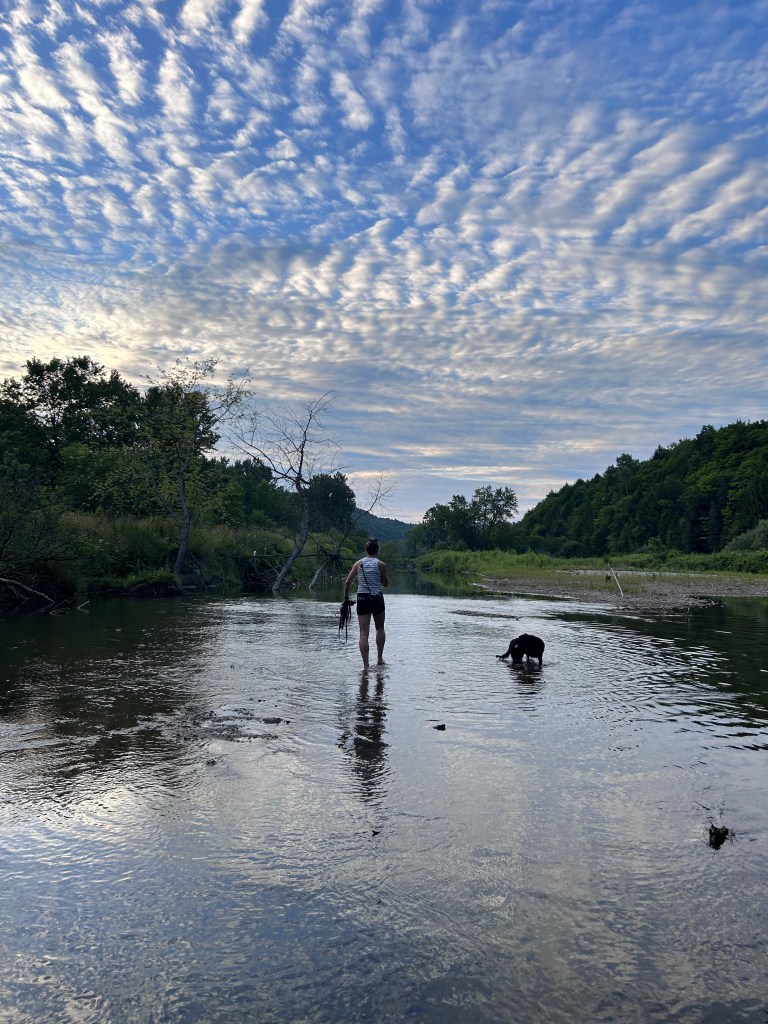
August appears, and I’m at work Saturday morning, trudging around a lake in a thickety forest with some of my favorite people in town, talking work and books and the edginess of this fleeting life, the puzzling conundrums of what people do.
Below, the Hayden Carruth poem I’ve posted before around August 1, during the years I’ve written in this space. Every year, when I read this poem again, different lines pop out. Here, “The world is a complex fatigue.” If I began a list of things I learned in my year (now, year and some) of surviving cancer and cancer treatments, gracious, I would keep writing and writing. The cats would not be fed this morning. The blueberries would not be picked.
But to return to August…. June, July, August, in my way of reckoning, these are Vermont’s high holy months, the long days of sweet roses and waving rudbeckia, the welcomeness of ice on your tongue, walking in twilight, the loveliness of sunlight chips and loons on pond water. Those worn clichés — savor every day, know your luck — are true of course, in the way that truth is multitudinous — in the way that Mac Barnett notes that Be Kind might be a given starting place, but not a plot. And human life, of course, is plot, plot, plot. Often, not of our own making.
Story, of course, is where I’m headed. These midsummer days, the glossiest greens already fading. As I’ve done for years, I hold to the strands that keep me sane in this world illusory and fragile and heartstoppingly thrumming with might far beyond any one or two or few of us… the chords of this mortal life. The gritty and sometimes joyous labor of writing, of walking in the world, the domesticity of family and friends. Brew coffee, weed the garden, ponder the sky.
AUGUST FIRST
by Hayden CarruthLate night on the porch, thinking
of old poems. Another day’s
work, another evening’s,
done. A large moth, probably
Catocala, batters the screen,
but lazily, its strength spent,
its wings tattered. It perches
trembling on the sill. The sky
is hot dark summer, neither
moon nor stars, air unstirring,
darkness complete; and the brook
sounds low, a discourse fumbling
among obstinate stones. I
remember a poem I wrote
years ago when my wife and
I had been married twenty-
two days, an exuberant
poem of love, death, the white
snow, personal purity. now
I look without seeing at
a geranium on the sill;
and, still full of day and evening,
of what to do for money,
I wonder what became of
purity. The world is a
complex fatigue. The moth tries
once more, wavering desperately
up the screen, beating, insane,
behind the geranium. It is an
immense geranium,
the biggest I’ve ever seen,
with a stem like a small tree
branching, so that the two thick arms
rise against the blackness of
this summer sky, and hold up
ten blossom clusters, bright bursts
of color. What is it — coral,
mallow? Isn’t there a color
called “geranium”? No matter.
They are clusters of richness
held against the night in quiet
exultation, five on each branch,
upraised. I bought it myself
and gave it to my young wife
years ago, in a plastic cup
with a 19cent seedling
from the supermarket, now
so thick, leathery-stemmed,
and bountiful with blossom.
The moth rests again, clinging.
The brook talks. The night listens.


I love the new-to-me poem, and your reflections about it and life in general.
Thank you!
Love it all.
Gwen.
💚
Perfect! And yes, a complex fatigue, indeed.
💚