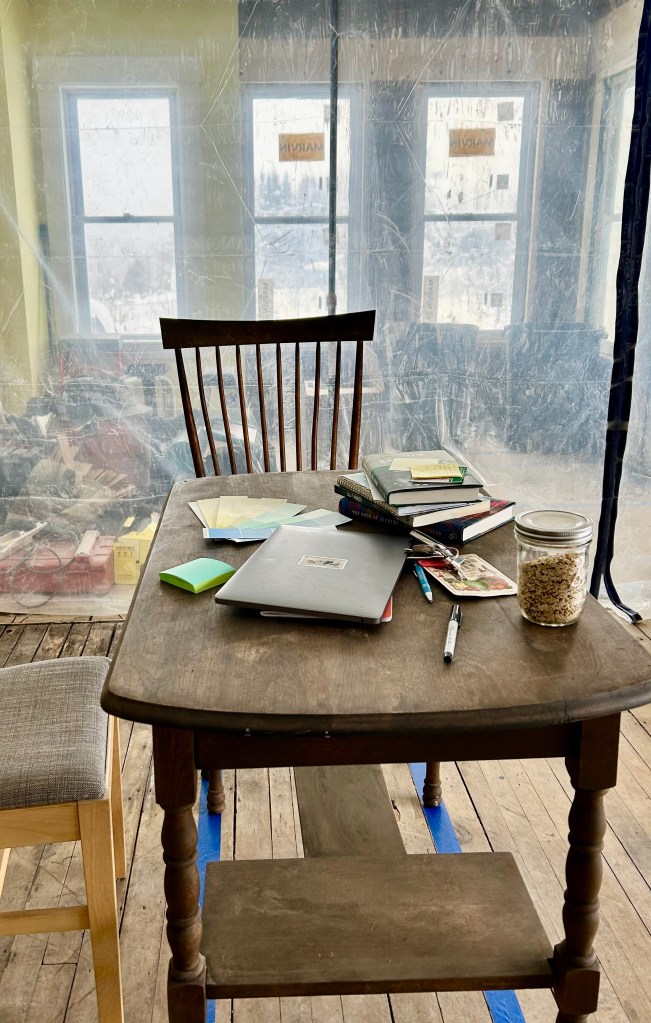
“The world is a complex fatigue.”

August appears, and I’m at work Saturday morning, trudging around a lake in a thickety forest with some of my favorite people in town, talking work and books and the edginess of this fleeting life, the puzzling conundrums of what people do.

Below, the Hayden Carruth poem I’ve posted before around August 1, during the years I’ve written in this space. Every year, when I read this poem again, different lines pop out. Here, “The world is a complex fatigue.” If I began a list of things I learned in my year (now, year and some) of surviving cancer and cancer treatments, gracious, I would keep writing and writing. The cats would not be fed this morning. The blueberries would not be picked.

But to return to August…. June, July, August, in my way of reckoning, these are Vermont’s high holy months, the long days of sweet roses and waving rudbeckia, the welcomeness of ice on your tongue, walking in twilight, the loveliness of sunlight chips and loons on pond water. Those worn clichés — savor every day, know your luck — are true of course, in the way that truth is multitudinous — in the way that Mac Barnett notes that Be Kind might be a given starting place, but not a plot. And human life, of course, is plot, plot, plot. Often, not of our own making.

Story, of course, is where I’m headed. These midsummer days, the glossiest greens already fading. As I’ve done for years, I hold to the strands that keep me sane in this world illusory and fragile and heartstoppingly thrumming with might far beyond any one or two or few of us… the chords of this mortal life. The gritty and sometimes joyous labor of writing, of walking in the world, the domesticity of family and friends. Brew coffee, weed the garden, ponder the sky.

AUGUST FIRST
by Hayden Carruth

Late night on the porch, thinking
of old poems. Another day’s
work, another evening’s,
done. A large moth, probably
Catocala, batters the screen,
but lazily, its strength spent,
its wings tattered. It perches
trembling on the sill. The sky
is hot dark summer, neither
moon nor stars, air unstirring,
darkness complete; and the brook
sounds low, a discourse fumbling
among obstinate stones. I
remember a poem I wrote
years ago when my wife and
I had been married twenty-
two days, an exuberant
poem of love, death, the white
snow, personal purity. now
I look without seeing at
a geranium on the sill;
and, still full of day and evening,
of what to do for money,
I wonder what became of
purity. The world is a
complex fatigue. The moth tries
once more, wavering desperately
up the screen, beating, insane,
behind the geranium. It is an
immense geranium,
the biggest I’ve ever seen,
with a stem like a small tree
branching, so that the two thick arms
rise against the blackness of
this summer sky, and hold up
ten blossom clusters, bright bursts
of color. What is it — coral,
mallow? Isn’t there a color
called “geranium”? No matter.
They are clusters of richness
held against the night in quiet
exultation, five on each branch,
upraised. I bought it myself
and gave it to my young wife
years ago, in a plastic cup
with a 19cent seedling
from the supermarket, now
so thick, leathery-stemmed,
and bountiful with blossom.
The moth rests again, clinging.
The brook talks. The night listens.

Dumpster Raiding, Poetry, Independence Day.

Ocean Vuong reads at a nearby arts center that is built in a farm field with a stage modeled on the Globe Theater. My friend and I cruise in, nearly late, and the parking lot is full. Hundreds of people have arrived. On this holiday weekend, I’ve swam and eaten ice cream, stepped inadvertently from friend to friend, like the twilight walk that ended in darkness on a trail, two small women talking, talking, fireworks booming in the blackness around us.

Vuong reads mesmerizingly, like a dream. He begins with remarking that humanity began in poetry and war, and how this will shake out after the Anthropocene is yet of course to be determined. By the reading’s end, I wipe tears from eyes. Immensely talented, utterly humble, Vuong offered homage to craft of storytelling—its essential role in all human life—and to the women who raised him. Four Vietnamese women in hardscrabble Massachusetts wrested free from their bad men and raised seven sons. None of these women were writers, but they were all oral storytellers who told their stories to salvage their dignity from the harms of the men. The repair was for their sons—and themselves.

And the poetry and war where Vuong began? By the hour’s end, his words stream through me, like that Buddhist retreat I attended last summer, my body still bitten by cancer to more bones than flesh. In those days, for fleeting moments I could envision my own near death, that this body I’ve used so hard will go down into soil and stone, that tendrils of roots and melting snow will erase me from this world of language and teeming desire, and yet I will have never gone anywhere at all.

Likewise, listening, I realize the poet carried all of us, not one more than another, along his mellifluous words, that the human history of this country, America, is inextricably bound in the polarity of war and poetry, a profound rushing flood of passing time and undefinable generations.

Later, my dear friend headed home to her dog and her life, I wandered along the back end of the village where a dumpster lies overturned. From the rubble, I extricated a glossy Dorothea Lange photo, the famous portrait of a mother and children. I rolled it up and tucked it beneath my arm. For you, I write for you, because you are me.

NOTHING

We are shoveling snow, this man and I, our backs coming closer
along the drive. It’s so quiet I can hear every flake on my coat. I
used to cry in a genre no one read. What a joke, they said, on fire.
There’s no money in it, son, they shouted, smoke leaking from
their mouths. But ghosts say funny things when they’re family.
This man and I, we take the weight of what will vanish anyway
and move it aside, making room. There is so much room in a
person there should be more of us in here. I wave to you, traveler,
inches away but never visible from where I am. Are you warm
where you are? Are you you where you are? Something will come
of this. In one of the rooms in the house the man and I share, a
loaf of rye is rising out of itself, growing lighter as it takes up more
of the world. In humans, we call this Aging. In bread, we call
it Progress. We’re in our thirties now and I rolled the dough just an
hour ago, pushing my glasses up my nose with my flour-dusted
palm as I read, reread, the hand-scrawled recipe given me by the
man’s grandmother, the one who, fleeing Stalin, bought a ticket
from Vilnius to Dresden without thinking it would stop, it so
happened, in Auschwitz (it was a town after all), where she and
her brother were asked to get off by soldiers who whispered, keep
moving, keep moving
 like sons leading their mothers through
wheat fields in the night. How she passed through huddled coats,
how some were herded down barb-wired lanes. The smoke from
our mouths rising as the man and I bend and lift, in silence, the
morning clear as one inside a snow globe. For how can we know,
with a house full of bread, that it’s hunger, not people, that
survives? The man pours a bag of salt over the pavement. But
from where I’m standing it looks like light is spilling out of him,
like the ray of dusty sun that found his grandmother’s hands as
she got back on the train, her brother at her side, smoke from the
engine blown across the faces outside blurring into pine forests,
warped pastures, empty houses with full rooms. The man
clutches his stomach as if shot, and the light floods out of him, I
mean you—because something must come of this. Poetry makes
nothing happen
, someone who is dead now said after a friend’s
death. When the guard asked your grandmother if she was
Jewish, she shook her head, half-lying, then took from her bag a
roll, baked the night before, tucked it in the guard’s chest pocket.
She didn’t look back as the train carried her, newly seventeen,
toward where I now stand, on a Sunday in Florence,
Massachusetts, squinting at her faded words: sift flour, then beat
eggs until “happy-yellow.”
 The train will reach Dresden days before
the sky is filled with firebombers. More smoke. A bullet in her
brother under rubble, his name everywhere outside her like the
snow falling on your face forty years later, on December 2, 1984,
while your mother carries you, alive only three hours, the few
steps to the mini-van where your grandmother, nearly sixty now,
crowns your head with her brother’s name. Peter! she says, Peter!
Peter!
 as if the dead could be called back from rubble into new,
stunned bones. The snow has started up again, whitening the
path as though nothing happened. Oh, to live like a bullet, to
touch people with such purpose. To be born going one way,
toward everything alive. To walk into the world you never asked
for but then choose the room where your hunger ends—which
part of war do we owe such knowledge? It’s warm in this house
where we will die, you and I. Let the stanza be one room, then.
Let it be big enough for everyone, even the ghosts rising now
from this bread we tear open to see what we’ve made of each
other. I know, we’ve been growing further apart, unhappy but
half full. That clearing snow and baking bread will not save us. I
know, too, as I reach across the table to brush the leftover ice
from your beard, that it’s already water. It’s nothing you say,
laughing for the first time in weeks. It’s really nothing. And I believe
you. I shouldn’t, but I do.

~ Ocean Vuong
Gravy

In the town where I work, the summer folks haven’t yet returned. By chance, on a rural road around the lake, I meet a builder. “Hey!” he calls to me, and I can hear the surprise in his voice. You’re alive? I am, indeed, yes.

Around us, a sugar snow melts. Sunlight falls through the trees that are a month out, at least, from this year’s first nubs of leaves. Behind him, the silent snow-covered lake. We kick around, as Vermonters do, what it’s like to live in our Green Mountain state right now, how hot passions run, how immediately aid is given to a neighbor in need. What it’s like to live in the crumbling of the American Empire, a madman at the helm. In a copse of cedars, blackbirds chorus.

Precisely one year ago, I could not walk outside my house alone. Ravaged by cancer and chemo and hunger, I was so weak I trembled, on the verge of falling. A rattle of bones, scraps of flesh.

On this clearing day, on my way home, I stop by the co-op and buy two pears. I lay these on the seat of my car and dart across Main Street to the post office. Without realizing it, I’m running. As I leap onto the sidewalk, I marvel at the pleasure of movement, the sun in my short hair, my cheeks wind-burnt from a recent long walk along a muddy backroad. I took the time to stand before a tree of chittering goldfinches.

All this week I’ve been reading Robert Frost, perhaps my mother’s favorite poet. A poet who wrote of stone walls and apple picking and the ineffable darkness of human life. But here’s a poem to celebrate today, this day, no matter where or who you are, by Ray Carver who knew the great symphony of life, too.

Gravy

No other word will do. For that’s what it was. Gravy.
Gravy these past ten years.
Alive, sober, working, loving and
being loved by a good woman. Eleven years
ago he was told he had six months to live
at the rate he was going. And he was going
nowhere but down. So he changed his ways
somehow. He quit drinking! And the rest?
After that it was all gravy, every minute
of it, up to and including when he was told about,
well, some things that were breaking down and
building up inside his head. “Don’t weep for me,”
he said to his friends. “I’m a lucky man.
I’ve had ten years longer than I or anyone
expected. Pure gravy. And don’t forget it.”

Knock it down, revise your life.

March, northern Vermont, the long dragged-out amorphousness where winter drags its slushy sulkiness into sodden spring. I long for a few hours of blistering sun. This season was the weather my mother despised most, all those New Hampshire years of my childhood. One afternoon, she pulled over on a back road and instructed my siblings and me to run through a farmer’s soaked pasture, patchily emerged from a winter of snow, and head for the woods at the far end. We did not know who owned the field and argued. Go, she insisted, go. You kids need to run. So we ran.

My novel, Call It Madness, which will be out in at the end of June, in a month when I intend to swim, is about the unvarnished craziness of family, of fiercely knotted threads of desire and thwarted passion, how the stories that shape and mold our lives are buried generationally. The novel is not about my mother, but it’s for my mother, the woman now dead nearly two years. She was mercurial, passionate about love and destruction. In the long-beyond-time stretch of recent cancer treatments, those endless months on the couch, I often thought of her; she was the only family member who had endured the triple violence of cancer-and-chemotherapy-and-surgery, sheer survival tenuous as a snowdrop. My mother surprised me until the very end of her life, the whole range of the unexpected, from sorrow to contentment. As her youngest daughter, how little I knew her, and yet I carry her with me, in my own might and fallibility.

In these months of remission, I’ve learned from yoga that inquiry is a force, a variation of that impossible Socratic dictum, know thyself. Healing, I plot a venture into transforming my kitchen, my home’s heart, and hire a carpenter to take down a wall, open an exterior wall with windows. Am I crazy, I wonder. At the edges at least of madness, recklessly heady with survival, with the raw knowledge of mortality clenched in one fist.

When the vinyl flooring is ripped up, the carpenter and I ponder the hardwood boards, stained and blackened and scraped. The lives of previous occupants rises like mist, mesmerizing, unknowable. What remains are their scars. My cat and I sit on the dusty floor and share a bowl of arugula. Wet snow slides from the roof in the flowerbeds. I planted the gold compass flowers. Who planted the pink roses I’ll never know.

Back out of all this now too much for us,
Back in a time made simple by loss
Of detail, burned, dissolved, and broken off
Like graveyard marble sculpture in the weather,
There is a house that is no more a house…

Here are your waters and your watering place.
Drink and be whole again beyond confusion. — Robert Frost, “Directive”

The Goddamn Gray, the Brilliance of Language.

A year ago, my daughter was driving me to the local ER, yet again, under the frigid winter sky. Wordless, I leaned my head against the side window of her Subaru, staring at the faraway pricks of stars vanishing and reappearing among the clouds. In the darkness, I fixated on one thought—the white hospital bed, the clear liquid drugs that would make the pain cease—and held to that, my lifeline. Cancer-and-chemo, in its infinite complexity, is a monotone landscape. In all those months, my existence was the blackness of pain, the temporary light of relief-from-pain, the crimson drug injected into my veins. Occasionally, a cardinal at a feeder, blood oranges, and then I couldn’t eat those, either, and I remained alive on Saltines and water.

I keep thinking of those below zero nights as I drive this night to the opposite end of town. There, with a friend in a place where I’ve never been, we eat drunken noodles and green curry, and then drive again through the darkness and the drifting snow that’s no threat, simply prettiness. At the Vermont Studio Center for the Arts, we settle into the dining hall with the residents. We’re greeted warmly, and the room is scented with the lingering remains of a savory dinner, of coffee and wine and the fragrance of flowers likely from the tables freshly scrubbed. This is a dear place, where I’ve been lucky to stay and work hard, meet friends and share stories about creativity, its hardness and joy.

Rigoberto González reads magnificently, his words, reminding me of when I was a teenager reading James Joyce for the first time, thinking yes, yes, this is what writing can do, push us into a place where we glimpse the world for a moment in all its shimmering and confounding complexity, its immense sorrow, utter fun, or the way a hand plucks a pebble from a river and holds it dripping and glistening to the sunlight.

At home, I stand in the darkness that is sodden with cold, a forerunner of the mighty freeze rushing this way. The crescent moon pushes against the clouds. In those underworld months, the goddamn gray occasionally scattershot with goldfinches exploding from bare branches, my fate might easily have veered another path. A storm and brutal cold loom over this nation submerged beneath political nefariousness.

This terrible disease, this exacting instructor, taught me brutal lessons. Among these, savor these draughts of warmth, recognize heart. Know this value. Do not disparage.

“Every person with a body should be given a guide to dying as soon as they are born.”
― Anne Boyer

Holy Nightsky.

10 degrees on a starry night, my daughter phones me while I’m cramming more wood in the stove. She’s on a dark-soaked back road, the northern lights resplendent, and urges me to go in search. Up Bridgeman Hill, she tells me, with the ridgeline view.

So, bundled in coat and hat, I drive through the little village and up the hill where the town lights cannot touch. In my headlights, wind scatters snow gathered from the wide hayfields, winter dormant. I pull over at the hill’s crest where two farms join. I get out of my car and walk down the road. The limitless sky gleams ruby and emerald, an immense shaft of white light luminescent. In the east, the black spreads profoundly, the stars so radiant I imagine I could reach out and grasp these gems.

John Donne wrote that illness is a “holy room.” My oncologist taught me that we are all the ailing; if not now, to come. Mortality’s cut makes zero discrimination. A cancer diagnosis gained me admission to inner chambers. Unwanted—let me reiterate again, I did not request admission. But I hung up my coat in the anteroom and set my hiking boots against the wall, and I walked barefoot and thirsty into the nexus, me and that fiercely multiplying lymphoma. The lymphoma and me — one of us was not going to survive this go-round.

In the night’s darkness, the rushing wind tore at my cheeks and hurled ice in my eyes. In the distance, a cow barn glowed with light, a scatter of houses in the valley. Around me, that immense and mysterious beauty over small human beings, at whatever mundane chore or decency or devilment we conjure, be it the evening milking or washing supper dishes or plotting a wrong against another.

The sharp-clawed cold shoves me back towards my car, back towards the village and my hot woodstove, my little house in the great holy room of this planet, this universe, this precise moment.

“It seemed like I was doing something ludicrous, trying to build a permanent work of literature out of broken little whimpering bits about the most ephemeral experiences when I was still mostly broken and half-ephemeral myself.”
― Anne Boyer