I’m walking up a fourth-class road when I spy a black shape moving along the upper end of the nearby hayfield. Vermont divides its roads into categories, from the interstates to dirt roads to the little-used former farm or forest roads that are snowed-cover in winter, mud-rutted in spring. I stand beside a wild apple tree, the blue view of the Worcester Mountains over my shoulder, and admire this bear, darker than midnight against the field’s glossy emerald. When green kindles in Vermont spring, it flourishes.
This place I’ve never walked, although I’ve seen maps and heard stories. The road treks uphill through the forest and dips down where Caspian Lake gleams, realm of summer visitors, but for the time, still the territory of the locals.
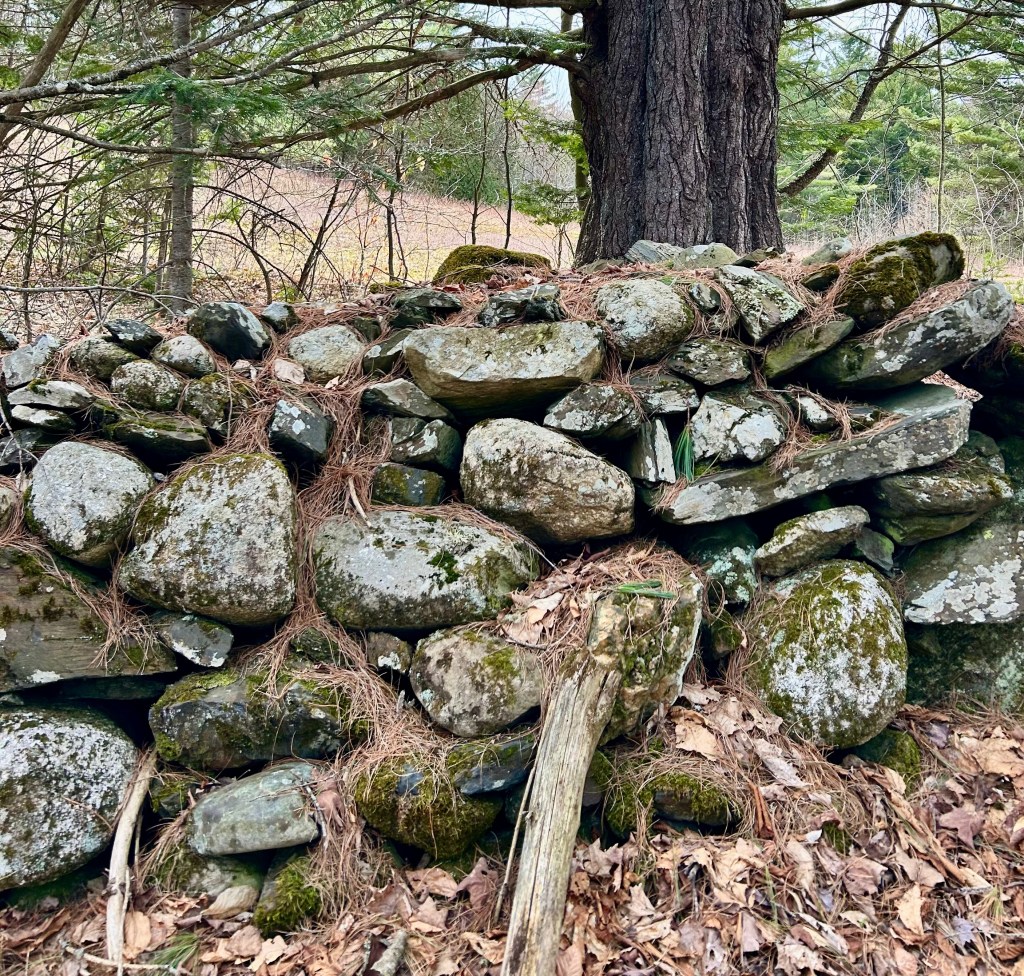
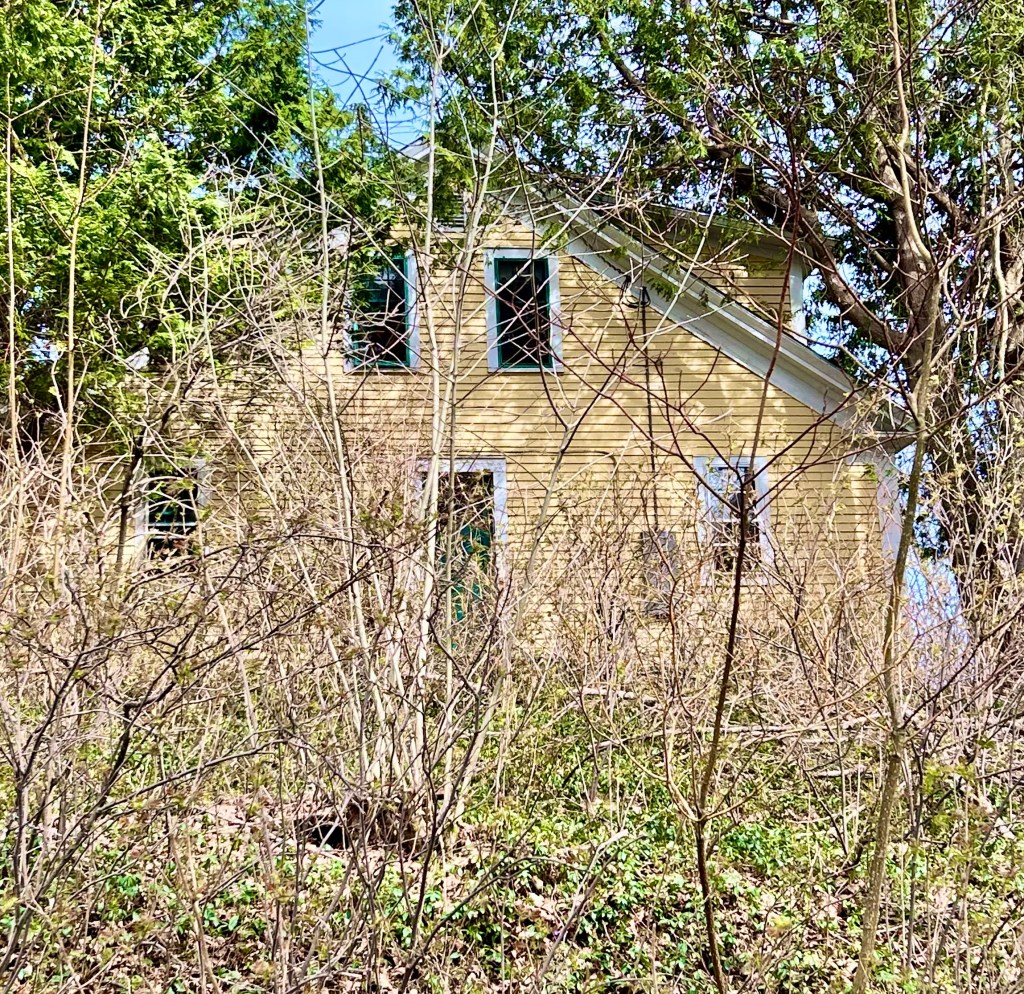
I find what I’m seeking and also what I’m not: the labor-dense stone walls whose once-upon-a-time fields are gone to forest, moss-covered cellar holes, twisted rusty remains of farm equipment. Peepers chorus. An old farmhouse with an enormous veranda on a hill must have once had a royal view of the lake, and endured bitter winter winds. Someone has tried to cut the wild reclamation from the house and mostly failed.
In the sunlight, I linger, wondering who lived here, their stories silent. The two-story house has large dormers and many windows; it’s not a fly-by-night, tossed-up structure. On my way home, I pause where I saw the bear, searching, but of course the bear has moved on. Three ducks fly low over my head. The earth exhales its sweetness of thawing mud, the turning-over of last autumn’s leaves, this summer’s great promise.
“Deep in the forest a call was sounding, and as often as he heard this call, mysteriously thrilling and luring, he felt compelled to turn his back upon the fire and the beaten earth around it, and to plunge into the forest, and on and on, he knew not where or why; nor did he wonder where or why, the call sounding imperiously, deep in the forest.” — Jack London


What a beautiful walk – and to have seen a bear in real life! Wow! Thanks for sharing all the photos and the adventure!
Thank you for reading!
Got my feet itching to go, go, go! No bears here but perhaps the twitter of monkeys, bark of a baboon. Someone long ago found a spoor of a leopard but they won’t be around any longer I don’t think. Too many people.
Love this!
I recognize that pause and imagine the thrill of seeing a bear there. Of course you’d want to feel that again. Anyway, that’s what I imagined. And what I’d do. Thank you for bringing me along to get a glimpse of that dark bear.
Bears are such amazing animals — and in midday, too.
Nice to have a wave hello in FSC this morning. Your posts have been really sublime of late. Thank you for them.
Thank you again for reading! And the FSC wave. 😀
Does anyone ‘own’ these woods? I’ve often wondered on trips to the US. Anyway, most happy sightings.
Fortunately, I live where there’s so much conserved, public land, much of it still wild.
That’s so good to hear.
💚
Forgotten houses, former homes, are sad for the lost memories and families. How amazing to see a bear!!
💚
Once, on a ranch in the New Mexico mountains, we looked out our window and saw a black bear and her cubs sauntering down our road. Sheer magic!
What luck to see this bear family!!