Hell-bent robins.

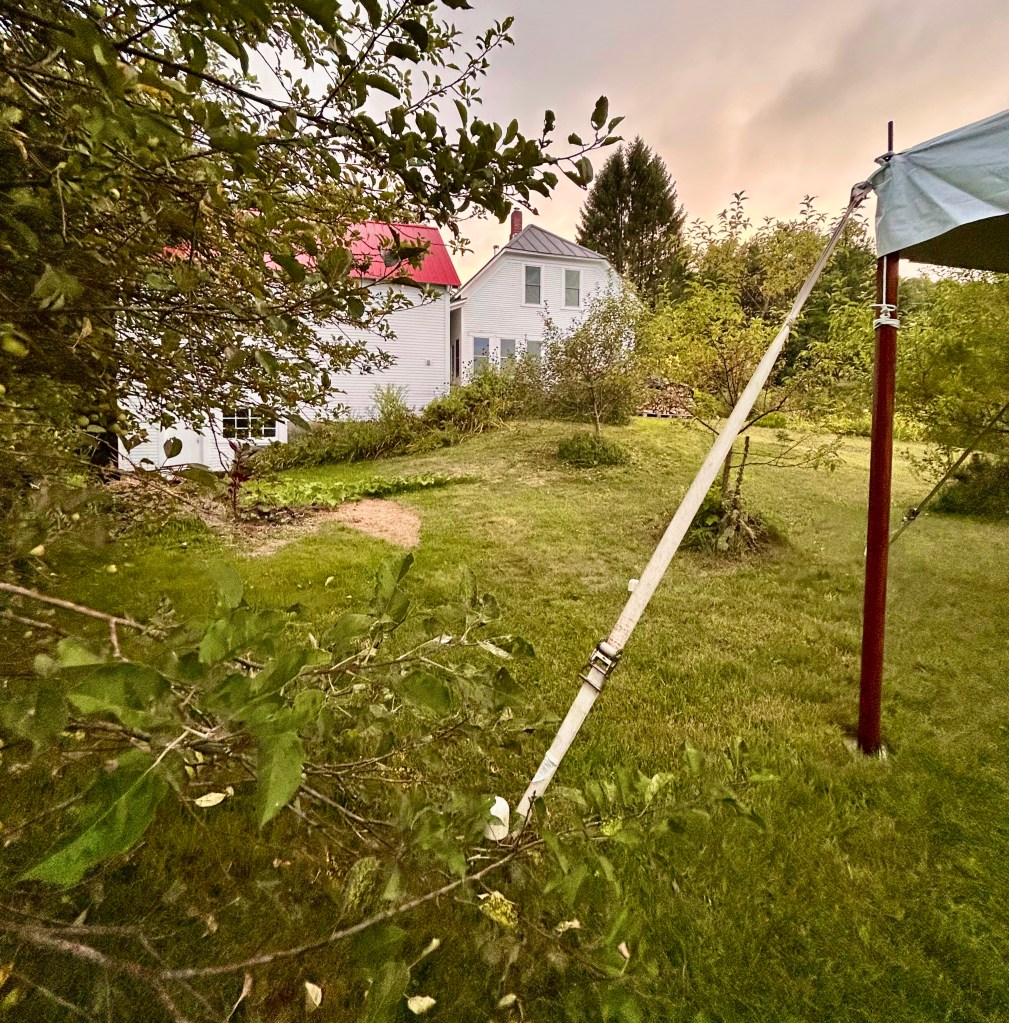
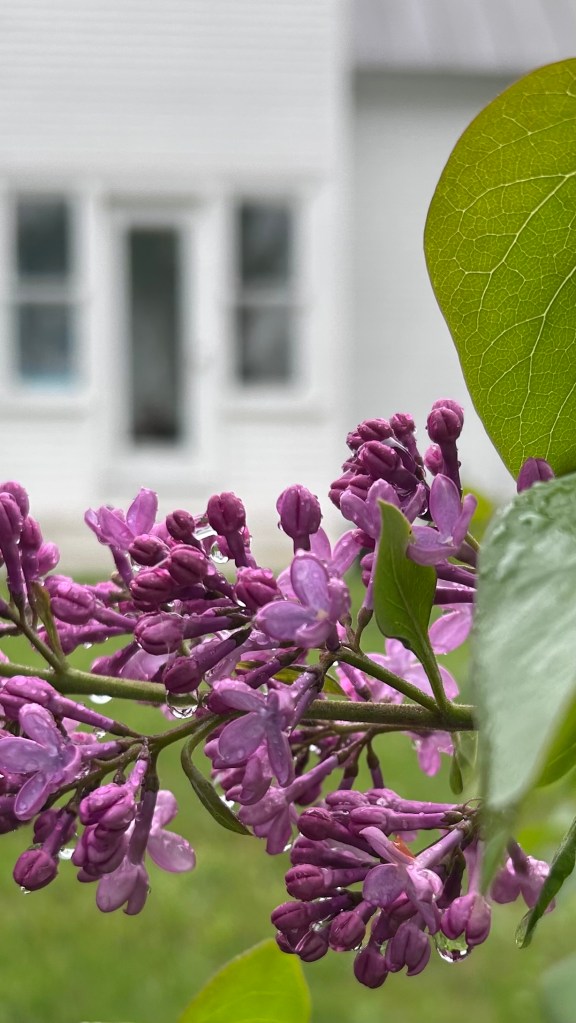
I arrive home from the local arts center, get out of my car, and a robin nearly flies into my head. Winged creatures are swooping from the apple trees to the hedge of lilacs that is just beginning to bud. My god, what a lovely day.

In my bag, I have an empty pint jar of water I’ve been drinking, and a ball of purple linen I’m knitting into a summer shift, and the books of the two authors whose reading I just attended — Helen Whybrow of The Salt Stones and Jody Gladding’s translation of Jean Giono’s The Serpent of Stars. I have a new book, too, a collection of stories by a Turkish author I’ve never read. Sitting with my book world friend, her publisher friend hands me a book, too. The afternoon and evening has gone this joyous way, like that hell-bent robin — strangers and friends and people I haven’t seen in ages — exuberant about literature and art and the unstoppable profusion of spring.

I like this art center so much I imagine curling up on a cushiony bench and sleeping beside the wide windows, the starlight on my face. An acquaintance I met at a Vermont Studio Center residency works here, too, and we plot some amusing possibilities. We’re beside the table heaped in lush mounds of delicacies, and I graze on stuffed mushrooms and empanadas and fresh tomatoes. I wrap lemon squares in napkins and hold these in my hands away from my books and knitting.

Outside on the stone patio, the wind is lifting over the meadow, the sun sinking and the cold creeping in. All around me looms that chilly darkness, the nearness of sunset, the hole in the night where dawn seems impossible. So much of my life I’ve teased and poked at this, and, conversely, pushed the vast cold away — through distraction and once-upon-a-time through drinking and work. Now, as the twilight drains away and night stakes in for its duration, I wander among the yet leafless apple trees, the garden with its green garlic nubs, drinking tea and listening to the birds settle down to sleep. My god, the myriad lessons of cancer. Note this, too: clench joy and fear in the same fist. See what happens.

Kitchen renovation paint considerations….

Journey of many layers.

One of the best journeys of my life was when I was 19 and had long hair I rarely brushed. My then-boyfriend and I were hitchhiking (don’t hitchhike any more, folks) at the Greenfield, MA, I-91 exit, heading north, home to Brattleboro. A man driving an old convertible Cadillac, a great white Moby Dick beast, picked us up. In my memory, he’s smoking a cigar and grinning. While he and the BF sat in the front, shooting the shit, I sprawled in a backseat so enormous it could host a family. I surely wore no seatbelt. My god, on that July evening, I felt like I was flying.

This week, a grad school friend of mine invited me to spend a morning as a visiting writer with his students. All the layers of this trip—the journey south, the first solo I’ve taken since the cancer (my girls urging me to drive carefully, have fun), the stop in Brattleboro where I’d lived in my twenties and was happy, the visit with my dear friend and his wife who I immediately feel is a kindred soul, in their inviting house with a backyard vernal pool and singing peepers, a night of rainstorms, the morning’s magnolia blossoms gleaming pearly—all these layers folded into these writing students who arrived with questions and notebooks, hungry. In this breaking world, what a joy to swim for a bit with others in the passionate stream of loving literature, in all its myriad forms.

On my way home, I stop at a café near Dartmouth-Hitchcock Medical Center. By then, early afternoon, I’m worn down. The café was a favorite of my daughters, in all those months I was treated. Last June, when I was finally well enough to join them, no longer sequestered in a hospital room, they bought me a plain croissant, and I ate a few bites of its inner softness. This afternoon, on the sunny patio, I devour pickled vegetables, soaked in vinegar—something I could not eat last year. Delicious.

April, mud season, it’s just me and a young woman with an infant cradled on her chest. I read for a bit, and then as I’m gathering my things, a car pulls up with two young women. They run to the woman and the baby, laughing and shouting, gleeful.

Midafternoon, I have a ways to drive yet, along the wide river and over the mountains. I take a small walk first through the pine forest behind the café. Warm sunlight filters through the canopy. No ephemerals emerge yet, but soon, soon, as the trout lily leaves spread over the earth. My mother would have noticed the young mother, her sleeping babe, the joyous friends meeting this new life. Such satisfaction she would have taken. One more element folded into this journey. Then I head north.

…. And for folks around me, Helen Whybrow will read from her fantastic The Salt Stones and Jody Gladding from her translation of Jean Giono’s The Serpent of Stars at Greensboro’s Highland Center for the Arts, Saturday, followed an artists’ reception for a stunning group exhibition celebrating Vermont’s pastoral life. I was lucky to write about this for Seven Days.

I am beginning to understand that healing is not about returning to what was, but about accepting the change and adapting to the brokenness. This is happening all around us, for people, for the land. People have done damage to the earth and to each other that can’t be undone. We can lament what was, but that won’t help us take care of what we still have. In fact, it might just hold us back. ~ Helen Whybrow

The die is cast?

Writing notes for a reading for Call It Madness, I scrawl in my notebook that this novel is jammed with secrets. Avah Lavoie, protagonist, stashes secrets of theft of longing, and she’s surrounded by secret-keepers, too. Early in the novel, I offer readers two clues. These questions underpin my life, too. No surprise.

The first that’s slipped into the narrative is the story of beavers in New England, how these creatures and their laborious dams once flooded New England, rendering that birch bark canoe a viable form of transportation. When the craze for beaver hats set in, the beavers were trapped nearly to extinction, drying up the land. The story of the past shapes the terrain where we live and how we see the world.

The second is Caesar’s line Alea iacta est — the die is cast. The machination of fate. It’s a question that’s arced through my life since I was a teenager, immersed in Russian novels. Now, from my Vermont house, in the tender dawn, pearly crescent moon hanging low in the horizon, the stars snuffing out as light grows, the robins striking up their day’s singing, this line returns to me. Is fate sealed for this country where, by circumstance, I live, a madman as a leader, intent to wreck destruction and pain, war crimes? Around me, the questions reverberates through everyone: how to live?

Sunday morning, the earth after this fierce winter softening, the daffodils pushing up through black earth, the delicate snowdrops pearly, persistent, the strength of these slender stalks a strain of secret, too.

“If, then, I were asked for the most important advice I could give, that which I considered to be the most useful to the men of our century, I should simply say: in the name of God, stop a moment, cease your work, look around you.” — Leo Tolstoy

Knock it down, revise your life.

March, northern Vermont, the long dragged-out amorphousness where winter drags its slushy sulkiness into sodden spring. I long for a few hours of blistering sun. This season was the weather my mother despised most, all those New Hampshire years of my childhood. One afternoon, she pulled over on a back road and instructed my siblings and me to run through a farmer’s soaked pasture, patchily emerged from a winter of snow, and head for the woods at the far end. We did not know who owned the field and argued. Go, she insisted, go. You kids need to run. So we ran.

My novel, Call It Madness, which will be out in at the end of June, in a month when I intend to swim, is about the unvarnished craziness of family, of fiercely knotted threads of desire and thwarted passion, how the stories that shape and mold our lives are buried generationally. The novel is not about my mother, but it’s for my mother, the woman now dead nearly two years. She was mercurial, passionate about love and destruction. In the long-beyond-time stretch of recent cancer treatments, those endless months on the couch, I often thought of her; she was the only family member who had endured the triple violence of cancer-and-chemotherapy-and-surgery, sheer survival tenuous as a snowdrop. My mother surprised me until the very end of her life, the whole range of the unexpected, from sorrow to contentment. As her youngest daughter, how little I knew her, and yet I carry her with me, in my own might and fallibility.

In these months of remission, I’ve learned from yoga that inquiry is a force, a variation of that impossible Socratic dictum, know thyself. Healing, I plot a venture into transforming my kitchen, my home’s heart, and hire a carpenter to take down a wall, open an exterior wall with windows. Am I crazy, I wonder. At the edges at least of madness, recklessly heady with survival, with the raw knowledge of mortality clenched in one fist.

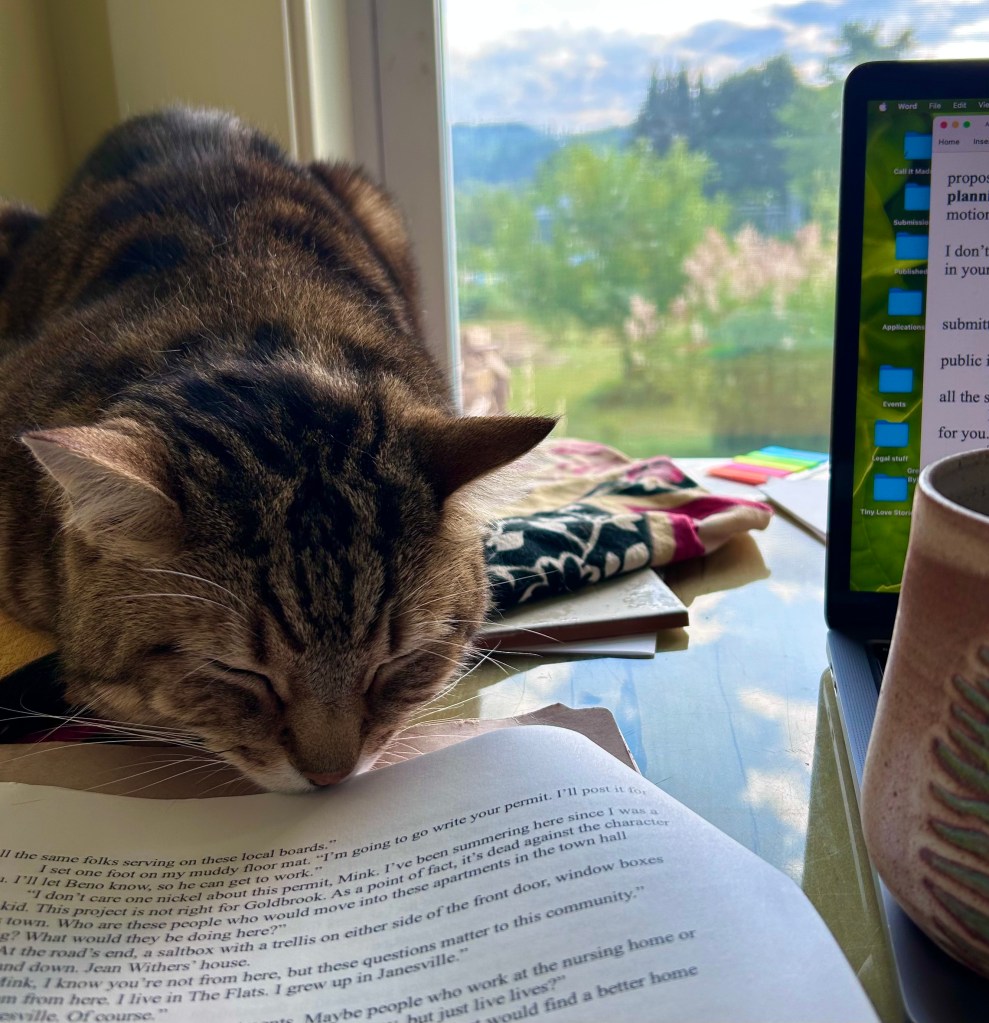
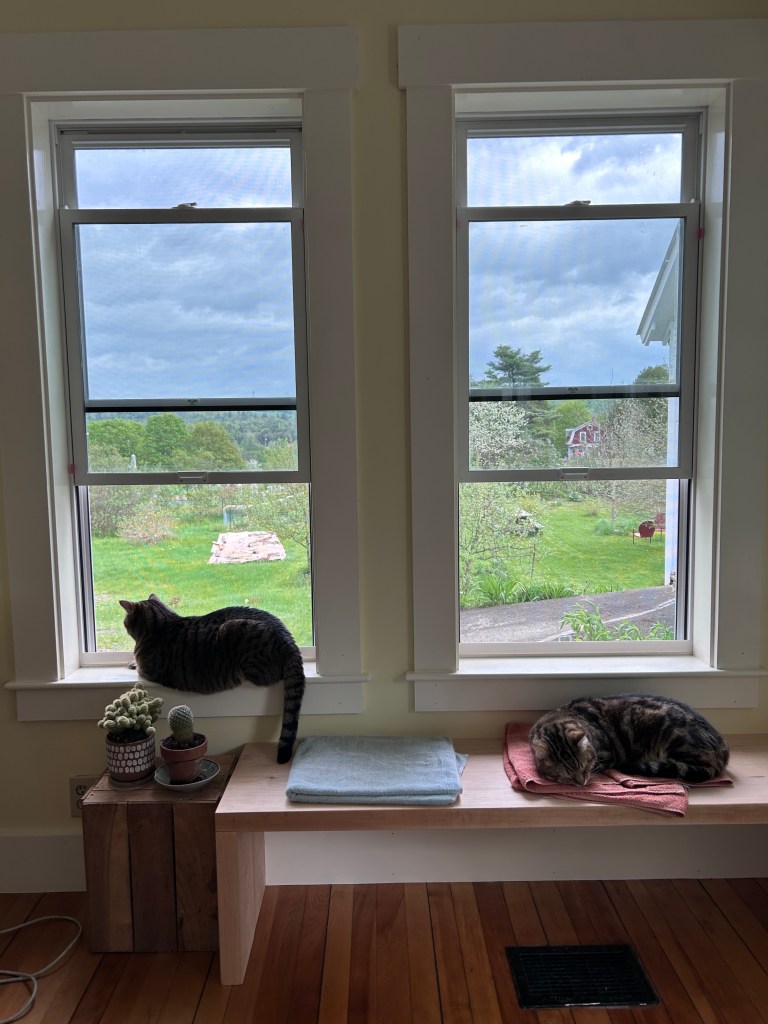
When the vinyl flooring is ripped up, the carpenter and I ponder the hardwood boards, stained and blackened and scraped. The lives of previous occupants rises like mist, mesmerizing, unknowable. What remains are their scars. My cat and I sit on the dusty floor and share a bowl of arugula. Wet snow slides from the roof in the flowerbeds. I planted the gold compass flowers. Who planted the pink roses I’ll never know.

Back out of all this now too much for us,
Back in a time made simple by loss
Of detail, burned, dissolved, and broken off
Like graveyard marble sculpture in the weather,
There is a house that is no more a house…

Here are your waters and your watering place.
Drink and be whole again beyond confusion. — Robert Frost, “Directive”

Mired in fog.

I hole up for the weekend reading Wallace Stegner, a pastoral novel about friendship and mortality, about the pre-internet world when complicated events unraveled perhaps not more kindly but more slowly. Vermont March is the season of live-or-die, the fits and starts of spring, jagged with driving ice, whirling snow, delirious sun.

I drive home from a dinner out in a fog so thick that the car before me pulls off, turns on flashers, and maybe simply intends to wait it out. It’s not late, but there’s no one else out, the wind throwing twigs at my windshield, the radio jingling Lou Reed. I’ve not driven in a fog so profound since I was in my twenties, living in the wooded spine of the Green Mountains, in the years when I was brash with youth and amor. The edges of the road vanish. I pull over at the spring with its pipe where people gather water, and I stand just outside the beam of my headlights, the nearby stream gushing against what remains of its winter ice. I surely can’t stay here for the night, shivering, on the edge of my own mad solitude. The way back, the way forward, all around: pathless, and surely a metaphor for this time.

I’m still shaken to the core by lymphoma, by chemo, by the surgeons who sliced me open and removed those physical scars so I might live. I’m here for this moment, flesh over my slender shoulders, my now bony hips that once carried two babies, and flesh—well, so easily ruined. I spent most of last March in one ED or hospital room or another. While the world spun on, I leaned into treatment, propped up by dear ones, who ferried me to remission.

Now, shivering, nearly blind with fog, I turn off my car and the headlights. The fog wraps around me. I drink it in.

“In the gnostic gospel of St. Thomas, Jesus says, “If you bring forth what is within you, what is within you will save you. If you do not bring forth what is within you, what is within you will destroy you.” — Andrew Solomon

Holy Nightsky.

10 degrees on a starry night, my daughter phones me while I’m cramming more wood in the stove. She’s on a dark-soaked back road, the northern lights resplendent, and urges me to go in search. Up Bridgeman Hill, she tells me, with the ridgeline view.

So, bundled in coat and hat, I drive through the little village and up the hill where the town lights cannot touch. In my headlights, wind scatters snow gathered from the wide hayfields, winter dormant. I pull over at the hill’s crest where two farms join. I get out of my car and walk down the road. The limitless sky gleams ruby and emerald, an immense shaft of white light luminescent. In the east, the black spreads profoundly, the stars so radiant I imagine I could reach out and grasp these gems.

John Donne wrote that illness is a “holy room.” My oncologist taught me that we are all the ailing; if not now, to come. Mortality’s cut makes zero discrimination. A cancer diagnosis gained me admission to inner chambers. Unwanted—let me reiterate again, I did not request admission. But I hung up my coat in the anteroom and set my hiking boots against the wall, and I walked barefoot and thirsty into the nexus, me and that fiercely multiplying lymphoma. The lymphoma and me — one of us was not going to survive this go-round.

In the night’s darkness, the rushing wind tore at my cheeks and hurled ice in my eyes. In the distance, a cow barn glowed with light, a scatter of houses in the valley. Around me, that immense and mysterious beauty over small human beings, at whatever mundane chore or decency or devilment we conjure, be it the evening milking or washing supper dishes or plotting a wrong against another.

The sharp-clawed cold shoves me back towards my car, back towards the village and my hot woodstove, my little house in the great holy room of this planet, this universe, this precise moment.

“It seemed like I was doing something ludicrous, trying to build a permanent work of literature out of broken little whimpering bits about the most ephemeral experiences when I was still mostly broken and half-ephemeral myself.”
― Anne Boyer