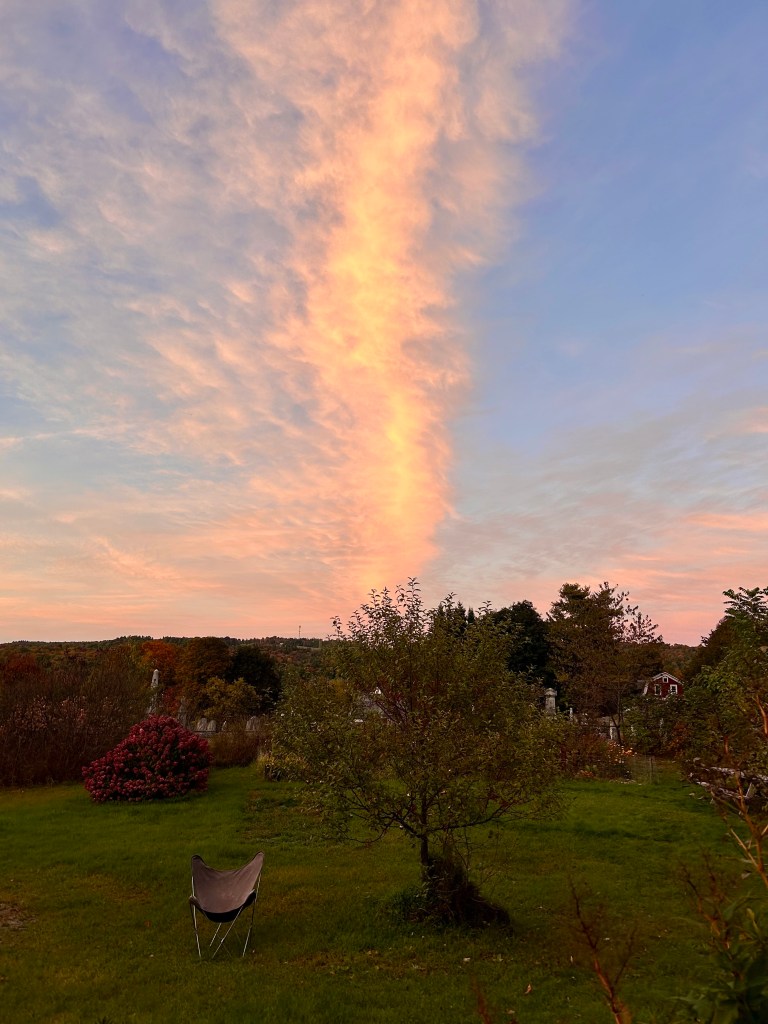
Bear, darker than midnight.

I’m walking up a fourth-class road when I spy a black shape moving along the upper end of the nearby hayfield. Vermont divides its roads into categories, from the interstates to dirt roads to the little-used former farm or forest roads that are snowed-cover in winter, mud-rutted in spring. I stand beside a wild apple tree, the blue view of the Worcester Mountains over my shoulder, and admire this bear, darker than midnight against the field’s glossy emerald. When green kindles in Vermont spring, it flourishes.

This place I’ve never walked, although I’ve seen maps and heard stories. The road treks uphill through the forest and dips down where Caspian Lake gleams, realm of summer visitors, but for the time, still the territory of the locals.

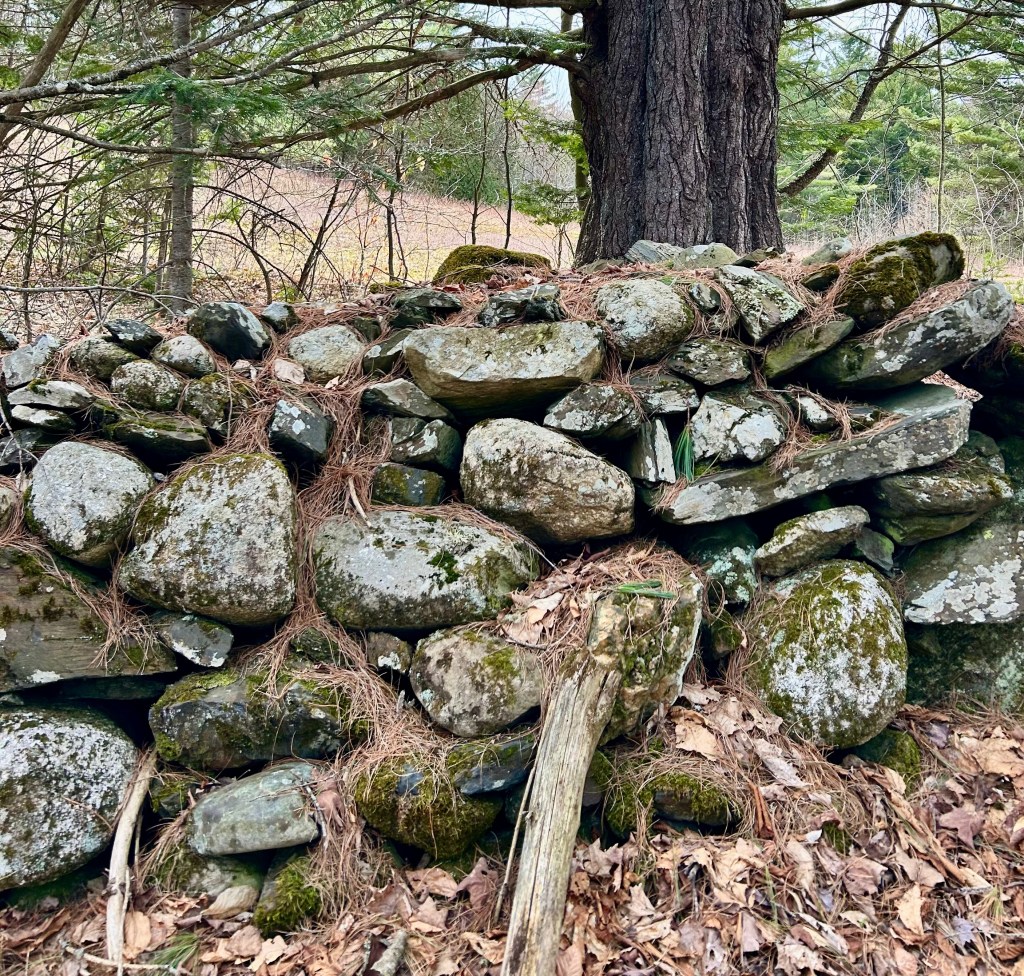
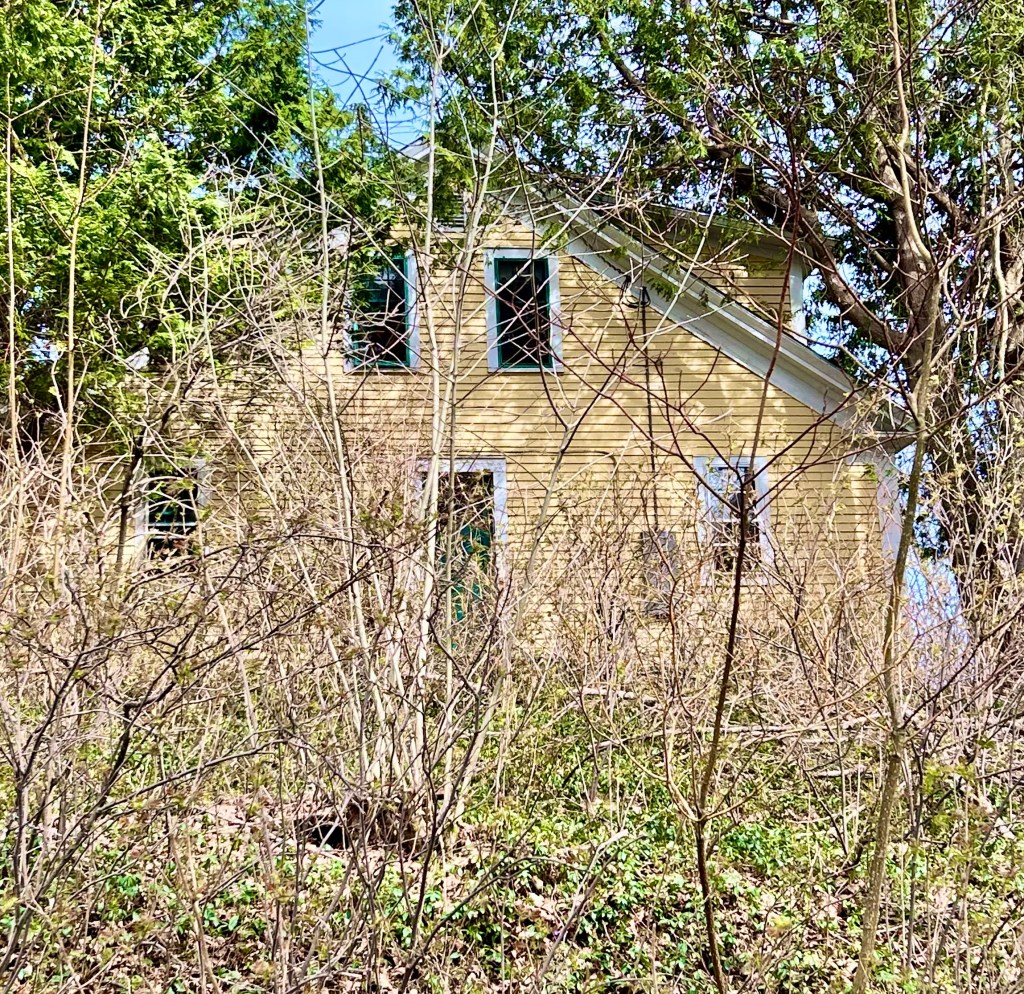
I find what I’m seeking and also what I’m not: the labor-dense stone walls whose once-upon-a-time fields are gone to forest, moss-covered cellar holes, twisted rusty remains of farm equipment. Peepers chorus. An old farmhouse with an enormous veranda on a hill must have once had a royal view of the lake, and endured bitter winter winds. Someone has tried to cut the wild reclamation from the house and mostly failed.

In the sunlight, I linger, wondering who lived here, their stories silent. The two-story house has large dormers and many windows; it’s not a fly-by-night, tossed-up structure. On my way home, I pause where I saw the bear, searching, but of course the bear has moved on. Three ducks fly low over my head. The earth exhales its sweetness of thawing mud, the turning-over of last autumn’s leaves, this summer’s great promise.

“Deep in the forest a call was sounding, and as often as he heard this call, mysteriously thrilling and luring, he felt compelled to turn his back upon the fire and the beaten earth around it, and to plunge into the forest, and on and on, he knew not where or why; nor did he wonder where or why, the call sounding imperiously, deep in the forest.” — Jack London

Sun. Rain Moving In.

These April days, suddenly full with light rushing back. I’m up early, getting things done, putting order into the messiness of my life. Does it make a difference? Who knows? Still, we need to eat. We wash up. Teen does homework. The songbirds and turkey vultures return in force. Now, blue herons fly over my house every day, from the reservoir to the pond near my friend’s house. I think, what if a heron dropped a note or a homemade donut? How cool would that be? But the herons fly on, way cooler than our little human minds.

Here’s a cool poem, though:

Over the Weather – Naomi Shihab Nye, 

We forget about the spaciousness
above the clouds

but it’s up there.The sun’s up there too.

When words we hear don’t fit the day,
when we worry
what we did or didn’t do,
what if we close our eyes,
say any word we love
that makes us feel calm,
slip it into the atmosphere
and rise?

Creamy miles of quiet.
Giant swoop of blue.

Wild Honey.

In what could be called Yet Another Phase of Life, I meet my oldest daughter at her apartment, and we take the dog for a walk up a dirt road where I’ve never been. It’s rural Vermont, and the road bends away from the river valley and winds steeply up a hillside. It’s sunny and cold, and there’s absolutely zero traffic on the road. The weather had turned warm a few days ago, rutted up in a foretaste of mud season, and now is frozen in deep ruts.

The trees end at a stone wall and a sprawl of farm fields, with an incredible four-story 19th century barn. Whoever lives here appears to be hosting a kids’ sledding party. The homeowner appears on the road, with his black dog, who coincidentally shares the same name as my daughter’s dog. We speak pleasantly for a few moments, and it’s clear not many strangers wander up this road.

My daughter snaps a photo of a dripping icicle from one of the little outbuildings.

The kids’ party slowly heads back to SUVs and station wagons, the kids red-checked, in snowsuits, carrying small white paper bags. The adults wave and smile at us.

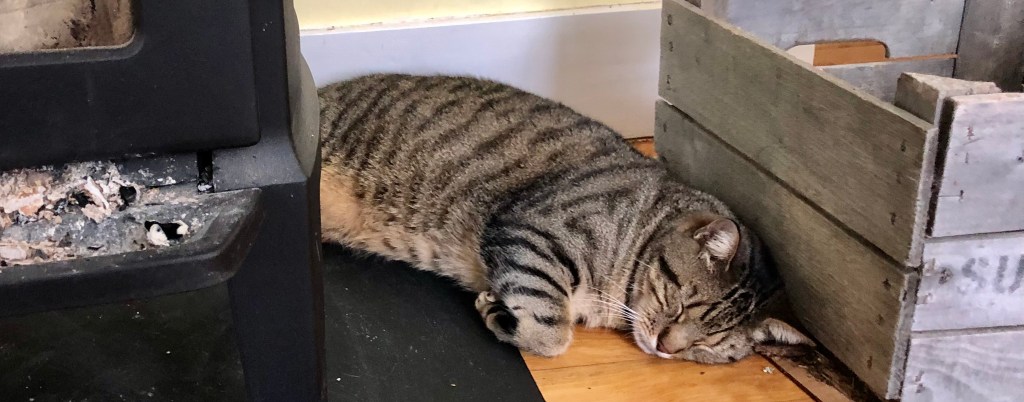
A little later, I drive home through that river valley I’ve driven countless times now, alone or with kids or sometimes with friends. The road switchbacks through the shadowy Woodbury gulf, and shortly after that, I’m home again, feeding the wood stove and cats, then on the couch with my laptop and work, listening to the litany of reporting from the Ukraine. I remember clearly when I was 23, too, living in Vermont, and it seemed utterly normal to have strangers ask, out of curiosity and nothing more, where do you live and what’s your story?

I sweep up the stove ashes and bring in more wood. The night promises more cold. How much I’d love to put my hands on sun-warmed soil and plant a garden of sunflowers.

Wild honey smells of freedom 

The dust – of sunlight 

The mouth of a young girl, like a violet

But gold – smells of nothing.

― Anna Akhmatova

Unexpected Phone Call. Driving.

My friend who has no cell phone (yes, indeed) phones me from someone else’s phone when she needs a ride, due to being “in a pickle.” I don’t get the message, as I’m on the phone with a hard-working journalist who’s graciously writing about my book.

Since it’s my lousy cell phone, I get the message about 20 minutes later, as messages are conveyed to my cell phone via carrier pigeon. I phone the stranger, who’s no help at all, but really darn nice.

I get in my car and go search for my friend, listening to a replay of Vermont Public Radio’s Brave Little State about the housing crisis. I pull into Montpelier and get out to look for my friend right around the time the podcast delves into interest rates and their role in this actual Real Life problem.

My friend is fine and home by then, and I sit on the steps of a closed restaurant and talk to her for a good long while. It’s dark, but not late, and the air is warm. I’m in this tiny little city that smells deliciously of something spicy, not sweet like cinnamon, but spicy like hot chili oil. I’m across from my beloved public library, closed up now, where I worked so many lovely long days, pre-pandemic, with never a thought that those days might cease for me. Since I have no real place to be, and my friend is ebullient to be home and safe, I tell her about the night so many years ago when I stood with my baby just down the street and contemplated renting a room in the inn and never going home. I’ve thought about that night and those crossroads in my life for years now, but when I tell my friend this story now, I imagine that long ago night lifting on little dove wings and fluttering over the roof tops.

I turn off my phone and drive home under the starlight.

August. Somewhere.

In the midday heat, my youngest drives us north, following vague directions, and we hike along two small ponds. The merest wind blows, ruffling sunlight over the water like sparkling scales.

Through the woods, we follow a trail up and then sit on a rocky ledge, admiring the view, drinking water and eating crackers and talking. The humidity reminds me of summers in southern New Hampshire, and how a summer seemed so long as a kid.

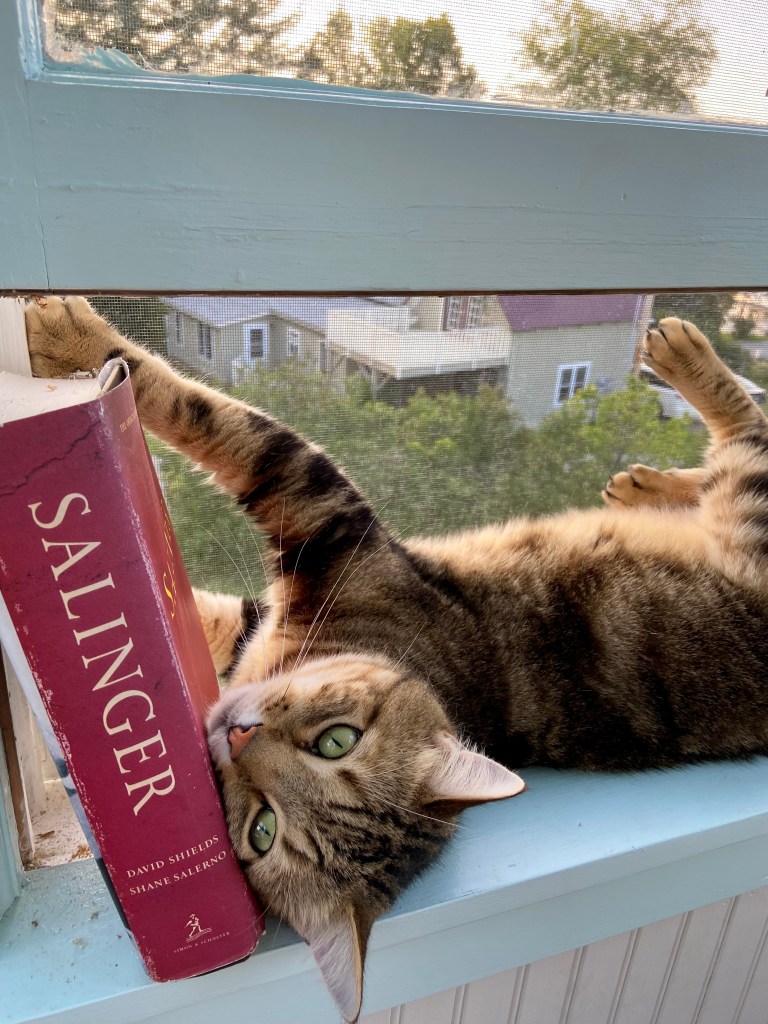
The sticky heat spreads out this day, elongates it. There’s plenty more ahead — my daughter heads into work and then goes swimming with a friend; I write on the back porch; my oldest returns from work and attends class on the upstairs porch; our cat catches his claw on the window screen. Rain falls.

But before all that, my youngest and I stop by a farmstead, and eat drippy and creamy-delicious vanilla ice cream cones. As we get into her car to leave, my daughter bites into a fresh peach. A friend pulls up beside us, and we talk for a bit. Our conversation winds quickly to work and misogyny. My friend apologies to my daughter for our conversation flying around.

My daughter asks politely, What? and pauses with that half-eaten peach in her hand.

My friend says, Oh, she’s in that lovely peach world.

Hard-working house cat, Acer.

Face From the Past

Every bird around us is singing this morning. The garden luxuriates in a clinging dew.

Unexpectedly, a woman I worked with for a number of years texts me with news she’s in town for a few days. We had last in early March, just before our world shut down.

We take a walk through the town forest and catch up on kids and work. Then, for a few minutes we stand in the parking lot, and our conversation branches a different way.

She asks about when my daughter and I were quarantining after my daughter contracted Covid. In those long days, waiting to see whether I (who wasn’t yet vaccinated) would contract Covid, too, I painted the window trim in our front porches, a blue light blue color called Innocence. While painting, I listened to hours of Derek Chauvin’s homicide trial.

So much of our lives, I muse, is simply circumstance — we’re white women, living in Vermont, with particular backgrounds and education. How much of our lives do we choose, and how smartly do we make decisions of what we do choose? It’s a question that’s been asked myriad ways in the past year, in innumerable ways.

Driving home, I keep wondering, what do we do with this now?