Why I Hate the Corn Maze

Ever read the late David Foster Wallace’s A Supposedly Fun Thing I’ll Never Do Again?

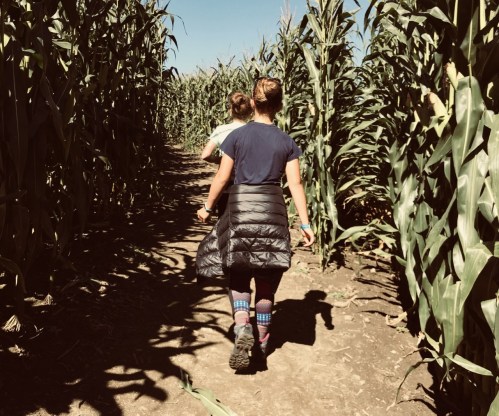
Okay, that was about cruise ships. My supposedly fun thing was a corn maze which began as lots of fun, driving along maple-lined dirt roads, past hayfields, laughing with the kids about the mist we kept entering and exiting, apparently in the middle of rural-Vermont-nowhere.

In this amazing corn maze, hard-packed dirt paths wound between immensely high corn. An hour in, actually beginning to wonder if we might not get out, I dredged up what limited survival skills I might possess, and ordered the kids to follow “the rule of right” and only make right-hand turns — as if that was the key out. Even smarter, perhaps, we tagged behind a cheerful grandparent-ish couple who practically ran through the maze and got us out.

So much for fun mothering experiences, these few hours that seemed, honestly, a little too close to the marrow, a little too near my life — wander around and conjure some savvy to get out.

Much later that Sunday evening, picking up stray socks and library books and putting away laundry — getting ready for a working week — I realized I failed that metaphor for life: enjoy the journey. Take note.

Because here’s something else that’s weird but true: in the day-to day trenches of adult life, there is actually no such thing as atheism. There is no such thing as not worshipping. Everybody worships. The only choice we get is what to worship. And the compelling reason for maybe choosing some sort of god or spiritual-type thing to worship—be it JC or Allah, be it YHWH or the Wiccan Mother Goddess, or the Four Noble Truths, or some inviolable set of ethical principles—is that pretty much anything else you worship will eat you alive.

— David Foster Wallace
thumbnail_IMG_3461

Lucky Charm

By the side of Route 14, my younger daughter leaps, waving at me to stop.  Nearby, her sister’s car is pulled over.

Flat tire.

The older daughter rails about her brand-new tire, likely ruined, and then her younger sister says simply, It’s just a flat tire.

“Flat tire” may become our new mantra — our own, hey, lighten up, change the tire and move on — maybe even a talisman, as if the tiny bit of ill luck might ward off the greater.

September 23 — birthday of the young man we’ve known since he was 1, who’s logged a million miles on his bike and is heading to Europe for even more. Safe travels. Much happiness in your new decade.


IMG_3433.jpg


Tiny Running Toddler

A very tall father and his nearly-one-year-old daughter live across the road from my library and often swing by. Yesterday while I’m in for a board meeting, not really open, they swing by, and the little girl runs to me.

Not even 7 days ago, the small curly-headed girl was tentatively taking steps, and here she is now, rushing across our worn carpet, her smile radiant.

When my daughters were babies, I was amazed how quickly their nearly translucent fingernails grew, how rapidly a scrape healed.

Babyhood’s quicksilver, sure, but adolescence mirrors that age. My 13-year-old has changed so mightily in the last six months, in face and body, that when I arrive at soccer games and can’t easily find her — idiotic, that I can’t immediately recognize my own daughter across a field — her sister says, Look for the green cleats.

Really? I think to myself. Identify my girl by her shoes?

When I was a mother of a toddler, I would have found this situation sad, maybe even just awful, but — and this may just be a combination of worn-down single mothering and that my daughter’s busied her life with all kinds of great kid projects and friends — I find her endlessly interesting, like a blossom whose name I don’t know, opening petal by petal. Where are you headed, I wonder. Where are you going?

Because he’s so good, here’s a few more lines from Andre Dubus:

But the writer who endures and keeps working will finally know that writing the book was something hard and glorious, for at the desk a writer must try to be free of prejudice, meanness of spirit, pettiness, and hatred; strive to be a better human being than the writer normally is, and to do this through concentration on a single word, and then another, and another.

IMG_3426.jpg

Simple Sweetness

Eleven years ago, my family had a member injured in a woods accident, involving a nighttime search and rescue, and myself driving to the ER at two in the morning with my two-year-old in the back of my old Volvo.

Of that time, I remember many things — in particular that so many people I knew had chainsaw accidents, men and women, that people compulsively shared with me.

That family member healed; our lives moved along. But every year, that shadow of how very badly things might have gone awry for us, in a few single moments, moves over me.

So, it’s with particular satisfaction that my two-year-old is now thirteen, and spent a recent night sleeping with her friend on a trampoline. All around them, the coyotes howled, and the sky, unbroken in the rural dark, was radiant with shooting stars. At three in the morning, cold and covered with a heavy dew, the girls ran into the friend’s house, laughing, and fell asleep again.

Just simply alive,
Both of us, I
And the poppy.

— Issa

IMG_3361

Home Work

Frost sprinkled around us last night. I hear the local reports on Goddard College-supported WGDR this morning while the cats stretch on the sunny kitchen floor. Alan LePage in his Curse of the Golden Turnip radio show takes calls and shares his farmer’s intel on climate change.

Halfway through the weekend, our house lies in actual physical chaos: the upstairs floor I bungled painting and must repaint. Failure, I remind myself, clasps hands with creativity.

In Vermont, season’s change — from a luxuriously warm summer to chillier fall where the shadows hold no light — begs interior reflection, too. Where are we headed? Or, what’s the plan?

As part of a larger writing project, I’ve been interviewing a woman in recovery from opiate use. Again, what impresses on me is the constant motion of life, that while our past imprints on us, marking each of us indelibly, life goes on.

A misprinted floor — wrong paint — is so minor, a mere irritant. A surmountable challenge. Perhaps, a sheer piece of luck.

With writing, we have second chances.

Jonathan Safran Foer, Everything is Illuminated 

IMG_3291

Friday Night, The Three of Us

Sitting on the back deck after dinner last night, in jeans and long-sleeved shirts, the girls asked if we were going swimming.

Well, why not?

The girls sprawled on the grassy bank while I swam down the pond, from the shadows into the sunlight, the water warm, the surface rippling with feeding fish.

All summer long, we swam in this cupped bowl in the earth, our bodies both in all that dragonfly-filled sky and the water with muck and weed, minnow and turtles. A curled oak leaf floated on the surface. I floated on my back, staring up at the fading blue sky, a single cloud laced pinkly at the edges with sunset.

Later, knitting scrap yarn into a scarf, I shivered. Hours later, still cold, a cat crawled with me until the blankets while I read with a flashlight.

During the siege of Leningrad:

The heat in the (public) library gave out early, and the plumbing eventually froze and burst. In late January, the building finally lost its electricity. The librarians still searched the shadowed stacks with lanterns, and, when they ran out of oil, with burning pieces of wood. They still served patrons and sought out the answers to practical questions posed by the city government: alternative methods of making matches or candles, forgotten sources of edible yeast. As the building grew colder and more battle-scarred, they closed the reading rooms one by one. Finally, patrons and librarians all huddled in the director’s office, where there was still a kerosene map and a buzhuika stove.

— M. T. Anderson, Symphony for the City of the Dead: Dmitri Shostakovich and the Siege of Leningrad

IMG_0391

Hardwick, Vermont