Homework

In the evening, with the windows open to the crickets’ songs, my daughters sit on the couch, doing homework together, while I read about the 1918 pandemic and knit.

Half-listening, I hear my daughters figure out the answer to a chemistry question, googling definitions. Decades beyond my own high school science classes, I’m no good here. Inevitably, these discussions always remind me of my adolescent years — well before google — when my father was the in-house reference for anything from trigonometry to weird geography questions.

Not so, in this house. I advise the girls to call my brother.

But as I listen, I realize they’re piecing through an interesting problem about change on the molecular level, and my youngest notes that change is the one constant.

It’s a particularly poignant observation for a 15-year-old, and I lay down my knitting and take a walk in the darkness around our house.

This week — heck, these months — seem filled with stories of people around me whose lives are in upheaval. These are all people I know and care about, in varying degrees. I keep thinking how, on a political level, so much misery is caused by exploiting the weakness of others. So, too, in our own personal levels, where so much of our energy often jockeys for a position of strength, betraying a marriage, a confidence, a professional relationship.

Meanwhile, change is the one constant. Surely, if nothing else, that could be a theme for 2020.

And yet, perhaps, it’s not.

In the darkness, I stand near the woodpile, breathing in the scent of sap and fresh wood, of damp soil turned up. Our cat sits on the windowsill, peering out at me. Overhead, the Milky Way spreads across the sky. My daughters’ voices drift through the screen, figuring out their answers, laughing a little — for the moment — happy.

In the Journey

In these warm September days, the little boys who live across the street dig in their dirt driveway, holding up their tractors for me to admire, their faces covered with dirt. The older boy, who’s heading into whatever might be kindergarten this year, wears his Spiderman suit everyday.

Our two houses are at the end of the one-way road. The two brothers, this summer, have begun dismantling the road’s pavement, picking up the broken asphalt pieces and building a tower in their driveway. I look at the tower with immense pleasure. Sure, the world may be falling down around us, but here’s two little boys, recreating the world.

I can’t help but wonder if someday these boys will remember the Covid time as the summer of digging, like I remember the summer of my brother’s fourth year as the time he dug a bear trap — and then fell into it.

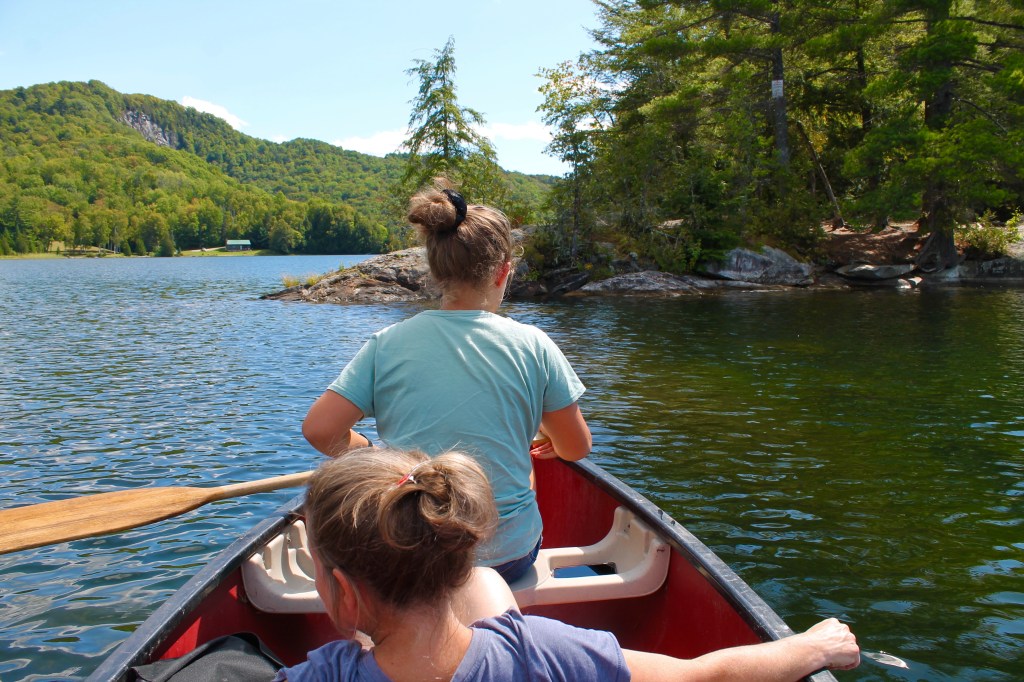
On our end, with my daughters, we canoed out to an island of hemlock trees, a beautiful place, silent but for the water lapping the shores and a loon calling across the pond. The girls packed sandwiches and apples and a bag of potato chips. We ate everything and then rowed across the pond. Why not? This is where we are. What’s the rush to go anywhere?

On the eve of school (possibly) reopening, I keep thinking of Maria Montessori’s wisdom….

Preventing war is the work of politicians, establishing peace is the work of educationists.
― Maria Montessori

Nichols Pond, Woodbury, Vermont
Photo by Molly S.

Shape of the Day

I drop my daughter at the high school for soccer practice. There’s maybe 12 high school girls on the field, the music cranked up, kicking balls and laughing. There’s no coach, no boys’ team, no open locker rooms, quite possibly not even a game this year. Just these girls, sunlight, grass, soccer goals.

I’m utterly grateful for this hour and a half, in a way I’ve rarely been grateful before. Just these moments of youth and aliveness.

Who knows what will happen next week when school is scheduled to open, or not. This coming fall? A greater, scarier unknown.

But this afternoon. Here. Now.

So, this Saturday, waking from a dream of Vermont’s enormous Lake Champlain, with its stony shores, the cats and I work through these dark hours as the sun slowly rises, and decide to declare this day the day of sunflowers, apples, tomatoes, and pie.

“We need acts of restoration, not only for polluted waters and degraded lands, but also for our relationship to the world.” 


― Robin Wall Kimmerer

Little Gifts

Much of my library work these days is talking and listening. Hey, how’s it going? What’s happening? When I listen a little longer, I hear stories of ordinary lives in upheaval — families separated, folks trying to figure out some kind of future.

I hand out books — mostly fiction and mysteries. And I often step outside the library where we keep talking and talking. From the school’s vegetable garden beds, I pick cucumbers and send patrons home with pickle fixings.

That’s about all I have to offer; that little will have to suffice.

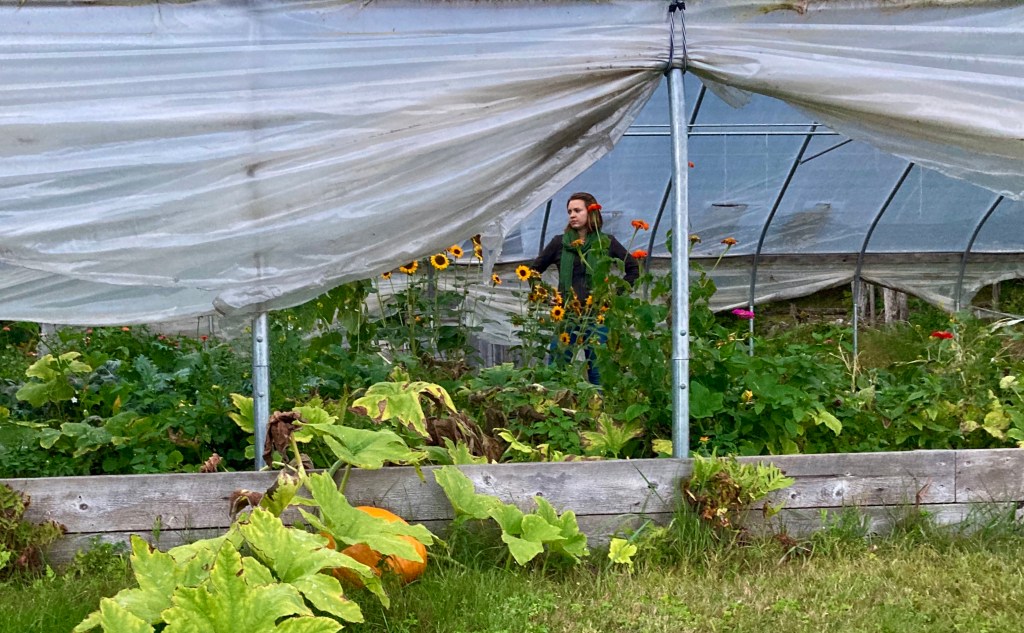
In my own garden, the zinnias have gone brushy and wild, brilliant pink. Radishes have flowered and gone to seed. Late afternoons, I wander, barefoot on the cold soil, taking in the colors, breathing the spicy scent of arugula.

Before long, frost will be nipping at my garden, but for now, the pollinators are hungry, the crickets are singing, and these ragged-petaled flowers are nothing short of miraculous.

Photo by Molly S.

True Compass

Yesterday, my 15-year-old drove on the interstate for the first time. Fittingly, this route was one of our favorites — a hardly used stretch across northern Vermont and New Hampshire.

Coming home, we took the long way around St. Johnsbury, where one interstate joins in with another.

At a particular but unremarkable place, just as we crested a hill, I remember driving this same highway in our old blue Volvo, my then-husband in the passenger seat, our girls in the back, talking and doing some kid craft project. My then-husband and I were listening to an NPR report about Teddy Kennedy and the late senator’s true compass.

So many years have passed since then. Our youngest is now driving, utterly confident, her sister and I offering advice — be wary of semis, know that blind spot. As I’m chauffeured by her, I think how my daughters will be tested in their lives in ways neither of their parents have, their own forming compasses pushed and challenged. So often, I feel I endlessly run my mouth with advice — don’t trust any other driver, suspect impairment and incompetence — but I know my girls always make their choices, create their own lives, enact their own unique dramas.

Mostly, I’m just so damn glad to be here, still part of their lives, ragged and worn out, the worrying mama….

True compass, I ponder as we drive home. This piece I keep to myself.

Ordinary Day

Like so many parents, the impending opening (or not) of school looms over us. My 15-year-old is desperate to go. Every afternoon, picking her up from soccer practice, my friend and I stand in the parking lot, talking. As we share trivial and not-at-all trivial snippets in these few moments, I eye the sprawling brick high school, thinking, Really? How is any of this possible? Lumping teens together, here or in any other building? Does this make sense at all?

What my kid wants is clear — to hang with her friends, to rise up in a real challenge, to learn, to begin finding her forward to her own adult life. Basic stuff.

I’ve hit places of indecision in my life before, like when I uncoupled myself from a marriage. But now? My friend and I stand in collective indecision. Finished, our girls walk towards us in their cleats, sweatshirts slung over their shoulders, masks dangling from their hands. They’re looking at each other and at us, laughing, maybe making a joke about the two of us, or maybe simply happy in this sunny August afternoon, tired from practice and hungry for dinner.

My friend and I look at each other and remark on our girls’ happiness — thankfully. We lean against our cars, talking.

For this moment, there’s no school, no tomorrow, no next week, not even these past lonely months.

And because my mind works this way, I think of how a river turns when it meets an obstacle, never bullying forward, but shifting with the lay of the land. The lay of our land has changed.

The girls look at each other, giggling, and I’m suddenly sure they’ve been laughing at my friend and me. I’m utterly happy about that.

“Life is always rushing away from us.”

— Stephen Kiernan, Universe of Two