Pieces of Writing, Things of Life

Twice this summer, as I’ve driven along the Vermont interstate, a blue pickup has swung out in front of me at the same exit, a man at the wheel, but what caught my attention both times was the Greek omega symbol on its side, leering up at me like some distant memory of high school science. As a writer, I can’t help but think, That needs to wind into my book.

One keen advantage of writing is that, while I’m often half-blind, at times I’m tuned in razor-sharp, wondering in what way the universe is patterning around me, with this truck and this omega so near I could stretch out my arm and grasp its curve. Perhaps the deeper advantage of this is that writing forces you to look, and look hard at times, for meaning and relevance in the world.

Writing a scene the other morning, I realized a female character, in a dim kitchen, held an ear of corn from her garden and was abstractedly picking the ear apart, peeling loose the husk and each strand of silk, bit by bit. Inside, she discovered those gleaming, uneven rows of kernels, new as milk teeth. Would she eat the corn raw? Steam it? Offer it to her stepdaughter? Heave it in the compost? Chuck it out to the chickens?

The things of the world we live in matter. It’s different to wear acrylic or hemp, to eat fast food hamburgers or brandywines from the garden, whether your house has walls of glass or hardly any windows at all. Neither, perhaps, good nor ill, but the things that return into your life might not be wholly arbitrary. What’s near to your hand might be there for a reason.

The simplest pattern is the clearest.
Content with an ordinary life,
you can show all the people the way
back to their own true nature.

–– Tao Te Ching

IMG_7906

Photo by Molly S.

Parenting a Teen and Writing a Novel

My long-time friend and I went canoeing and swimming with our kids today. The ten-year-old girls immediately ran for the beach, swam the entire time, and never put one toe in the canoe. The two teenagers, a him and her, swung the heavy canoe off the car and confidently carried it to the lake. How the heck did this happen? These two kids I once held on my lap while they shared goldfish crackers? After a dutiful swim, they preferred to sit on the beach–forget romping in the water–and talk.

There’s a fiction phrase–a willing suspension of disbelief–which, the further along in parenting, the more that seems a truism for life. I expect to be in the teen years for a good long while yet, and I could say it’s interesting, but, in fact, it’s darn mesmerizing… among a few other adjectives, too. But when these teens were ten-years-old themselves, I could never have believed they would become so full as people, so funny, so wry, and with legs sprawled everywhere. Here I am, I thought, in that perpetual rough draft of my life, garnering more material.

What you are aiming for (in writing a novel) is willing suspension of disbelief, and the first person who must suspend disbelief is yourself. Some beginning novelists have more disbelief than others, but even if your burden of disbelief is heavy, the only way to suspend it is to keep adding sentences to the ones you have already written.

–– Jane Smiley, 13 Ways of Looking at the Novel
…. Or, I take this to mean, in other words, keep on trekking:  parenting and writing.

DSCF9673

Look for the Humble

Recently, my younger daughter told me the word humble saved Wilbur’s life. Shouldn’t I know the ins and outs of Charlotte’s Web by now? While I’m no kiddie lit devotee, this is one of my most favorite books, ever. But this single word, humble, saving a pig’s life? What a neat way to envision the book. Sure, Wilbur was humble, and, true, Charlotte knew this, but she used what she had at hand, a scrap of paper and an adjective with potential. What a writer!

Someone once advised me to use what’s at hand. That’s keen advice, for living and writing. Take what’s at hand: a sparrow in a current bush on a broken branch, or a hole worn in the elbow of a favorite sweater. What’s the potential? A woman with a hole in her broken heart, revealed as her fingertips fray that unraveling yarn and tear at a callous on her skin.

Humble might have saved Wilbur’s life, but the word was spun into his world by the writer.

By the end of the eleventh century… the previous silver standard, founded on men’s violent and sporadic activities as Vikings, had been replaced by the homespun standard, based on women’s peaceful and steady work as weavers.

–– Nancy Marie Brown, The Far Traveler: Voyages of a Viking Woman

IMG_2331

Young Woman at Work/Photo by Molly S.

Revision and Freedom

I write, but I’m also a knitter, and one of the beauties of knitting is that you can rip the whole darn thing out and begin again. It’s just yarn, as I tell myself. Re-knitting might be tedious, but it’s achievable. Or even, god forbid, toss the yarn out and begin again. Isn’t reworking and rewriting nestled at the heart of craft? Why would we ever think something like craft or art might be easy? How lucky writing is: revision is possible, even demanded, whereas, in life, revision is a little more tricky. And that might be one of my greatest understatements.

… writing itself is one of the great, free human activities. There is scope for individuality, and elation, and discovery, in writing. For the person who follows with trust and forgiveness what occurs to him, the world remains always ready and deep, an inexhaustible environment…

–– William Stafford, Writing the Australian Crawl

IMG_2343

Photo by Molly S.

Playing Hearts, Writing Books

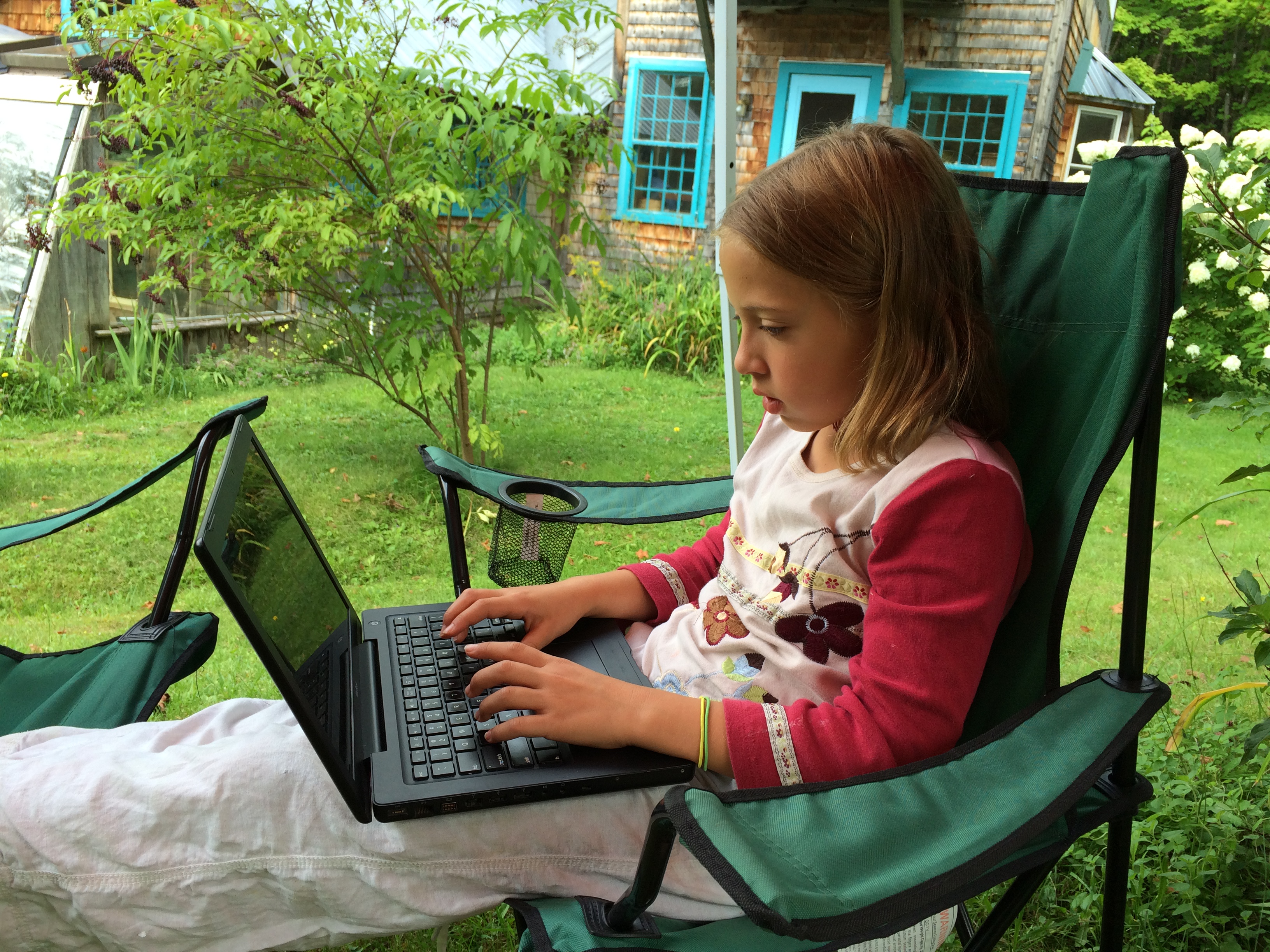
Last night, my ten-year-old daughter, her grandfather, and I played Hearts. New to this game, she was tentative for a few hands, fearful of losing. The third game in, she dropped a card that caught me entirely by surprise: a king of clubs who gobbled up my sloughed heart. The card was so precisely the right one I gasped aloud. She won this game on her own fine merit.

We had this moment, my grinning girl and I, of such sheer ten-year-old kid radiance, such pleasure in her own quickness, her success at navigating a difficult game and counting cards. She wore a shirt with red flowers and tiny lavender rose-blossom earrings. Sure, our life is chock-full of all kinds of things that are difficult and dark, that scrape right down to Eugene O’Neill’s Long Day’s Journey Into Night. When I sit down again tomorrow morning to rewrite my book, yes, I’ll aim to write deeper, and yes, again, even deeper into all the hardest and what appears to me most unknowable things, but our life also brims over with effervesence and joy–an evening of fifty-two cards, a grandfather, a mother, and two granddaughters–and I’ll wind that in, too.

Ann Sexton once remarked in an interview, when asked why she wrote such dark and painful poems, that pain engraves a deeper memory. Pain engraves a deeper memory. Think of a time in your own life when you have experienced a sudden shock, a betrayal, terrible news. Perhaps you remember the weather, the quality of the breeze, a half-full ashtray, a scratch on the wooden floor, the moth-eaten sweater you were wearing, the siren in the distance. Pain carves details into us, yes. I would wager, though, that great joy does as well.

–– Dani Shaprio

Photo by Molly S.

Photo by Molly S.

Summer: Sing Like the Sea

Day by day, this sweet August season winds down. Next week, I’ll walk with my girls down the driveway to the bus stop, where we’ll kick around the fallen apples from the wild trees along the road, looking through the misty fall mornings for the bright yellow bus. Our summer has been packed with all kinds of things: hiking and friends and art camps, not enough swimming, countless s’mores with the cousins.

We spent a lot of miles with my older daughter at the steering wheel, me with my knitting in the front seat, the three younger kids in the backseat, everyone talking sometimes all at the same time. Near the end of the cousins’ stay, late one afternoon we drove up the winding dirt road towards home, everyone hot and hungry, miserable and crabby all the way around. Without thinking, I put both my bare feet out the window and waved my soles at the passing trees. The children shouted, What are you doing? and because I started laughing, they all started laughing, even the teenager in the driver’s seat who does not approve of such undignified behavior, not at all, although she graciously tolerates my foolishness.

Silly? Completely. But in the face of things that are not humorous–words that none of us even want to say, like cancer for instance–why not occasionally throw your feet up and rally to the grubby children in the backseat? Say: I don’t want to hear bickering; just hang with me for a little bit in this golden summer, with all of you so near?

Driving to work today, I thought of these kids of mine and that afternoon, and the last stanza of one of my most beloved poems, “Fern Hill.” I’d always considered the final words tragically bittersweet, but I wonder perhaps now if I misunderstood these lines. Perhaps this poem is about acceptance of our mortality, and simultaneously an exhortation to sing like the sea, rage on against the dying light, laugh in the face of despair. Write beautifully in this good world.

Nothing I cared, in the lamb white days, that time would
take me
Up to the swallow thronged loft by the shadow of my hand,
In the moon that is always rising,
Nor that riding to sleep
I should hear him fly with the high fields
And wake to the farm forever fled from the childless land.
Oh as I was young and easy in the mercy of his means,
Time held me green and dying
Though I sang in my chains like the sea.

–– Dylan Thomas

IMG_7430

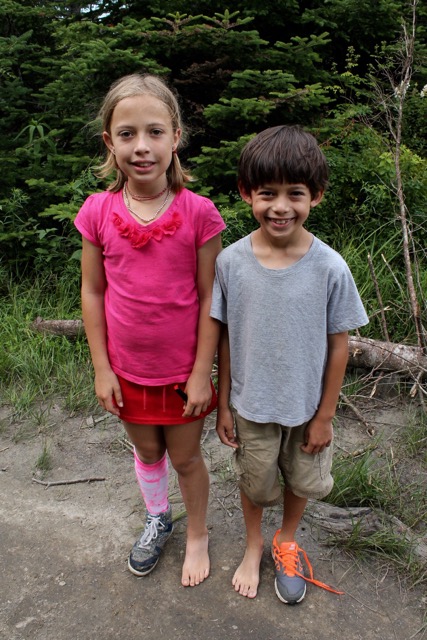
Photo by Molly S. Gabriela and Kaz, Sterling Pond