Beautiful Travels

Reading Daniel Mason’s new novel, The Winter Solider, I’m reminded of first reading Russian novels — Tolstoy, Dostoyevsky, Turgenev — when I was a teenager. How hungry I was for those books — what will these characters do? — in their snow-buried landscapes. Tender green shoots of spring poked through the gritty ice.

This reading mirrors the kind of life I carved out as an adult. Live on a hundred acres of woods, work outside in all weather, pull your toddler along the backroad in the sleet, just because…. Know that where the moon rises above your house is essential. Be afraid; know that the snow and the long-toothed northern cold can and will maim and kill, but how beautiful this world is…..

They were five hours east of Debrecen when the train came to a halt before the station on the empty plain.

— Daniel Mason, The Winter Soldier

IMG_3580.jpg

Cambridge, Vermont

Vermont Dawn

It’s autumn here. Better — Vermont autumn — a landscape hordes of people drive and fly hundreds, thousands, of miles to see.

Because the world is dying down, my prolific garden beginning to crumple, autumn always seems to me the season of memory.

A memory of pulling beets and carrots in an enormous garden while my friend’s husband lay in the house, dying of skin cancer. More happily: a memory of my older daughter’s first Halloween costume, a piece of a sheet I cobbled into a baby ghost costume.

Tricia Tierney directed me to Leslie Schwartz’s The Lost Chapters: Reclaiming My Life One Book at a Time. Late nights, I lay awake reading, thinking how glad I am not to be jail. Early one cold morning, I pull on my down jacket, a beautiful turquoise hand-me-down, now worn thin and stained at the cuffs, and follow the path behind my house, disappearing into the darkness and walking all through the sunrise, the ebony sky streaked through with endless ribbons of luminescent pink.

Schwartz writes, “Writing is survival.” Surely creative work of any kind carries us along. Like the Vermont landscape I live in, creativity has its cycles, too, my garden’s sunflowers shedding their golden petals, bending down for winter’s dormancy.

IMG_3553

Hardwick Sign of Spring #3

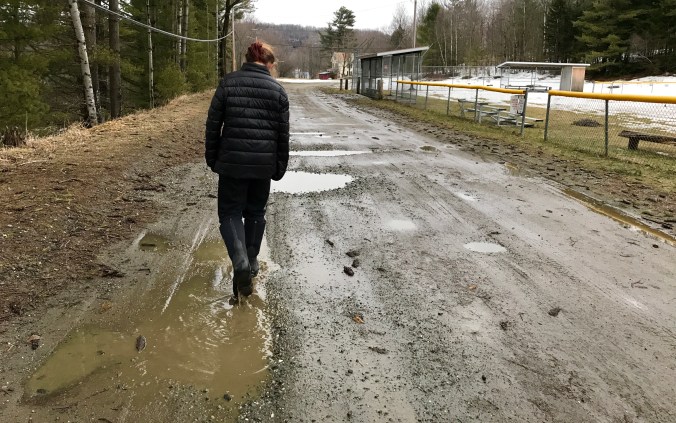
A dozen turkey vultures circled overhead, spiraling on wind currents, silently following us on a walk. They’re back, my daughter noted.

A day of serious wet: cold rain, rivers running high with melt-off, black mud thawing.

We walked in no particular hurry, talking, my daughter awkward in her sister’s too-large boots, pausing to study the vultures circling low, their wing feathers black against the clouds. As our path turned, the circling birds followed us.

I’m fascinated by the landscape around us of junco and robin, hawk and vulture, vegetable garden and cemetery. My daughter zipped her jacket against the raw spring. Those vultures are following us, she said. Creepy.

To pretend that all is right with the world when it is not, to use art as a pair of rose-colored glasses to distort the reality of the world, to paint over the agonies of our time, is to misuse art. Any light and life, joy and ecstasy we can derive from art in our time must be paid for with the admission that this joy and goodness comes to us out of the barbarous darkness all around us.

— David Budbill in Yvonne Daley, Vermont Writers: a State of Mind

IMG_1437.jpg

Our Lives, Seen and Unseen

A few minutes early to collect the 12-year-old and her friend from track practice, the 19-year-old and I take a walk around a neighborhood circle near the high school, passing a house I considered buying but didn’t.

Full of excitement about her morning, my daughter talks on and on, her happiness as visible as red-breasted robins in a bare-branched maple tree. We pause for a moment before the three-story house, with large original windows on the first and second floors, bordered at the top by ornate stained glass. The owner confessed the windows leaked air profusely but couldn’t bear to replace them. The house is no longer for sale; my daughter and I speculate the family still lives there.

We walk by another house flanked by five sugar maples, the trees young enough to live for many more decades.

Robins, both visible and hidden, sing.

My daughter and I pass these houses and these possible lives our family might have taken but didn’t. Then we’re back at the high school, still in the cold and clear March sunlight, beside a maple filled with robins fluttering their wings, chorusing in the beginning of spring.

I know that I love the day,
The sun on the mountain, the Pacific
Shiny and accomplishing itself in breakers,
But I know I live half alive in the world,
I know half my life belongs to the wild darkness.

— Galway Kinnell

IMG_1393.jpg

Tree Collecting

I stepped outside the Montpelier Library today and stood for a moment with my face turned up to a shower of cherry tree blossom petals steadily raining down.

As a writer, I collect words I particularly love: myriad and succor, litany and exquisite, constellation and pinwheeling. For years now in my travels around Vermont, I’ve noted particular trees of exceptional grace, like Hardwick’s beauty mark of three silver maples on route 15.

Last weekend, stepping out the back door of my brother’s brewery, I nearly walked into an enormous apple tree covered in pearly blossoms and humming bees. What’s this?  I asked.

Amazing tree, he answered.

What a strange thing!
to be alive
beneath cherry blossoms.

– Issa

FullSizeRender.jpg

Photo by Molly S.

In my weekly commute to Burlington, some mornings I hit traffic, and some mornings I don’t. Today, waiting in a long line, I listened to Garrison Keillor read poetry.

“Despair” by Billy Collins

So much gloom and doubt in our poetry—
flowers wilting on the table,
the self regarding itself in a watery mirror….

Today, with the sun blazing in the trees,
my thoughts turn to the great
tenth-century celebrator of experience,

Wa-Hoo, whose delight in the smallest things
could hardly be restrained…..

Sitting alone in my little Toyota, I laughed out loud.

It’s the fragrant apple blossom season in Vermont. Dandelions are rampantly blooming. My teenager daughter texts me at work of her misery, the stark unfairness of the world. Of course, I text back, but go for a run. The ten-year-old skips on our evening walk. I’m just so happy, and I don’t know why.

How many decades has it taken me to relearn what I knew when I was ten? And to laugh about it? The black flies are out and biting fiercely, but the sparrows are singing mightily.

FullSizeRender.jpg