Luminescence

In the backseat yesterday, my daughter’s friend suddenly looked around and asked where I was driving.

I told her I changed my mind; we weren’t headed to Waterbury, Vermont, but were on our way to I-80 and the midwest. In less than a heartbeat, she said, I don’t mind. I’m glad to go anywhere.

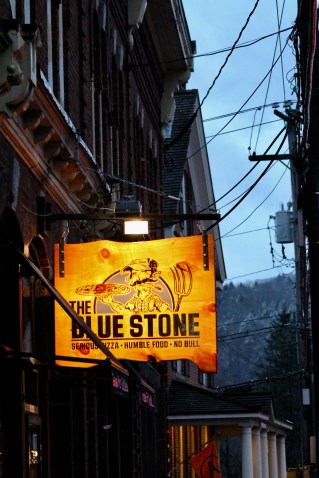
Instead, we went to Waterbury, once famed as home of the Vermont State Asylum for the Insane. Bundled in their warmest clothes, the kids and I were there for a procession of illuminated paper lanterns, dancing, live music: primal at its heartbeat.

The girls and I followed at the parade’s end, behind a man who held up a white clipper ship decorated with tiny white lights. Over our heads, a light snow fell from the impermeable darkness. At the end, the girls sprawled in a slushy field and watched the dancers with spinning handfuls of fire.

All the way home, through the night and then brilliantly-lit Stowe, following the familiar road around Elmore Mountain and up the maze of slushy dirt roads home, I thought of that stranger’s arms held over his head, that radiant ship a sailing beacon.

Before going to bed
After a fall of snow
I look out on the field
Shining there in the moonlight
So calm, untouched and white
Snow silence fills my head….

May Sarton, “December Moon”

IMG_4018.jpg

Waterbury, Vermont

A Few Words

Ice has hammered down around us. The sky is gray. All the kids along our road stayed home from school today, sliding in their winter boots over the slick roads. Inside, the wood stove burns hot. The children’s mittens dry on the hot tiles beneath the stove.

The ice has physically shrunk our world. No longer the season of long days and endless bike rides, the kids swing in the hammock hung in our kitchen and wonder when they’ll grow too heavy for that particular set-up.

My daughters’ father is far, far away these days, building shelters at Standing Rock in North Dakota. Scant word comes over the internet. Fuller stories arrive from a friend who has returned. My teenager is hungry for what shadowy news she can find. Late, late, into the nights we talk.

What can I say to her? History is a brutal, bloody business: merciless.

And yet – whether in one’s one tiny family or in the great sprawl of humanity, hope always, indomitably, rises out of struggle. Those few simple and enormous words, ancient as humankind itself: and now abideth hope, faith, charity.

Meanwhile, the ice falls.

…all states can be parceled into four types: pluralist, in which the state is seen by its people as having moral legitimacy; populist, in which government is viewed as an expression of the people’s will; “great beast,” in which the rulers’ power depends on using force to keep the populace cowed; and “great fraud,” in which the elite uses smoke and mirrors to convince the people of its inherent authority.

– Charles C, Mann, 1491

fullsizerender

The Edge of the World

November light in Vermont is eerily dim, the daylight rapidly leaking away, and even what full sunlight we have is thin and scant. My older daughter complains, I don’t like this, to which I reply that no one does. Sometimes I wonder if an unspoken mainstay of my parenting might more concisely be: deal with it.

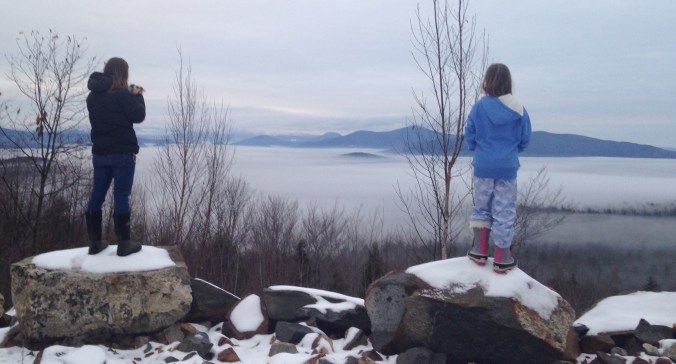
Yesterday, the girls and I took a short, unfamiliar hike in the White Mountains, switchbacking up an abandoned road. Below us, pine trees and mountains rose out of a sea of mist, and we never saw the valley floor. The girls were enchanted by this Lord of the Rings world. As we climbed higher, the view spread further, as if we peered down into an endless ocean with sacred islands rising majestically from its billows.

At the top, we found a blasted site where someone had once intended to build a house, and – likely through lack of money – abandoned that project and wandered off elsewhere. Fox prints tracked through the house now. The younger daughter remarked that the school bus wouldn’t come. She’d have to ski to school, she noted with real delight.

Stay honest whatever happens
says the bamboo bent under snow
over my window

– Buson

fullsizerender

Mt. Washington Valley, NH


End of One Road….

After a summer of chaos and bitter heartbreak, tears, the Vermont state police, too many times through the county courthouse’s metal detectors, I crashed my car yesterday. The impact came at slow speed, and when I got out of the car, I knew instantly I was uninjured. The woman in the car I hit also assured me she was fine.

I stood on the road, my vision caught for some reason at the sun shining in the canopy of an immense maple nearby. I stood staring upward for a moment, admiring the brilliant September afternoon. In every sense of the word, I had been driving blind, the inside windshield of my car smeared greasily, never tended to, and I had been crying. I hadn’t seen the woman who was at a standstill, until after I hit her. By sheer grace of luck, I had managed not to hurt this stranger, and then she spent three hours sitting in the grass with me, infinitely patient. This morning, an apple pie bakes in my oven as a meager gesture of my gratitude.

My publisher, Dede Cummings, describes herself as a glass-half-full woman, a feature I’ve tried to emulate. That afternoon, my glass foamed over. All the things I had held coiled so tightly within me – my daughters’ well-being, lack of childcare, too many demands for money and too little lucre – released from me when I stepped out of that crumpled car. Standing on the road, I felt strong, resilient as a birch sapling, and immensely calm, expansively alive as the nearby hayfield. Oddly, I had been returned to whom I was once, soles on the ground, my eyes sparkling and full of sunlight.

It had been a very long time since I had hoped for more than that my daughters and I accept and endure their father’s apparently unbreakable descent into a place where we cannot reach him. In that brief moment, I realized we would thrive, too, that our lives would unfold further in a vibrant tapestry, and the goodness of the world was, truly, yet at my hands, there for the taking. The world hadn’t turned its familiar back to me.

In my novel, the moon in all her various faces – crescent, gibbous, cloud-strewn – appears repeatedly as a talisman to my main character. Yesterday’s geometry of sunlight descending scattershot through leaves, dusty road beneath my clogs, and the  September afternoon with its darting dragonflies wound together as my own unbidden talisman.

I never accomplished what I intended that afternoon. That evening, the moon rose full, the hue of spring-grass-tinged cream. O, sweet lady moon, traversing her patient path across the heavens. We slept with the windows open to the night, moonbeams moving across our cheeks as we slept.

Come, see the true
flowers
of this pained world.

Bashō, On Love and Barley
fullsizerender

Woodbury, Vermont

On the Cusp

The raucousness of Vermont summer simmers down in September. The songbirds are long finished with their mating season, and our main company these days is the constant sizzle of crickets.

As if she sensed the quietness, too, my 11-year-old and I played cribbage after school, drinking lemonade with the kitchen windows wide open and eating tomatoes. My kid’s favorite snack these days are tomatoes, juicily ripe, still warm from the vine. Before bed tonight, she stood on the balcony, the curve of moon hidden in an apple tree.

Summer’s nearly shot all its splendor out. What’s growing in the garden has hit its threshold, except for some greens and the squash still fattening under the cover of its vines.

It’s a poignant time in many ways, with the days shortening rapidly, but the afternoons steamy enough to swim. I always consider September full of many things: back to schoolbooks but still digging in the dirt, the tempo winding down, the wild beauty of autumn’s song just around the bend.

Dry cheerful cricket
chirping, keeps
the autumn gay…
Contemptuous of frost

– Bashō

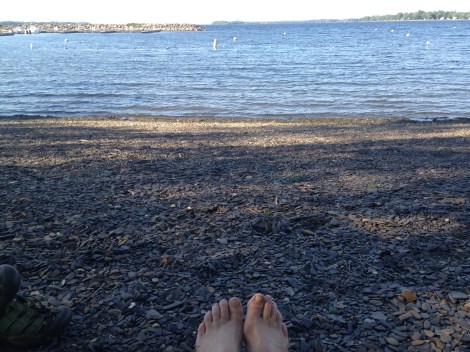
fullsizerender

Craftsbury Common, Vermont


Moon Rise

Camping these past few days on a island in Lake Champlain, the kids and I were biking back from the south end in the dusk when a crimson full moon appeared over the horizon, startlingly beautiful.

A 100 years ago, this mile-long island was farmed by tenant labor, sending out vegetables, dairy, wool. Now, those once-upon-a-time farm fields run rampart with goldenrod and stinging nettles. Sumac trees branch over paths for enchanting tunnels. The mighty lake, like so much of our world now, is polluted, but even so, the beauty of water and sky, singing cricket and chorusing frog, blue heron and turtle, is mesmerizing.

The next night, the children and I canoed into the dusk, and then walked out on a rocky jetty as dark filtered in. We perched there, watching the moon rise over the horizon. I’ve been reading Howard Axelrod’s The Point of Vanishing, a book about his two years in Vermont solitude, and I kept thinking of his line near the end: you are human. Not solitary, not a discrete entity, but part of the moving, changing landscape, in all its infinite beauty.

I wanted to see through all surfaces and to see through myself, but I wasn’t a transparent thing. I was bone, sinew, skin. If I lost depth perception when it came to life, if I removed every line so there was no difference between near and far, I’d never survive – maybe as a ghost or as a cipher but not as a human being.

IMG_2114.JPG

Burton Island, Vermont