The Footprint of Where You Live

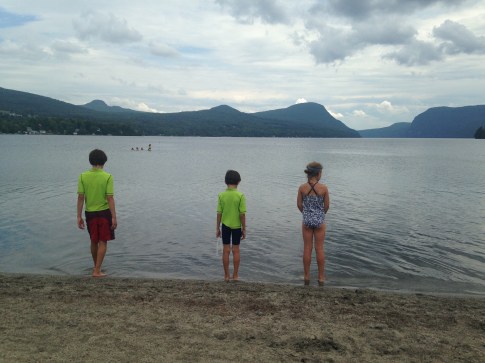
I live in a Vermont town which has very little pavement. Route 14 heads north-south right through the village’s tiny center. In the village, a small amount of pavement fronts the post office, volunteer fire station, and the currently-closed general store. The elementary school has a square in the dooryard, none in the playground or dirt parking lot. Our town is wood, field, and a great deal of water in lakes, ponds, running streams.

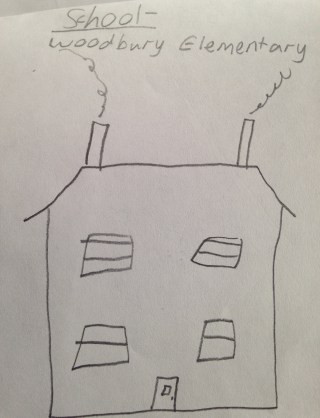
The schoolkids took a field trip to Barre, and I met them in the morning, standing beside their one school bus, in a sunny but cold morning, eating apples on cracked asphalt. I laughed.

If you’re a kid, does it matter that your school garden’s footprint is larger than your pavement’s print? Does it matter as adult that you have both winter boots and mud boots? That your horizon is framed by trees and not rooftops?

I tend to think, whether we notice or not, where the soles of our feet walk matters.

Instructions for living a life.
Pay attention.
Be astonished.
Tell about it.

– Mary Oliver

FullSizeRender.jpg

Burlington, Vermont

This Small, Good Moment

When I was 17, I was infatuated with James Joyce. I remember watching a documentary with a woman who knew Joyce and described the undercurrent of his life as filled with tristesse. I was learning French at the time and found that notion so romantic. What would that mean, to have tristesse in one’s life? Oh, naiveté.

As a young mother, I endeavored (oh, how hard I tried) to never let unhappiness or want cross my daughter’s life. I failed, of course, miserably and utterly predictably. Now, I’m at that place in my life where I know human life is filled with tristesse and also fear, longing, happiness, and laughter: an ever-changing sky boundless with wind and cloud, studded with arcs of rainbows, their roots eternally concealed.

Over and over, I have wondered what I could give my daughters instead, what arms might they raise against the inevitable slings and arrows of their earthly lives? At the very least, this: my own pleasure in this tangible world, in a handful of strawberries, a kite cartwheeling across the spring sky, a daughter’s haircut. In this moment, in this time together.


One of the things I know about writing is this: spend it all, shoot it, play it, lose it, all, right away, every time. Do not hoard what seems good for a later place in the book or for another book; give it, give it all, give it now. The impulse to save something good for a better place later is the signal to spend it now. Something more will arise for later, something better. These things fill from behind, from beneath, like well water. Similarly, the impulse to keep to yourself what you have learned is not only shameful, it is destructive. Anything you do not give freely and abundantly becomes lost to you. You open your safe and find ashes.

– Annie Dillard

FullSizeRender

A Need for a Nap

The other day, I sat beside a woman who was breastfeeding her baby, and I remembered just how physical were those early years, so much milk and baby holding, so much need and so much affection. Mothering growing girls remains remarkably physical, too.

Who ate all the strawberries? Braid this girl’s hair, race down to the mailbox, rule on which friend is now taller than me. Sweep dried mud from boots, bake chicken legs with sage scavenged from the garden, whisper good night.

No wonder mothering can be so exhausting. Like writing, parenthood is something we take in, our very bodies forever expanding with this dimension.

Only after the writer lets literature shape her can she perhaps shape literature. In working-class France, when an apprentice got hurt, or when he got tired, the experienced workers said, “It is the trade entering his body.” The art must enter the body too. A painter cannot use paint like glue or screws to fasten down the world. The tubes of paint are like fingers; they work only if, inside the painter, the neural pathways are wide and clear to the brain. Cell by cell, molecule by molecule, atom by atom, part of the brain changes physical shape to fit the paint.

– Annie Dillard


FullSizeRender.jpg

Hardwick, Vermont

When Traveling Through a Storm….

Here’s one good reason to read:

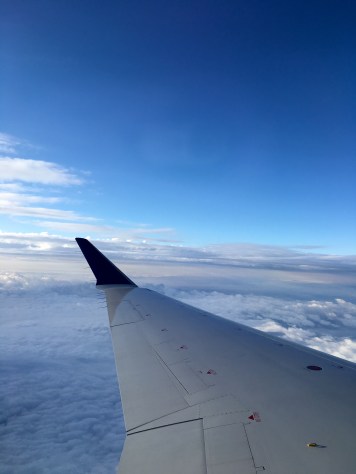
Captain Bligh, in his ill-fated, famous Mutiny on the Bounty story, sailed from dreary, oatmeal-eating England to Tahiti, lush land of coconuts and little clothing. He naturally headed across the Atlantic to curve around Cape Horn, situated way down at the bottom of South America. But the ship, plagued by fierce winter storms, was unable to navigate that Cape. Instead, after weeks of battling fierce weather and sailing backwards rather than making headway, Captain Bligh ordered a change in course around the Cape of Good Horn (at the southern-most tip of Africa), adding over 10,000 more miles to the Bounty‘s journey.

In the midst of the sleet, snow, and wind that eventually turned him back:

Bligh could note that blue petrels and pintados, “two beautiful kinds of bird,” followed their wake. – Caroline AlexanderThe Bounty

When to turn? When to change direction in a life?

Remember this: in the harshest, most ungodly conditions, note unexpected beauty, following your travels.

FullSizeRender

Hope Cemetery/Barre, Vermont

Travels Around the Globe & Through the Centuries

Late into last night and early this morning – two periods of darkness – I read Caroline Alexander’s The Bounty, the travels of Captain William Bligh and his misfortunes. She writes of the exquisite natural beauty of Tahiti, and about the chaos of Western men sailing on their rampage for vengeance, men sailing the seven seas, the seven deadly sins rioting through this story.

This evening, walking with my daughter in the early spring evening, the robins singing, I imagined how divine that virgin land must have been, with its contrasts of color and elevation, its welcoming inhabitants, the plethora of food. As a writer, I can’t help but admire the endless metaphorical possibilities….

Reading about the great strife and literal journeys of others deepens the geography of my own domestic Vermont life, reflecting my black sandy beaches. Greater misery of others doesn’t diminish the suffering of those in my world, but widens the landscape, per se, of what it means to be human.

… under cloudless skies and mild breezes…. the lush, dramatic peaks of Tahiti. Closer in, and the mountain cascades, the graceful palms, and the sparkling volcanic black beaches could be seen beyond thundering breakers and surf. The few ships that had anchored here had all attempted to describe the vision like beauty of the first sight of this island rising into view from the blue Pacific. Bligh had called Tahiti “the Paradise of the World.”

– Caroline Alexander, The Bounty: the True Story of the Mutiny on the Bounty

FullSizeRender.jpg

Woodbury, Vermont


A Starlit Night

Last night, my daughters and I walked the neighbor’s child home in the dark. We had been outside for a while, playing a variation of tag with flashlights and laughter, resulting in the older daughter slipping on ice and lying elbows-down in mud. With the flashlights off, we walked along the muddy road beneath the starlight. The night was balmy for mid-March, suffused with the scent of thawing earth: a rich odor so pervasive it was a constant companion. The moon, a white curve, shone a pure, yellow-white light.

On the way home, we saw our house through the bare hardwoods, the strings of little lights the girls nailed along the eaves twinkling. We passed just one house along our road where a single light shone; they must have been gone. It was just the girls and the star-and-moonlight and the mud and I. The peepers are not stirring yet, and none of the woodland creatures called. Beneath our boots, the earth shifted, softening, giving up its winter frost. My older daughter said, I could walk forever, on a night like this.

This morning, watching a single robin tugging at our lawn, I thought of my older daughter, and how, before long, this girl will be on her womanly journey, walking different patches of earth – in boots, or sandals, or heels – beneath this same exquisitely beautiful sky. I opened the window and listened for birdsong, relishing the season we’re in.

What a strange thing! to be alive beneath cherry blossoms.

– Issa

FullSizeRender

Vermont, Mach 2016