What’s Here

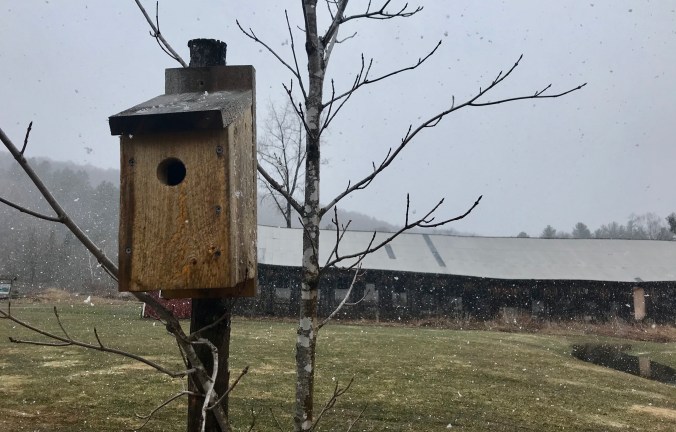
In a wet, raw snowfall, I lean against a maple tree behind the high school and talk on the phone. It’s mid-afternoon, and I don’t see a single person.

I’m clearing my head after a work conference with Skype. Skype, Zoom, google hangout — the whole thing — why bother? Vermont has completely shut down, as it appears most of the country and much of the world, too. During this hard time, much of this stuff just doesn’t matter, it seems to me, while other stuff does.

I’m worrying hard about what so many other people are — my job and income. How will my teenager survive isolation as a sole teenager in this house? But other worries — like what kind of parenting I’ve done — seem to have vanished utterly, as if knocked under an ocean wave.

My little family of my two daughters is tighter and closer than we’ve ever been, with both daughters stepping up immediately. We’re hardly alone in this. I hear from family after family, where family means something different now — deeper and richer.

It’s a strange world these days, where playgrounds are empty of children, and no one lingers in the post office, laughing and passing bits of news and gossip. We live in a world of masks and wary eyes now.

Nonetheless, in this upended world, there’s gems, sparkling and true.

I finish that phone call and lean against the tree trunk. The wet snow soaks my jeans and down jacket. I shiver for a while, and then eventually I head home. My daughter is baking a cake. Our deck of cards lies on the kitchen table.

Just around the corner,
there’s a rainbow in the sky,
So let’s have another cup of coffee,
and let’s have another piece of pie.

IMG_7497

Gifts

A friend leaves a dozen eggs and a stick on our back porch. She instructs my daughter to put that stick in water.

Doubtfully, my daughter sets the unassuming brown branch in a glass of water on our kitchen table. Really? she asks me.

I tell her it’s a twig from a Daphne bush she’s walked by countless times. When it blooms in that water, you’ll be amazed. I promise her this.

Here’s Adrienne Rich’s poetry for the soul, forwarded from my father.

I won’t tell you where the place is, the dark mesh of the woods
meeting the unmarked strip of light—
ghost-ridden crossroads, leafmold paradise:
I know already who wants to buy it, sell it, make it disappear.


IMG_7455

Travels into the Past

My daughter and I stop briefly in the New Hampshire town where I grew up, as part of a much longer day trip. Although Goffstown is three hours from where we live, my younger daughter had never been there. My parents have long ago moved back to New Mexico, my siblings spread out in their own adult lives.

The little village, where I haven’t been in years, is surprisingly unchanged. There’s some sprawl here and there, but not as much as I expected. A town ballfield has been converted to a cemetery, planted with saplings and marked, so far, with a single tombstone. Below that, the small pond where I learned to ice skate is still encroached by weeds and brambles, making for tricky skating but immensely interesting viewing for a child lying on the ice.

The snow has mostly melted here, and the earth is an amber-brown. Not a single shoot of spring green is visible yet. Walking around, I see the places that I loved: the gone-to-wild swathe behind our neighborhood houses — places a child could endlessly explore for years — the Ucancoonuc Mountains, the woods with huge glacial erratics surrounding the town. The library where I read out the children’s section and held my first job as a library page has been expanded. We walk through the library. Tom Wolfe famously wrote that you can’t ever go home. I can’t quibble with that wisdom, but walking through this library I loved so dearly, I step back into my childhood for a few minutes. Crammed with books, the library was both alive for me with the social chatter of the town but also ineffably fed my hungry imagination.

On this Wednesday morning, the library staff says hello and good morning to my daughter and me, and I feel, again, that same hum of life, endlessly unspooling, utterly fascinating. The shelves now stretch far up to the high ceilings, and this makes me so happy, to know the library is loved and funded.

Likewise, walking past my former house, I see a treehouse in the backyard and a tire swing from one of those enormous maples. Every summer, my father — and then his three children — painted the clapboards. Whoever lives there now does the same, I see.

I had expected to be sad, maybe nostalgic, about this town I never visit any longer. But walking around with my teenager, I see immediately that I’ve taken that town with me, that the child and teenager I was then carried that love of woods and wild, of imagination and dreaming, the same quirky family story and laughter with me.

At my parents’ former house, I see children play in that mixture of tended domesticity and the small patch of woods behind that old house. It doesn’t make me feel old; instead, I feel resilient. Driving, we listen to Coronavirus news, to the stock market careening, to the political uncertainty of this world. My daughter and I talk and talk and talk. Listening, I don’t second-guess myself, I don’t wonder what I’ve failed as a mother. I know, instead, I’ve given her a fertile, imaginative childhood, and I know it’s hers, to decide her own course, too.

IMG_7305

Little & Big Worlds

On an incredibly warm afternoon, a little girl discovers a pencil-thin garter snake curled up in the gravel alongside the library. Snow lies ubiquitous on the playground, but the earth there has emerged from its winter hibernation: a green iris shoot, dark mud. I love snakes, the girl says dreamily.

VPR carries news of the stock market’s plunge, of quarantine, of illness. All these factors, in one way or another, may eventually — later? sooner? — reach this little girl. For now, she stands in the snow in her boots and a t-shirt, staring at the creature. Under her arm is tucked a grownup natural history guide, a book she’s checked out of the library.

Later, after a nearly six-hour-long school board meeting filled with simply stuff, we lean back in chairs. It’s nearly midnight. There’s still snacks on the table. I’ve long finished my tea. Head home? I put my forehead on the school library’s table, its wood hard beneath my bone. Eventually, I gather my papers. Outside, the air is balmy. I breathe.

IMG_7285

Put a Fork in Winter

On a sunny and breezy Friday afternoon, the Transfer Station Guys assure me the back of winter is broke. Their weatherman — who’s never wrong — told snowmobilers and skiers to put a fork in winter. It’s about done in.

I’m on my way from here to there, later changing out of the mud boots I’d worn to the dump, switching to shoes on a sidewalk. A log truck driver, seeing me in sock feet, raises one hand in a thumbs up.

Later, picking up my daughter around five at the high school, the grownups stand around chatting while the kids scale the enormous, dirt-blackened snowbanks flanking the parking lot.

Redwing blackbirds are singing: oh, sweet harbingers of spring.

IMG_7275

Visitor, An Ask

On a sleety day in rural Woodbury, the bright spot in my afternoon is the woman who walks to the library — a mile or so on slushy backroads because she and her partner have no vehicle. The truck died.

She checks out books, we talk about men and raising kids, the cost of living in Vermont. I’ve been working in rural libraries and schools long enough now that I quickly know who’s hard up versus who’s driving that old Subaru because an old Subaru might make them look a little less affluent. In the sogginess of March, my library visitor is sharp and funny, with an amusing eye for details. Sitting there, in the warm library, after a few hours of relative quiet to catch up on work, I winch, thinking of how carless-ness, unemployment, and rural Vermont can crowd up against a person.

When I leave, I drive her down the road to Hardwick, the two of us, talking, talking. It’s after 5, and while dusk isn’t far off, the day still holds light. She’s pragmatic about her chances for a ride back up the road. I never know. Then, just before she gets out, she asks for two dollars, for him, the boyfriend.

… understanding, and action proceeding from understanding and guided by it, is the one weapon against the world’s bombardment, the one medicine, the one instrument by which liberty, health, and joy may be shaped or shaped towards, in the individual, and in the race.

James Agee

IMG_1309