Small Journey

My younger daughter drives the two of us on a cold January afternoon to Montpelier. I can’t remember the last time I’ve been to the state capital, although (pre-pandemic) I was in Montpelier at least once a week.

We’re in search of a birthday present for my oldest daughter — a single present, that’s all I’m looking for — and we go into only one store. At the register, the owner tells me how happy she is to see people; the city has been a ghost town for the last week.

In the downtown’s heart, we pass empty storefronts. I’ve never seen so many vacancies in Montpelier before. On one main corner, my daughter notices the bakery where I once bought her chocolate chip cookies is locked, too.

Where I can’t bear to pass by is the library, the beautiful stone building where a year ago I often spread out my laptop and papers and worked for hours. In the large reading room, the well-heeled snapped on lamps and read and wrote. There was a couple who always appeared who seemed to be gambling online. The homeless and college students filled chairs. After school, children ran through.

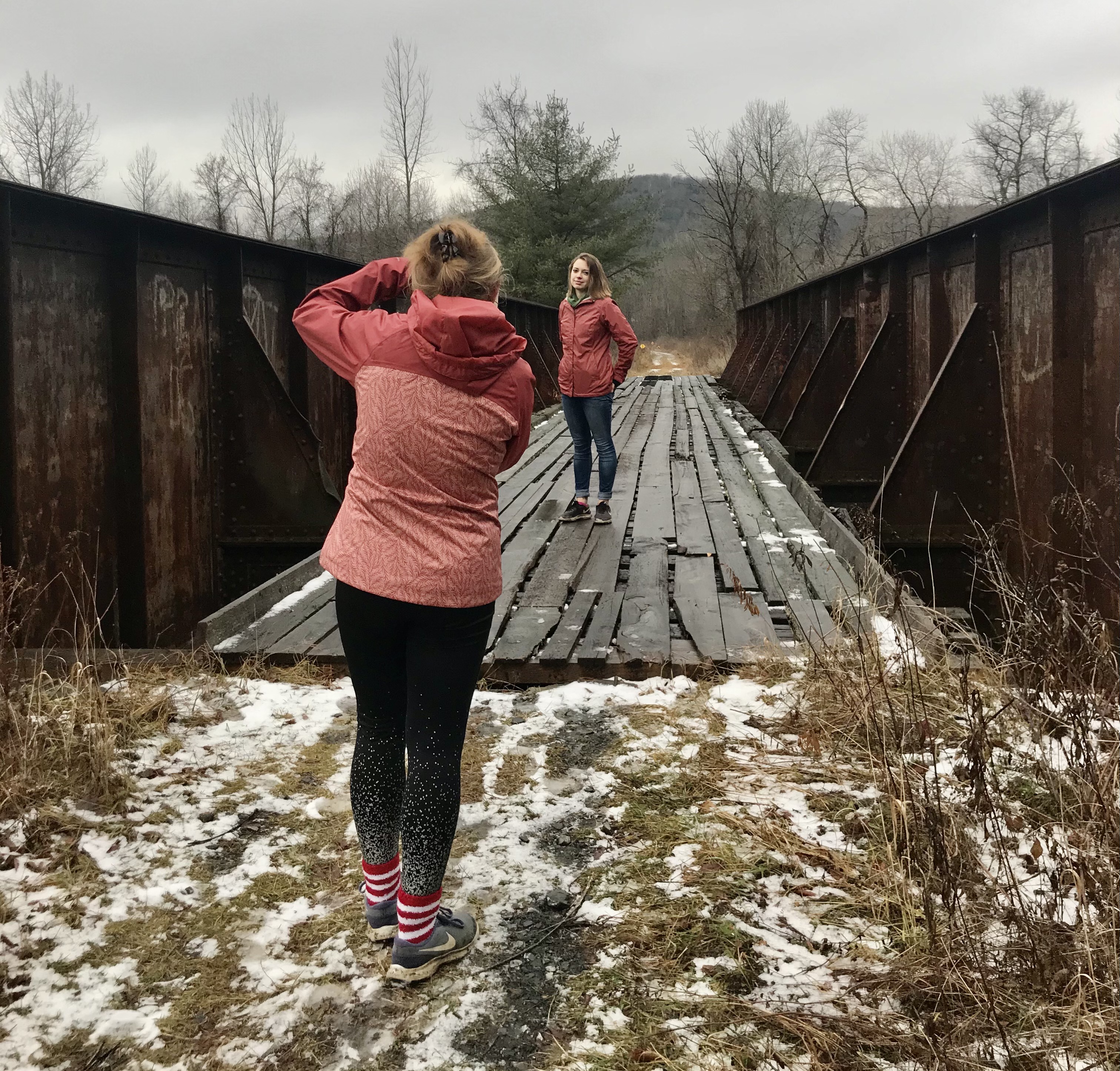
At my daughter’s request, we walk through Hubbard Park in the cold and up the stone tower to see the city surrounded by mountains.

When we walk down the snowy steps, a mother and her daughter are sitting on the tower’s stone floor. There’s only openings for windows and doors, and the girl is crying with cold. The mother struggles to tie an icy lace on the girl’s ski boot.

Been there, I think, done that.

I no longer have the keys to my own car. My daughter drives past the state house where no one is out. Not a single person on the granite steps. Driving home, she suddenly says, The good thing about living in Vermont is spring. Even if winter seems forever, there’s always spring.

[Kintsugi], the Japanese method of repairing broken pottery [uses] gold to bind the pieces together. In this way, the break becomes what is beautiful, what is valued. It is a way to embrace the flaw, the imperfect. In place of the break, there is now a vein of gold.

— Nick Flynn, This is the Night Our House Will Catch Fire

Photo by Gabriela S.

Strange Bed

The forecast for this Vermont Christmas is 100% rain, which pretty much sums up the year 2020.

From work, I take home a donated cat bed, lined with a downy fuzz and nearly new. When I set it on our living room floor, our cats approach with caution, sniffing, and then begin growling, doubtlessly sensing some former occupant.

A dog? Or simply some stranger?

All evening, our pampered house cats pace around the bed, suspicious. But, in the morning, I see our tabby Acer curled up in the bed’s center, sleeping, paws over shut eyes, tail tucked beneath his chin.

And so it: 2020 and on into 2021. Wherever each of you are, dear readers, I hope you take some comfort in this strange bed of where we are, as our planet slowly turns back toward the light, again.

Cutting with the ax,
I was surprised at the scent.
The winter trees.

— Buson

Hardwick, Vermont

Small Joys

Friday afternoon, I knock off work early and stack wood with my youngest.

She’s a far better wood stacker than I am, precise in her ends, creating long tight rows on our porch. About the only thing I have going for me is endurance; I’m determined to stack it all, on this fine sunny day — that endurance, and my utter pleasure to be working outdoors, breathing the sweet smell of sap.

She rakes the piles of bark and the slivers we’ll use for kindling, as we talk about little things, nothing much. Later, she swims with a few friends, the three happy. Seeing her happiness fills me with joy.

On the cusp of school reopening, uncertainty is palpable. Will school open for a week? A month? What kind of crazy plan is this? Like most parents, I’m wondering what’s the way forward? What’s the way to feed her desire for learning and friends — in a pandemic? Who knows?

When I set the rake back in the barn, I find our hatchet. Its head is dull and loosened, in need of repair. Years ago, ax repair would have been my husband’s purview. I hold its hardwood handle. Okay, I think. Find a different solution.

The neighbor’s cat sprawls on our woodpile, gray belly up to the sun, purring.

The cool breeze.
With all his strength
The cricket.

— Issa

IMG_8167.jpg

Photo by Gabriela S.

Wilderness

On a humid Sunday, we walk into Peacham Bog. When I suggest this, my youngest clarifies, A bog? That’s your idea of fun?

It’s Class I wetlands, I answer — as if this is even the remotest tease of fun.

What does lure her is the car keys. Driving there, I mention, Hey, you should always check the gas gauge before you leave home.

What’s the point? she answers. I always drive with you.

We’re driving over a particularly lousy piece of pavement then, and she carefully avoids a pothole — diligent learner.

I answer, But you won’t always drive with me. Isn’t this the whole point here? Because before long you’ll be driving on your own?

She takes that in — thinking over what’s obvious but of course isn’t — that she won’t be a child forever, that even as we’re talking she’s hurtling toward adulthood — a glacial pace for her, a rocket pace for me.

All that hike into the bog and back — exquisitely beautiful, bordering ethereal with its wildness — she carries those keys in her backpack. I can imagine she’s thinking, and I won’t be driving to any flipping Class I wetlands, but she humors me.

But I did not want to go,
not yet, nor knew what to do
if I should stay, for how

in that great darkness could I explain
anything, anything at all.

— Hayden Carruth, The Cows at Night

IMG_8669

Photo by Molly S.

Where We Are

On a gorgeous Friday afternoon, my 15-year-old and I are outside the Vermont Department of Libraries, to pick up a sneeze guard and hand sanitizer for my library. The building’s locked (of course), but we’re allowed into the vestibule of this beautiful building that once was the town’s high school.

The Department’s employee who helps us is like all the state library’s employees — utterly helpful — and a bag of children’s books has been included, too, to add to my library collection or give away. I imagine on the employee job application is a box — Are you a decent person?

There’s been some snafus in the pickup, and I’ve been texting the woman who arranged for these free drop-offs around the state. By then, my daughter and I are at our next errand. She’s in the driver’s seat, and we’re in the parking lot of a wood stove store.

The woman apologies for the confusion, and I text back not to worry. She writes that elevator problems were not in the plan. Then, laughing, I text that 2020 and Covid were doubtlessly not in her plans, either.

Haha, she writes back, nor were distributing sneeze guards and hand sanitizer in my career plans, either.

While I’m laughing and texting, my daughter has cracked open one of the half-gallon bottles of sanitizer and says, Hey, this is the good stuff!

The July day is stunning beautiful — not too hot, but the perfect day for swimming. There’s plenty of good things I’m happy about this day: I’m employed. I’m (nearly) finished with another draft of my book and about to hand that in. My 15-year-old is ecstatic to have the car keys in her hand.

Here’s what’s also happening.

I’m in this parking lot because I’m looking to solve a chimney problem in my house and heat again with wood. In the early mornings, reading the news, like so many other people, I worry about the country descending into chaos. My 21-year-old reads the same news and asks me what it means. What’s happening?

Like everyone else, I don’t know. I’ve never lived through times like these. But I do know human history is filled with times of uncertainty and movement and hardship. I’m doing everything I can to get us through the winter, as best as possible.

Part of getting through the winter is loving these summer days now, knitting deeper the ties around me — and that includes these bits of texting with a woman I haven’t yet met. The levity doesn’t diminish what’s happening, but collectively lightens the load. My daughter, rubbing that great sanitizer into her palms, asks if I’m going to laugh and text all afternoon. I might.

You’re rocking the distribution of plexiglass, I write.

She answers me, Thank you!

Then I put on my mask and head into the store.

IMG_8066


Spectator

At a baseball game at the high school, my friends and I talk about the shape of the evening clouds. The high school has a view of Buffalo Mountain. Behind it, the sun goes down.

I’m late to the game, finishing a book I’m reviewing and answering a handful of emails. When I arrive, I stand back for a bit, watching my younger daughter and her friends who are sitting by the side, apart but not that much apart, their hair piled on their heads, talking and laughing. There’s nothing new here — talking is the lifeblood of teen girls — but that world seems so rare in our world these days. — Go be a kid, swap stories, figure out your place in the world — the pulse of adolescence.

As the sun lowers and I keep talking with my friends, I keep glancing at these girls, their eyes full of sparks and joy, for this evening, these hours, this very moment.

Like wars and depressions, a pandemic offers an X-ray of society, allowing us to see all the broken places. It was possible Americans would do noting about the fissures exposed by the pandemic: the racial inequalities, the poisonous partisanship, the governmental incompetence, the disrespect for science, the loss of standing among nations, the fraying of community bonds. Then again, when people confront their failures, they have the opportunity to mend them.

— Lawrence Wright, “Crossroads”

IMG_8059