Onset of Pre-Cabin Fever.

I shake stunningly beautiful snow from my mittens onto my cats. Mid-January. Winter’s loveliness has just arrived. My house is again the three of us, two fluent in Cat and one marginally fluent in Human. The one who speaks Human gets the deciding vote, so we get up very early. The Cat speakers are wholly in favor of this, as the wood fire is fed and the cat kibble rationed into bowls. Eventually, the dawn finds us, and the rest of the world creeps in.

If this keeps us, the prognosis is mad-as-a-hatter by Honest Abe’s birthday. No fear of that. Any hermiting is constrained around here. Two small excerpts from my novel are accepted by journals. The cats and I nestle into our narrative. I let them lick butter from my fingers. Snow silently fluffs around us, concealing the stars, the sunflower stalks, the ash bucket I left by the step.

A little chaos…

I call the mechanic back about my car who says it’s all good news, a replaced muffler, and the car looks fine.

Finally. Something repaired in the chain of a dying range, a done-in washing machine, my own washed-out and piss-poor attitude.

In one of the few sunny days I’ve seen recently, I’m standing on my back porch, listening to water dripping. We talk a little about the shitstorm of this decade so far, the election roaring up in nearby New Hampshire. He mentions he doesn’t know my political leanings, and I laugh. I’ve been writing him checks for years now, and I’m certain it’s no surprise who I didn’t vote for. But he bends our conversation a little further, kicking the standard gloom-and-doom away and remarks that we might as salvage some happiness in this life.

On this rainy midwinter day, I convince my youngest to drive north to a library in search of a Claire Dederer book. Here’s a few lines from the last chapter of Monsters.

Love is anarchy. Love is chaos. We don’t love the deserving; we love flawed and imperfect human beings, in an emotional logic that belongs to an entirely different weather system than the chilly climate of reason….

Music = flowers = courage.

Nearly a decade ago, my then-husband and I attended an improv poetry reading and concert in a church in Cabot, Vermont — an afternoon I later remembered as the last good thing we did together as a couple. Later that afternoon, news arrived of illness in our family. Although there was no way I could have predicted it at the time, the stress of disease further fractured our fragile marriage.

This weekend, I returned to that church with its high-ceilinged rough beams and unadorned crucifix for a performance with native flutes and storytelling as part of the town’s Twelfth Night celebration. Before the performance, the storyteller remarked about a flute, tens of thousands of years old, made from the rib of a cave bear. Flute music, like the drum which mirrors our mothers’ heartbeats, is bound into our DNA. With a rattle of shells, he began with the Chippewa’s creation story of the flute and expanded into a meditation about music as auditory flowers. Not Hallmark’s pastels: flowers are the rugged beauty that propagate our world. The music poured my heart full with courage.

Outside, a light snow sprinkled. Somewhere in the pandemic, my youngest played spring soccer in this town. In that time, no one was carpooling, and so I always drove. While she played, I walked along the river, early enough in spring that the peepers were singing but the black flies hadn’t hatched.

I had left my hat on the pew. When I walked back in, I met the poet’s wife. The poet, who was once so kind to me, has passed on now. His wife and I spoke for a few minutes, and then I went out, hat in my hand, snowflakes falling into my hair.

“… the need is now for a gentler, a more tolerant people than those who won for us against the ice, the tiger and the bear. The hand that hefted the ax, out of some old blind allegiance to the past fondles the machine gun as lovingly. It is a habit man will have to break to survive, but the roots go very deep.”

— Loren Eiseley

What we can’t know.

The cold hammers down around us in the way we’ve known Januarys before — nothing fierce, but sharp. January is a season that draws us up against our own mortality. Stumble and you’ll break a bone. Sleep outside, ill-prepared, seriously down on your luck, and you could perish.

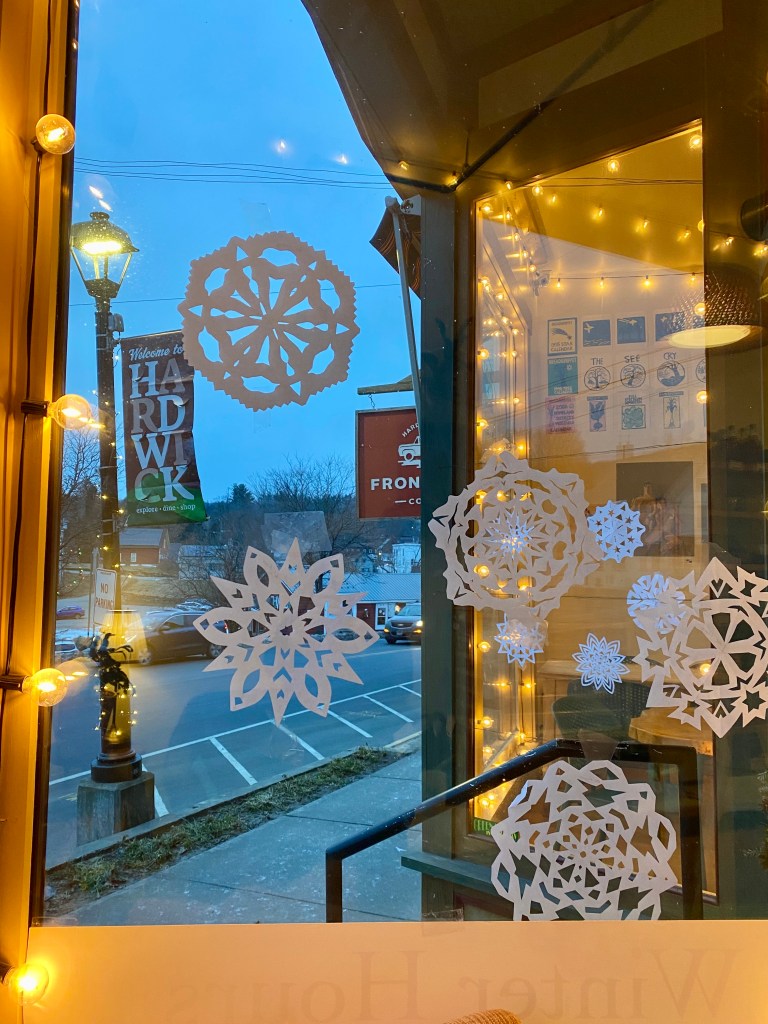
Wednesday morning on the early side, I’m drinking coffee and staring at the snowflakes that have appeared in the downtown again, a memory for an absent person. News has wound my way of the death of a person distant from me by numerous steps, the fate we’ll all meet, one way or another, the great leveler. In the afternoon, when I return from work, the window washers are carefully removing the lacy paper, setting the delicate flakes to one side, and then re-taping them on the windows. A gentle, wordless act of care. A piece of our human puzzle.

These winter days, I’m devouring Paul Lynch, about as good as anything can be.

“I believe it is worth writing to remind ourselves of what we can’t know. To remind ourselves that certainty is dangerous. That factual knowledge of the world casts only a small light. Fiction is necessary because it seems to me that only fiction can accommodate the total strangeness that is life. To remind us that truth is actually impossible.”

Household chores and world events.

The last day of 2023, I let the fire in my wood stove extinguish, and I take my stove apart. The stove has been spitting ash and spark through a damper, a chore I’m driven to by sheer necessity.

I unscrew the stovepipe and the back heat shield and plate, and carefully remove the two honeycomb metal filters that are choked with fine ash. It’s a messy job, and I’m a messy woman. My curious cat walks through the cinders and leaves dirty paw prints on my white enamel kitchen sink.

When I’ve put the stove together again, I find the driest kindling I can in my barn and build a small fire and slowly heat the stove again, kneeling before the glass where the flames ripple, listening to public radio hash over the year. I add wood, study the flames, murmur to my cat who is seriously invested in this warmth and the doubtless impending feline nap.

I’d once torn a photograph from a New Yorker issue and thumbtacked it near my desk of Marina Oswald, taken the morning after her husband Lee Harvey Oswald was arrested for assassinating President Kennedy. Her face twisted unhappily, she’s pinning cloth diapers on a line. So it goes: the necessity of domestic life as the great events of the world unfold.

My stove burns merrily. I bake spanakopita and invite a few dear ones who bring chocolate. This morning, January. A drift of snowflakes. The lean winter light.

The snow is melting
and the village is flooded
with children.

— Issa

Last Moments.

4 a.m., I’m drinking espresso on a balcony in Rome. Our tickets home have been cancelled. (Hello, strikers.) After a scramble, I’m hoping my patch-up fix will hold.

The morning is cool with a promise of sultry heat. Birds serenade in treetops and fly among ruins from an ancient world.

At the metro, my daughter and I are separated on opposite sides of a turnstile. I throw her my wallet over the gate. Her ticket won’t work, nor the second. A man appears, opens the gate on my end, and speaks to me in Italian. My daughter hurries through. I say thank you, thank you, thank you, to the stranger disappearing into the crowd.