Your own darkness.

An old friend from years ago sends me a message. She’s persistent, wearing down through my imposed or self-imposed hermitage, whatever this thing is I’m doing, and I drive myself out on muddy roads. She has such a lovely little girl, I’m smitten immediately. I sit down on the floor and chat up the child, and eventually remember my good friend and how much I enjoy her world. She’s funny, with boundless good will and cleverness, in a life that’s had her share of lemons.

End of March, nearly Easter, my perennials spike up further every day. How the earth desires green. I’m far enough along now in my own life that I know the cupboard of my mortal life will always hold certain grooves and scars, its beaten shape, the way the material in my life has shaped me. Aren’t we all that way, though? Maybe this is why spring is the dearest of seasons, that from mud and ice emerge tender shoots, the improbable made manifest every year.

Beginning

The moon drops one or two feathers into the field.   
The dark wheat listens.
Be still.
Now.
There they are, the moon’s young, trying
Their wings.
Between trees, a slender woman lifts up the lovely shadow
Of her face, and now she steps into the air, now she is gone
Wholly, into the air.
I stand alone by an elder tree, I do not dare breathe
Or move.
I listen.
The wheat leans back toward its own darkness,
And I lean toward mine.

— James Wright

Necessary Birdsongs.

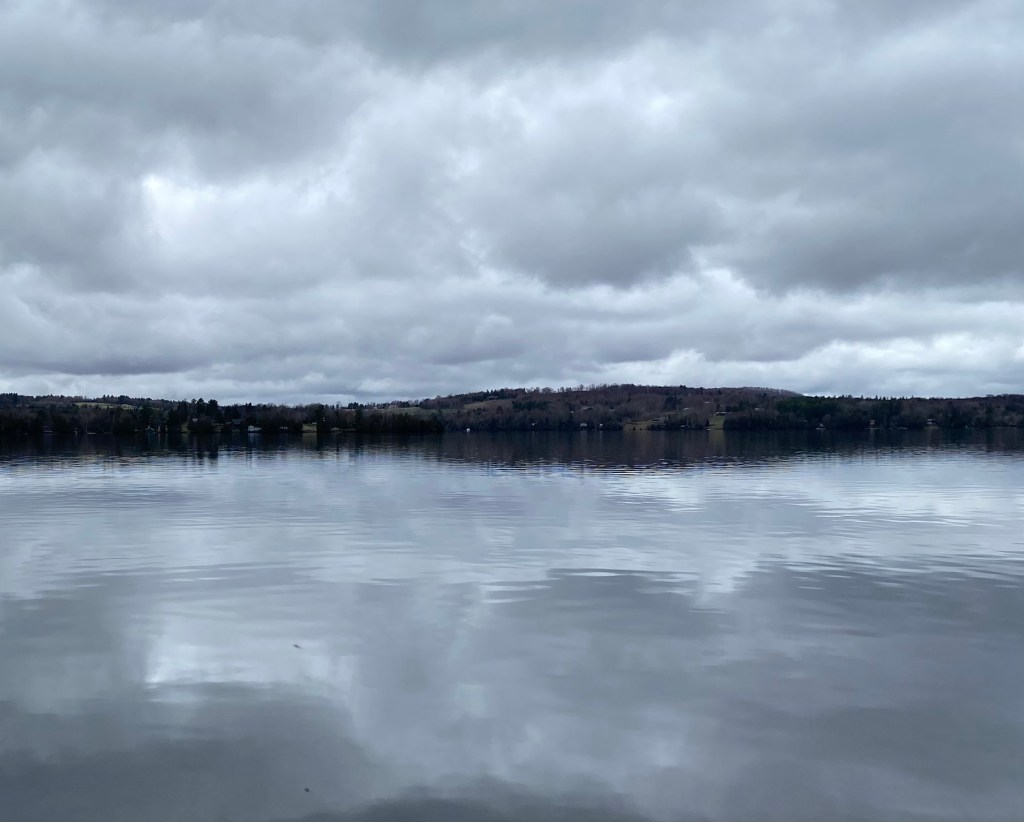
Lake Champlain

Mid-March, the unlovely muddy Vermont: I bend beneath the snarled rose bushes, seeking green nubs pushing through the wet earth. By June, this world will be verdant, lush, those old roses a tangle of green, tiny blossoms each a delicate bouquet of pale pink. These roses, planted by someone doubtlessly long passed over into the other world, ruggedly fence my house, their flowers such a dear sweet fragrance.

In this brown world, I wander to the places where, in springs past, I’ve heard the early songs of redwing blackbirds. Yesterday, I hear these birds, not the full chorus yet, but the warm-up crew. We are well before the yard clean-up and gardening season. The town roads are rutted, hard to travel, and the summer folks have not yet returned. Hidden in this clump of cedars, the blackbirds steadily, without any fuss, go about their blackbird lives. Not so many weeks away, marsh marigolds will blanket these wetlands — dazzling yellow, killer green — but for now, the dun palette of silvery cedar, umber earth, the birdsong melodies yanking us along to spring.

Vermont’s fifth season: mud.

I carry my laptop out the backdoor of Hardwick’s coffee shop. A couple I know pulls up on their fat tire bikes and rave about the biking. There’s an adage in Vermont that the state’s fifth season is mud season. The first week of March is way early for the back roads to break up. Most towns post their roads around March 15, prohibiting heavy trucks, like log or delivery trucks, from destroying already soft roads. Now, towns have already posted these warnings, ribboned with orange survey tape, a sure sign that winter is on the wane.

I meet a friend at a former golf course now owned by the city of Montpelier where people let their dogs run. The course is last year’s brown grass, but when I squint I can see emerging green beginning shimmer, pushing back the dull amber. How much the world leans into living.

My oldest daughter calls from New Mexico, on her journey to visit the grandparents. Through our phones, her face glows with desert light. I think of her driving around Santa Fe, this old adobe city and the stunning landscape an infinitely complex story that stretches so far back. Within that human history, my own family story lodges in with its numerous plot points. Ah, family… never a straight line.

T. S. Eliot wrote of that April is the cruellest month, breeding/Lilacs out of the dead land, mixing/Memory and desire, stirring/Dull roots with spring rain. Winter kept us warm… Mud season may be the least loved. But in my mind, it’s the sweetest. Sap runs. The softening ground sucks our boots into its stickiness. Tender green unfurls, strengthens. We move, onward.

‘Soon it will be the sky of early spring…’

Wild February!

At noon, I stand talking to the road crew in a sparkling snowfall. I wax on about the prettiness of snow on the emerging earth. The crew, who’s endured the strange vagaries of mud season in December, the fickleness of Vermont’s winter weather made weirder by climate change, humor me with a nod.

Fifty degrees and rain forecasted for today, followed by more, followed by bitter cold, then rain and wind, the sun I lean towards…. Late winter, again, and I remember when I could distinguish the years: the spring we boiled sap from March 1 to the 31st. The year we made 540 hard-earned gallons, two of us and a five-year-old, and I wore through three pairs of gloves carrying in wood and feeding the arch.

Walking around my snow-scattered garden, I envision where I will plant the bare root Japanese lilac I’ve ordered, for me or someone else to admire and love. The path down to my compost is both icy and soft mud, the conundrum of winter reluctantly losing its teeth to spring. The true joy is the inevitability, the earth’s order to proceed from twinkling snowflake to downy crocus, the planet’s sheer opinionlessness regarding skunks and black flies.

The road crew and I kick around a few more pithy remarks about government corruption, and then we head along….

From my one of my favorite Louise Glück poems, March:

The sea doesn’t change as the earth changes;
it doesn’t lie.
You ask the sea, what can you promise me
and it speaks the truth; it says erasure.

Finally the dog goes in.
We watch the crescent moon,
very faint at first, then clearer and clearer
as the night grows dark.
Soon it will be the sky of early spring, stretching above the stubborn ferns and
violets.

Don’t let your cow get the upper hand, er, hoof…?

Ah, February, the month with the strange “U” that children stumble to spell. Two inches of a sugar snow this morning when I carried out the stove’s ashes, the cardinals whistling the day alive, a buttery full moon charming the evening sky. For the past few weeks, my life has overflowed with the challenges of faraway aging parents, with details mundane and immense, and all very very real. There’s that Tolstoy saying about families unhappy in their own way. Carrying in firewood, I remind myself: families endure the unspeakable in their own particular vernacular, swaddled in the way of all human life.

Sugaring season is hustling into Vermont now. The years I spent sugaring with a husband and two young daughters taught me to strip away the unnecessary, to bend into work when bending is required. It’s a habit I’ve carried to writing, and I’ve managed now to write three books against odds that even now seem not in my favor. But it was single parenting that honed my skills to grasp the nourishing in times of hardness, suck hard the marrow of the real. In a conversation with a young homesteader and poet today, she offers me a line of wisdom so pithy and wise I laugh out loud: Don’t let your milk cow get the upper hand on you. Yeah, think that one over.

Here’s a David Goodman interview with Elizabeth Price, mother of the young Palestinian man Hisham Awartani who was shot with two friends in Burlington, Vermont, last November. The family epitomizes courage, knowledge, and depth of heart — highly recommended.

Cats, Coyotes.

The return trip from my parents’ house in New Mexico to my own Hardwick, Vermont, house was 20 hours. When I stepped off the plane, I was effusively grateful to see my daughters waiting to drive me home, to wrap me again in our own particular kind of family — loving and funny, with the fierce rivers of stories that run between us.

A friend texts me and sweetly offers to make me a meal; these days, about all I’ve done is trudge into work, then lie on couch with my cats, reading Michael Crummy and soaking in Jon Stewart’s election update. When my daughters were babies, I lived in a rarefied kind of atmosphere, of warm milk and scant sleep and intense curiosity: what now? what next? As if bookended, my parents in very old age live in a unique world, too, suffused with New Mexican sunlight, and with a similar uncertainty: what next?

In that middle-of-the-night drive to Albuquerque, circling through the airport parking lot, I spied a coyote. I pulled over, opened the car door, and looked back. Under the amber streetlights, the coyote hurried along, brushy tail bouncing, not so much as glancing over its shoulder at me. Around us, so much cement, then the desert, undulating, spreading up into the hills, disappearing from sight.

The wild creature vanished into the dark.

“A body must bear what can’t be helped.”

— Michael Crummy