Bookselling & Stories

December is the best month to be a bookseller, because it’s the month when people give stories to one another. All day, folks stamp in from the cold and ask for a book for their ancient aunt who enjoys knitting and local history, or a baby not yet born who has a whole world yet to love. My favorite today was the young uncle who bought Roald Dahl for overseas nephews, but went home to reread James and the Giant Peach before mailing the novel.

Today, with the ground finally covered in our familiar snow, the light returned in the solstice kind of way we New Englanders know and love. This evening, a half moon glows on our piece of the earth, the clouds scudding back and forth over its pristine illumination.

Like this light, stories came in all day at the bookstore, not simply flowing out in wrapping paper and bags. We heard stories of the babies on their way, of the old who were babies themselves in this town; one, two, three stories that made me want to weep, the story of a woman buying an auto repair business in the Northeast Kingdom, and many more simply funny and joyous. Taken together, this was a bouquet of stories, all across the human realm. Fitting in a place for literature.

You can speak as though your life is a thread, a narrative unspooling in time, and a story is a thread, but each of us is an island from which countless threads extend out into the world.

— Rebecca Solnit, The Faraway Nearby

IMG_4067

Photo by Molly S.

Stories

Driving the kids home from basketball practice tonight, I listened to their discussion about the beginning of humankind. Did people come from monkeys or from God? My daughter eventually brought up the Big Bang. That must have been the beginning, but how did the Big Bang fit into God and the monkeys?

Eventually, I suggested maybe all these ideas might be true. The kids’ answer was to ask for more snacks.

I kept thinking about that idea of how we tell stories of ourselves. And where does one story begin and another end? I’d just been with a group of teachers asking, Tell me the story of what is it you do. I listened for the hard bones, the unseen, that jointed their stories together.

Long ago, I believed stories remained in books, interesting but tepid things. Now I know story is the absolute heart of who we are, at times suffused with finesse and grace, at others – as in Baltimore – swollen with the tangles of history and present outrage.

There’s a phrase we use in our house: an ax can be both tool and weapon. Story, too, can be utilized as either, but further, I’d say, as tool, weapon, and journey.

We tell ourselves stories in order to live, or to justify taking lives, even our own, by violence or by numbness and the failure to live; tell ourselves stories that save us and stories that are the quicksand in which we thrash and the well in which we drown, stories of justification, of accursedness, of luck and star-crossed love, or versions clad in the cynicism that is at times a very elegant garment.

— Rebecca Solnit, The Faraway Nearby

FullSizeRender-2

Photo by Molly S.


Autumn Dusk

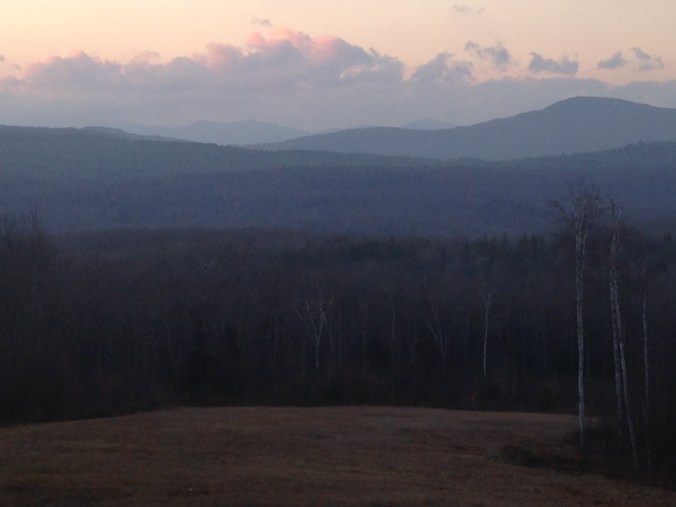
With no snow, our late autumn Vermont appears like coals burned out, none of our summer’s radiance, our snowy luminosity. This afternoon, not yet four, with the light already leaking away, I lay down in my daughter’s forest lair, dead logs propped up against an enormous white pine. While she wandered away, busily scavenging planks for a footbridge over a culvert with a running stream, I lay back on the pine needles and closed my eyes.

The afternoon was extraordinarily still, with not even a stir of wind, a chatter of chipmunk. I smelled mud, that thick, humusy scent of forest floor opened up. Still waiting, I opened my eyes and, through a part in the branches overhead, saw three crows traveling across the gray, cloudy sky, their wings steadily flapping, quite possibly not at all disturbed by the night falling down and the dearth of glow. And that, perhaps, might be the flight of autumn across our sliver of the world.

A lone crow
sits on a dead branch
this autumn eve

— Basho

IMG_0420


Singing in the Dark

This time of year, the darkness knits around us. Waking early, I’m awake for hours working into the light. Very early evening, I returned with the children in the full dark, the stars overhead distantly radiant in the pitch firmament. The shortest day of the year is now so near, I can feel the arc of our universe nearly rounding the bend, gradually slingshotting us back toward light.

This is my one life. Say you know.
Say this means many things, say snowy owl,
say three feet of snow, say kestrel. My one
life is here at the table, next to me. Say you know,
say fine night for soup, glad to have you,
how was your drive….  Say here,
One Life, settle in with us. Here is the fire.
Say here is a warm stone. Say sing.

Say Sing, Kerrin McCadden


IMG_0430

Plot, or Opening Doors

My ten-year-old daughter told me she was in the school’s elevator the other afternoon and couldn’t remember whether she was supposed to press L for Lobby or 1 for the first floor. While the elementary school is micro-small, the schoolhouse was built over a 100 years ago, with the gymnasium and kitchen on the second floor. A number of years ago, the town opted to put in an elevator for public access, and, hence, my child with her buckets of compost in the elevator. The door opened… and she found herself looking at the first-and-second grade class.

She said, Ooops! and explained her predicament, before swinging the door shut and continuing on her school chore way. The teacher told her, Well, it’s nice to see you.

What a lovely surprise my daughter must have been behind those doors, a bashful smiling girl. Working out the plot of this second novel is like opening doors in my characters’ lives: what now? Too many times in our lives, the opened door isn’t necessarily a smiling girl with a bucket of lunch compost. I’ve often thought, What fresh new hell is meeting me now? But in fiction (as, I suppose, in life), opening a door means the unspooling of a new thread of story, and I try to remind myself, Greet that opened door with some moxie of optimism.

The things we want are transformative, and we don’t know or only think we know what is on the other side of that transformation. Love, wisdom, grace, inspiration — how do you go about finding these things that are in some ways about extending the boundaries of the self into unknown territory, about becoming someone else?

–– Rebecca Solnit

FullSizeRender

Hardwick, Vermont/Photo by Molly S.

Unraveling and Knitting

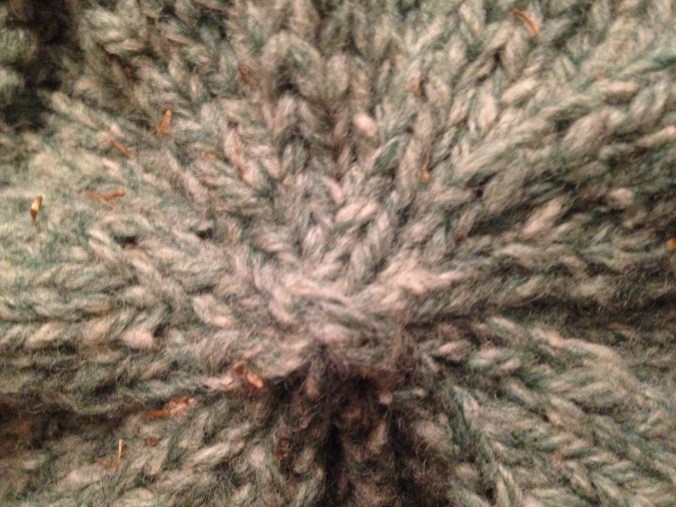
This cold, dank and inimitably dark season is also the yarn season. Unlike living, any knitting project can be unraveled and reknit. Late last night, knitting while reading my bell hooks library book propped open with my bare toes, I realized the needles and yarn I had mated didn’t fit. Still reading, I  unwound the hat and rolled up the yarn. This evening, I chose a smaller needle size, and this hat I’m knitting for a friend’s Christmas present is aptly on its way.

Not so, our lives.

I’m sometimes asked, But is your fiction real? Of course it’s real, but it’s also fiction. Isn’t the craft of writing rewriting ad infinitum? Take out a character, emphasize a plot point, weave through an image of a great blue heron? Our lives are bulkier and baggier things.

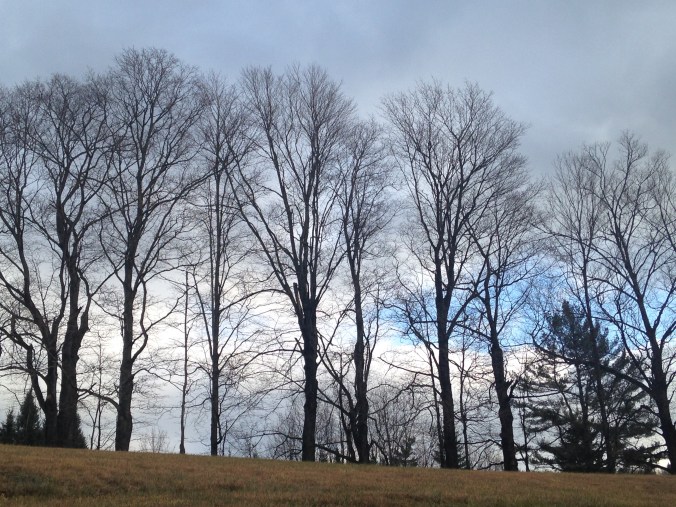
I was reminded of this, stopping along a roadside today, admiring how the trees knit into the sky. One of my childhood’s keenest memories is standing at the edge of a giant cornfield in Illinois, where our family was camping on one of our numerous cross country treks. I was likely ten, the age of my younger daughter now, and I stood with my father, excited as I have ever been about anything in my life. Good lord, all that corn and the sky! The world was limitless.

The true artist is never so lost in his imaginary world that he forgets the real world, where teenagers have a chemical propensity toward anguish, people between their thirties and forties have a tendency to get divorced, and people in their seventies have a tendency toward loneliness, poverty, self-pity, and sometimes anger. The true artist choses never to be a bad physician. He gets his sense of worth and honor from the conviction that art is powerful – even bad art.

John Gardner, The Art of Fiction

IMG_0405