Hunger.

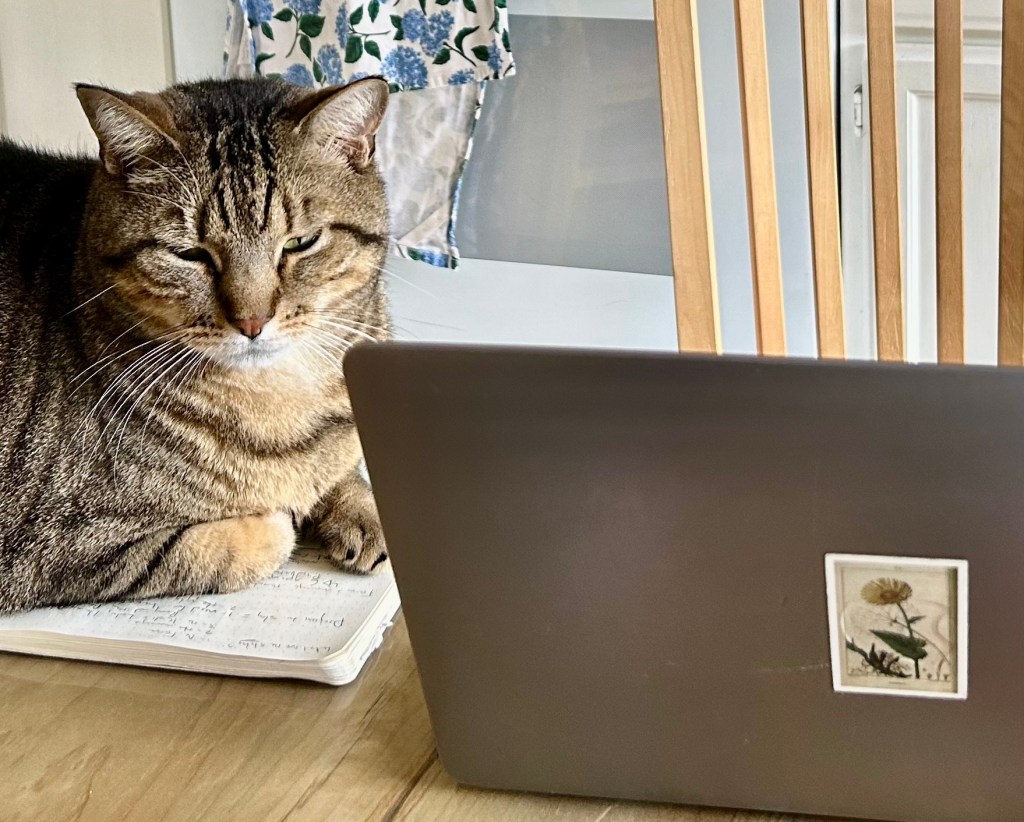
Curious cat named Acer

A few years back when my youngest was doing odd jobs, she came home with four strawberry plants someone had given her from a garden she weeded. Naturally, I planted these in our garden. The plants spread and have produced beautifully this year. I crouch beside these weedy plants and devour red berries. The crop is so small no berries ever make it into the house. Since it’s usually just me here these days, I eat in the garden. I’m famished for this sweet food. I devour the strawberries, juice dripping down my chin.

I’m ravenous for the sharp June sun, for this morning’s cold dumping rain, for my daily midday reading break, for the purring cats who clamor across my keyboard. Healing from cancer, I’m supposed to sleep (get seven to nine hours!) but, come that glimmer of gold at the horizon, I’m finished with bed, hungry for coffee, oatmeal, maple syrup. Eager to finish my novel revisions.

In those months of chemo, I’d worried my mind and imagination might dull, my fierceness lessen. Six weeks out from surgery, I’m diminished in body but a peculiar power blooms in me. A determination to do what I want. An impatience with artifice. Don’t waste my time.

And yet, the old haste that plagued my days and nights has quelled. Stopping by my neighbor’s, I sink into her armchair, set my feet on her footstool, listen, let the day’s exhaustion drape around me. That fatigue is now familiar to me as the blanket a stranger gifted me at the beginning of this cancer journey. We talk and talk, then wander outside and keep on with these conversational matters, the color of paint she’s considering for her house’s clapboards, how to encourage Columbine to grow among the phlox.

This time, I really want to listen…. I’ve spent my life mistaking instinct for fact, subjective experience for reality. What a waste of time here on earth to spend it as a slave to one story, how boring and repetitive, how many of our days are spent in chains.

From Sarah Gilmartin’s Service.

Do Two Things at Once.

Walking on a trail beside the Lamoille River, my daughter points out a snapping turtle, a giant creature, its head tucked in, watchful. Her partner reminds us that he grew up in a village where snappers took over the elementary school playground to plant their spring eggs. An inherent element of that school’s curriculum was try to get along with other beings.

The irises and rhododendron bloom profusely. Rain falls, chilly, for much of the day. In the late afternoon, the sun emerges. I cut back the hostas alongside my house to stave off the wet and rot. By late afternoon, I’m finished with my work and chores. I hang out on the porch, read, drink my cocktails of ice water and lemon. Listen to Nina Totenberg.

A month out from surgery, six weeks from chemo, I met a friend for coffee. We talk cancer and community, about the joys of traveling overseas and shifting perspective. Myself, I will be traveling near to home this summer, most of it by foot. Each day, I walk more and more, reclaiming my strength. As next year’s woodpile is transported into my barn (thank you, thank you, kind wood mover), I imagine planting a garden on that emptied place. As a younger woman, I believed vegetable gardening would change my world. I wasn’t wrong; Red Russian kale and bull’s blood beets fed my growing children for years. But blossoms and bushes and trees nourish the wild (and me, too).

I live on a hillside where hungry young woodchucks run rampart. Not so long ago, I considered the chucks my enemies. Now, having endured the scorched-earth transformation of chemo and cancer, I worry far less about these sleek-furred creatures. By summer’s end, I know the foxes thin this population. In the meantime, I slowly go about that repetitive work of weeding and mulching, and the visioning research of transforming lawn into wildflowers.

My coffee companion reminds me to take my time and take risks. Who wants to take risks after surviving cancer treatments? Answer: why not, why not? Dig more gardens. Contemplate the woodchucks. Plant coreopsis to replace the hollyhocks holes from the woodchucks’ foraging… Do two things at once: go with the flow and keep paddling.

White peonies blooming along the porch
send out light
while the rest of the yard grows dim.

Outrageous flowers as big as human
heads! They’re staggered
by their own luxuriance: I had
to prop them up with stakes and twine.

The moist air intensifies their scent,
and the moon moves around the barn
to find out what it’s coming from.

In the darkening June evening
I draw a blossom near, and bending close
search it as a woman searches
a loved one’s face.

~ Jane Kenyon, “Peonies at Dusk”

Seeking the Something New.

A friend arrives with a box of seedlings, including tithonia, AKA Mexican sunflowers, a tall, brilliantly orange, hopeful plant. A few mornings later, more friends appear with seedlings and a pitchfork. Lucky, lucky me.

I am a gardener who allows the Johnny-jump-ups and forget-me-nots to spread where they like, pulling back a few and nestling in basil, scallions, poppies. Why unroot a flower? Eventually, I weed diligently, ruthlessly. The garden mirrors my approach to novel writing. My friends leave with their boxes filled with forget-me-nots as a gentle rain falls on the tender seedlings.

Every day is a further day from surgery and chemo, the days and night accumulating like pages read in a book. I put away the narcotics, the Tylenol, the ibuprofen. Mornings, I drink a single cup of café au lait. I sauté mushrooms, bake a quiche. I ask for a ride to drop off my car at the garage, worrying about walking up my hill, but picking it up is mostly downhill. I walk.

For a little bit yet, I’m a person of interest in this small town. The postmistress asks me, no, really, how are you? For months, the PO staff has stuffed my box with cards and books and sheaves of medical bills from two hospitals. I’m there to pick up a book of essays (a gift which quickens my heartbeat). I tell her I’m in remission, that word still awkward as it emerges from my throat. I want to add that remission does not mean cured, does not mean that this strange and uninvited cancer beast has left my body – and certainly not my soul. I don’t know this woman at all well, but she looks steadily at me, as if she understands what I’m thinking.

Here’s the thing: how afraid I was of cancer eight months ago; honestly, I’m still fearful of it. Yet, cancer rooted in me, infested my family, my friends, a great wide circle of people around me, including my readers here. This is not unique. In its myriad forms, cancer spreads widely. I lived for years with the putrifying secrets of addiction. I refuse to repeat that with cancer.

Last November, I thought I wouldn’t live to see spring. I did. If jaywalking doesn’t do me in, cancer certainly might. Or I might die as a scrawny old woman from a stroke or heart attack. In this rainy late spring/early summer, I’m grateful for the possibly random dice throw, for plants and gardeners, for an infinitude of people. Among these are the people who’ve shared their stories with me, of decades-ago cancer diagnoses, almost always offered sotte voce, as if not to tempt the fates. Their stories ring clearly: I endured, I transformed, I thrived. This possibility can be mine (maybe yours, too).

From Suleika Jaoad’s The Book of Alchemy:

But there are also moments when our internal compasses tell us it’s time to change course–to leave something behind and build something new…. Rebuilding is not easy…. But to me, rebuilding unfolds alongside becoming. It is crucial, if we want to keep evolving and flourishing, to get rid of things that are no longer serving us and make space for something new to grow.

“You got a God.”

Years ago, I ripped out a photo from the New Yorker of Marina Oswald taken the morning after her husband assassinated President Kennedy. She was hanging diapers on the clothesline, her face scrunched in misery. It was 1963, the realm of cloth diapers, and she had two babies. I tacked the photo on my wall.

No assassins in my household. Yet, as I described to a friend, I’m healing from chemo and surgery while the dailiness of life tugs me onward. In some ways, this is a relief; I’m utterly grateful to be in the world where I hand over my credit card for groceries, rise in the night when my daughter returns from work to ask about her hours. I order firewood, problem-solve our broken car scenarios. It’s triage and logistics, a math problem.

This May, a cold spring, snow yesterday all day in the New Hampshire White Mountains, I read through the mail. Make one phone call. A colleague stops by. My daughter makes grilled cheese, slices avocados, rims the edges of my plate with peanut butter cups. My brother texts, my sister calls, reminding me to eat, eat. In all this, I open the Grapes of Wrath, join hitchhiking Joad, and eventually sleep in the wood stove’s warmth. I dream of our lilacs who hold their buds closed against this cold, the Joad corn in the 1930’s, buried in feet of dust. Through my dream washes the rain against our windows, the purple and white violets studding our overgrown grass. Time and place and season sift like a jumbled dump cake.

When I wake, my cat Acer lies purring against my foot, contentedly grooming a dainty paw, supremely confident of an imminent dinner and another toasty night before the beloved hearth.

Memorial Day weekend, when we always invite friends and neighbors for an outdoor dinner. Not so, this year. The pieces in my life, my family’s lives, shift, rearrange, mend. Slow healing, slow domesticity.

From Steinbeck: “You got a God. Don’t make no difference if you don’ know what he looks like.”

Don’t these greens taste good…

My oldest daughter attended preschool for a year on the second floor of a Unitarian Church in a little village on a pristine glacial lake. The village is heavy on the white clapboard quaintness. To get to the town, we drove through acres of farm fields. In May, the fields gleamed with dandelion gold. The merry month of May: bumblebees and blossoms. Revel on…

My daughters visited me yesterday at Dartmouth, a repeat that’s become bizarrely routine — a repeated I’m determined to break. They came bearing gifts of peonies and good cheer. Sunday, we wandered through the wide and mostly empty halls. The hospital is designed to pour natural light into the building, and the sunny afternoon showed its success. We admired the blooming crabapples and wandered through garden courtyards. I gathered more reading material.

I rarely post photos of myself, but here’s me, in my daughter’s sweatshirt, in a photo snapped in an elevator. Dandelion from the youngest tucked into my zipper.

The First Green of Spring

Out walking in the swamp picking cowslip, marsh marigold,
this sweet first green of spring. Now sautéed in a pan melting
to a deeper green than ever they were alive, this green, this life,

harbinger of things to come. Now we sit at the table munching
on this message from the dawn which says we and the world
are alive again today, and this is the world’s birthday. And

even though we know we are growing old, we are dying, we
will never be young again, we also know we’re still right here
now, today, and, my oh my! don’t these greens taste good.

~ David Budbill

Bare soil.

Midnight, I’m sitting outside the local hospital in the balmy night, a few mosquitoes drifting in the streetlights. There’s no one around, save for the young woman in reception poking her phone, the peepers chattering in the wetland down the road. The night is so warm I’m reminded of summer’s open-ended days and nights, the pleasure I’ve taken these last few years sitting outside in the dark, listening to the nightsounds of rustlings and callings, human and wild.

The person who drew my blood just a few hours ago told my sister and me about the local library in nearby Johnson, Vermont. This evening, the library will be moved from where it was built and recently flooded to safer and higher ground near the elementary school. The town will shut down as the brick building is wheeled down Main Street and over a bridge spanning the Lamoille River. In the velvety darkness, I imagine the scene: the floodlights, the crews, the townspeople who will come out to admire and cheer. A small but certainly mighty miracle.

Around the building, I hear the rattle of my Subaru’s loosening heat shield. Then my sister appears in the driver’s seat. Along empty roads, she drives us home. In Wolcott village, I spy a fox rushing across the road. The animal pauses at the weedy edge, head turned towards us, perhaps wondering what we’re up to, too, this creature, like us, in no rush at all. Home again, the cats press against the kitchen glass doors, as if expecting a reckoning from me, an accounting of my absence.

What can I say to these tabbies? When a nurse apologized for dropping a plastic cap on my shoulder, I mused aloud that it wasn’t heavy — and isn’t that a line from Phish? Things are falling down on me, Heavy things I could not see… The nurse knew these lines, too. The heavy falling things are taking a pause, perhaps, in spring, as the earth reorients herself, through peeper song, unfurling leaf, the heady scent of rain on bare soil.