Dumpster Raiding, Poetry, Independence Day.

Ocean Vuong reads at a nearby arts center that is built in a farm field with a stage modeled on the Globe Theater. My friend and I cruise in, nearly late, and the parking lot is full. Hundreds of people have arrived. On this holiday weekend, I’ve swam and eaten ice cream, stepped inadvertently from friend to friend, like the twilight walk that ended in darkness on a trail, two small women talking, talking, fireworks booming in the blackness around us.

Vuong reads mesmerizingly, like a dream. He begins with remarking that humanity began in poetry and war, and how this will shake out after the Anthropocene is yet of course to be determined. By the reading’s end, I wipe tears from eyes. Immensely talented, utterly humble, Vuong offered homage to craft of storytelling—its essential role in all human life—and to the women who raised him. Four Vietnamese women in hardscrabble Massachusetts wrested free from their bad men and raised seven sons. None of these women were writers, but they were all oral storytellers who told their stories to salvage their dignity from the harms of the men. The repair was for their sons—and themselves.

And the poetry and war where Vuong began? By the hour’s end, his words stream through me, like that Buddhist retreat I attended last summer, my body still bitten by cancer to more bones than flesh. In those days, for fleeting moments I could envision my own near death, that this body I’ve used so hard will go down into soil and stone, that tendrils of roots and melting snow will erase me from this world of language and teeming desire, and yet I will have never gone anywhere at all.

Likewise, listening, I realize the poet carried all of us, not one more than another, along his mellifluous words, that the human history of this country, America, is inextricably bound in the polarity of war and poetry, a profound rushing flood of passing time and undefinable generations.

Later, my dear friend headed home to her dog and her life, I wandered along the back end of the village where a dumpster lies overturned. From the rubble, I extricated a glossy Dorothea Lange photo, the famous portrait of a mother and children. I rolled it up and tucked it beneath my arm. For you, I write for you, because you are me.

NOTHING

We are shoveling snow, this man and I, our backs coming closer
along the drive. It’s so quiet I can hear every flake on my coat. I
used to cry in a genre no one read. What a joke, they said, on fire.
There’s no money in it, son, they shouted, smoke leaking from
their mouths. But ghosts say funny things when they’re family.
This man and I, we take the weight of what will vanish anyway
and move it aside, making room. There is so much room in a
person there should be more of us in here. I wave to you, traveler,
inches away but never visible from where I am. Are you warm
where you are? Are you you where you are? Something will come
of this. In one of the rooms in the house the man and I share, a
loaf of rye is rising out of itself, growing lighter as it takes up more
of the world. In humans, we call this Aging. In bread, we call
it Progress. We’re in our thirties now and I rolled the dough just an
hour ago, pushing my glasses up my nose with my flour-dusted
palm as I read, reread, the hand-scrawled recipe given me by the
man’s grandmother, the one who, fleeing Stalin, bought a ticket
from Vilnius to Dresden without thinking it would stop, it so
happened, in Auschwitz (it was a town after all), where she and
her brother were asked to get off by soldiers who whispered, keep
moving, keep moving
 like sons leading their mothers through
wheat fields in the night. How she passed through huddled coats,
how some were herded down barb-wired lanes. The smoke from
our mouths rising as the man and I bend and lift, in silence, the
morning clear as one inside a snow globe. For how can we know,
with a house full of bread, that it’s hunger, not people, that
survives? The man pours a bag of salt over the pavement. But
from where I’m standing it looks like light is spilling out of him,
like the ray of dusty sun that found his grandmother’s hands as
she got back on the train, her brother at her side, smoke from the
engine blown across the faces outside blurring into pine forests,
warped pastures, empty houses with full rooms. The man
clutches his stomach as if shot, and the light floods out of him, I
mean you—because something must come of this. Poetry makes
nothing happen
, someone who is dead now said after a friend’s
death. When the guard asked your grandmother if she was
Jewish, she shook her head, half-lying, then took from her bag a
roll, baked the night before, tucked it in the guard’s chest pocket.
She didn’t look back as the train carried her, newly seventeen,
toward where I now stand, on a Sunday in Florence,
Massachusetts, squinting at her faded words: sift flour, then beat
eggs until “happy-yellow.”
 The train will reach Dresden days before
the sky is filled with firebombers. More smoke. A bullet in her
brother under rubble, his name everywhere outside her like the
snow falling on your face forty years later, on December 2, 1984,
while your mother carries you, alive only three hours, the few
steps to the mini-van where your grandmother, nearly sixty now,
crowns your head with her brother’s name. Peter! she says, Peter!
Peter!
 as if the dead could be called back from rubble into new,
stunned bones. The snow has started up again, whitening the
path as though nothing happened. Oh, to live like a bullet, to
touch people with such purpose. To be born going one way,
toward everything alive. To walk into the world you never asked
for but then choose the room where your hunger ends—which
part of war do we owe such knowledge? It’s warm in this house
where we will die, you and I. Let the stanza be one room, then.
Let it be big enough for everyone, even the ghosts rising now
from this bread we tear open to see what we’ve made of each
other. I know, we’ve been growing further apart, unhappy but
half full. That clearing snow and baking bread will not save us. I
know, too, as I reach across the table to brush the leftover ice
from your beard, that it’s already water. It’s nothing you say,
laughing for the first time in weeks. It’s really nothing. And I believe
you. I shouldn’t, but I do.

~ Ocean Vuong

Eating Roses.

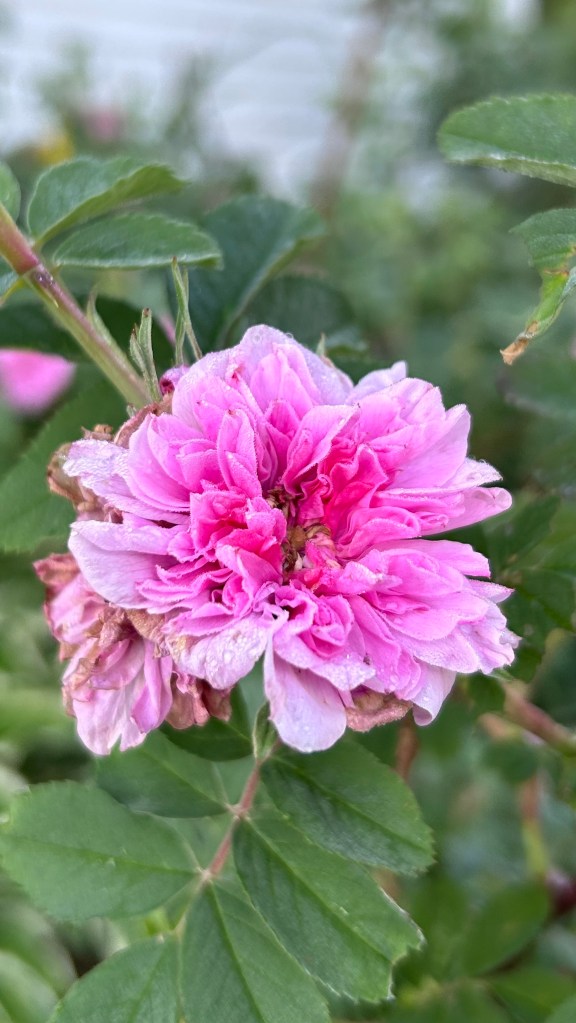
I’ve just finished stacking a fallen-down section of woodpile when a friend texts and asks if I’m interested in a twilight walk. Heck, yes. With my thumb and fingernail, I snip a rose and carry the fragrant pink beauty cupped in my hand as I walk towards my friend’s house, trailing tender petals.

We meet at a halfway point between our house. To my surprise and delight, she eats the rose.

In the lingering light — June’s gold and green beauty — we walk along the rail trail and pause at the bridge over the river. Leaning on the railing, we talk about all the things — family and money and loneliness — while the river runs over and around the boulders and bends around the forest, heading through the village.

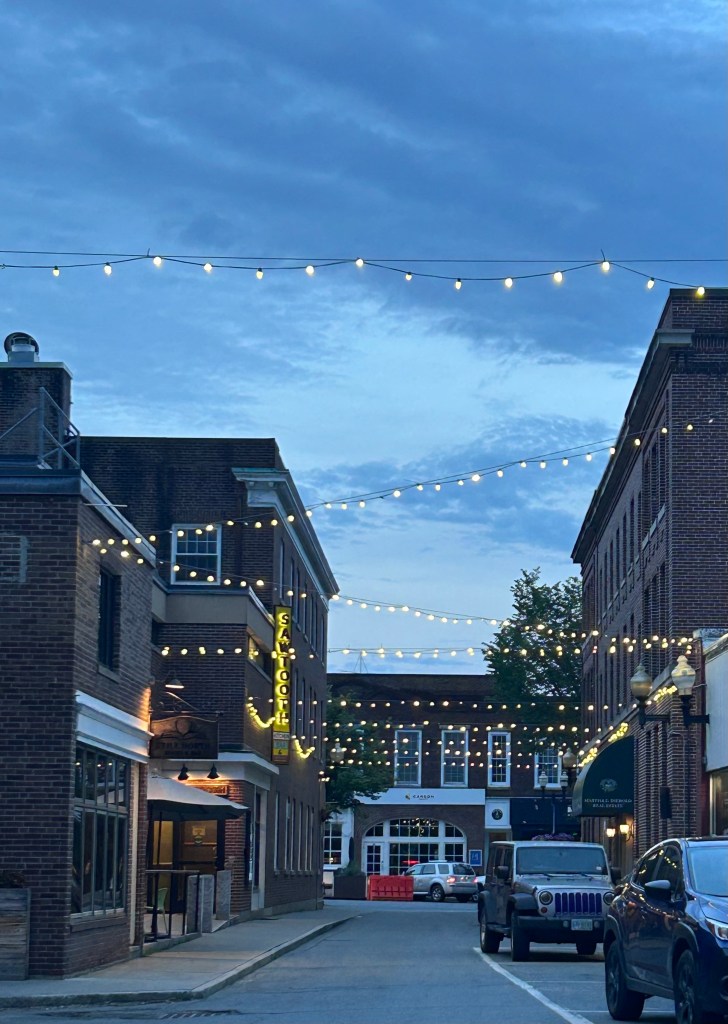
Darkness drifts down when I finally head home through the scent of clipped lawns, the roses along the Catholic parsonage, the seduction of garlic from the downtown restaurant, its door propped open, a woman rubbing a cloth over the bar.

Vermont June. Mighty, magical month.

And…. book launch for Call It Madness, this Tuesday, 7 p.m., hosted by the Galaxy Bookshop at the Jeudevine Memorial Library’s amazing addition. If you’re around, come!

Looking into the Longevity of Our Stories.

Writer Tom McKone called me last week for a CALL IT MADNESS interview. We spoke for longer than either of us had expected, as I leaned over my back porch railings. His review ran in yesterday’s The Bridge. McKone is my ideal reader: curious, thoughtful, precise. Writing a book requires years—years of labor that has zero relevance to a time clock; labor that demands writing through doubt and kismet; labor that gleans from ebullience, nihilism, and that broad plain of gray uncertainty. There’s a splash when a book is released, a flurry, but the goal? The real desire? Have a reader sink into a hammock or lean against a swaying subway wall and read.

An excerpt follows.

“Our memories, where and when we’re born, and our family, social environment, and economic situation can shape who we are,” Stanciu said. Mentioning the work of mythologist Joseph Campbell, she said it is very hard to “step out of that repetition of the past,” especially when that past is burdened with poverty and alcohol.

“One of the things I hope people get out of this book is the ability to ask questions (and) to be curious,” she said. “Why do people act the way they do? What do I not understand about them — both when they behave well and when they behave in infuriating ways? I think it’s always been a relevant question, but it’s super relevant right now — not to see each other in two-dimensional ways, but to really look into the longevity of our stories.”

On the Road…

My twenties were years of road tripping, Vermont to Washington state, lots of New Mexico, sleeping in the back of our black diesel VW Rabbit, 55 mpg, our Rand McNally shedding pages. Thirties were babies and learning to garden, raising high the roof beams, forties the scrambling decade of parenting alone and keeping kids shod and fed. Fifties, kids are paddling their own lives, and yet we’re tight, tight; cancer survivorship schooled us rapidly in what’s dear and what’s so easily lost.

Among these decades, my own unbroken thread of writing. Road trip with a self-made atlas.

A beloved friend hops into my car. We lived on the same dirt road for years. I would phone and say, It’s sleeting. Come walk with me. She was always game. This late afternoon, I drive south, that too familiar journey of Route 15 and I-91, heading towards Dartmouth-Hitchcock, but I park in pretty Hanover, NH, where I’ve been invited to read from Call It Madness — a title that reflects my own life — madness, madness, everywhere — both the crazy-making of divorce and cancer but also my own fierceness for my dear ones, for literature and the roses blooming around my house and the precipice I tread between ebullience and the frigid teeth of despair.

The loveliest of evenings at Still North Books. My reading companion, Shasta Grant, is true and gifted, the bookstore staff warm, the audience curious and kind. My friend and I are the last to leave, save for the cheery folks folding the chairs and emptying our water cups. I drive north into the night. The sun dwindles into gold and pink. We talk about cars and money, kids of course, drinking and books and death.

She gives me her apple. I eat and drive. Thirty years into our friendship, as the darkness folds around us, I think, What a long way we have come. In my driveway, we linger, the car’s engine clicking as it cools, the fireflies flickering. How happy I am to begin my own hand-crafted book tour for Call It Madness. In my youth, those decades when I leaned so hard into my life I hardly brushed my hair, I believed my life would flatten, temper into quietness. Oh friends, the world’s depths are revealed as bottomless crevasses and immense peaks, largely unknowable. What’s knowable is the stickiness of that apple’s juice on my fingers, the darting fireflies, the answer I gave to a stranger’s question at the end of the Still North Books reading: “My real flaw was cowardice.” I’ve long ago abandoned the flimsiness of that forgiveness concept, for myself or others. Life propels onward, word by word, sunset to sunrise, companionship in all weather.

A few things…. I’ll be on Bon Mot on Central Vermont Radio, Sunday, June 21, 5 p.m. Call It Madness book launch Tuesday, June 30, 7 p.m., at the Jeudevine Memorial Library in Hardwick, Vermont, sponsored of course by the hometown and most stellar Galaxy Bookshop.

Survive, professor! That’s all you really have to do. Keep the grass from creeping into eh carrots, deal with the woodchuck stealing the apples, patch up the pipes! — Makenna Goodman

Multitudes.

A friend comes for cheese sandwiches and raspberries, and we walk through the hydrangeas and across the cemetery and downtown to the Galaxy Bookshop where Garret Keizer launches his new book. The evening is illuminated with sunlight. Keizer reads well, and at the end, my hands folded over my knitting in my lap, I feel how this room of friends and strangers leans together, yoked by the intensity and compassion of his words. He thanks the audience and says drive home carefully.

Over those sweet raspberries, we’d talked about the curious threads that knot through communities, the connections between people known in segments. Likewise, we comprehend this universe in all its radiance and brutality through a smudged lens. This week, in a nearby town, an unimaginable car crash.

Lingering at the bookstore’s door, two old friends and I muse about these strange political days. One friend ventures that collective celebrations, like the recent Knicks’ win, keep us buoyant. As a writer, I’ve always leaned into words, the shelter of creation, the force of imagination. Yet, there are realms where language no longer suffices. Nine years ago, we moved into this house. I opened the living room windows, and the perfume of roses washed through the rooms. Nine years? a friend asks. What does that feel like?

It feels like multitudes.

… Last, grateful for this nice write-up of Call It Madness in the Times Argus.

Always, the question, which way?

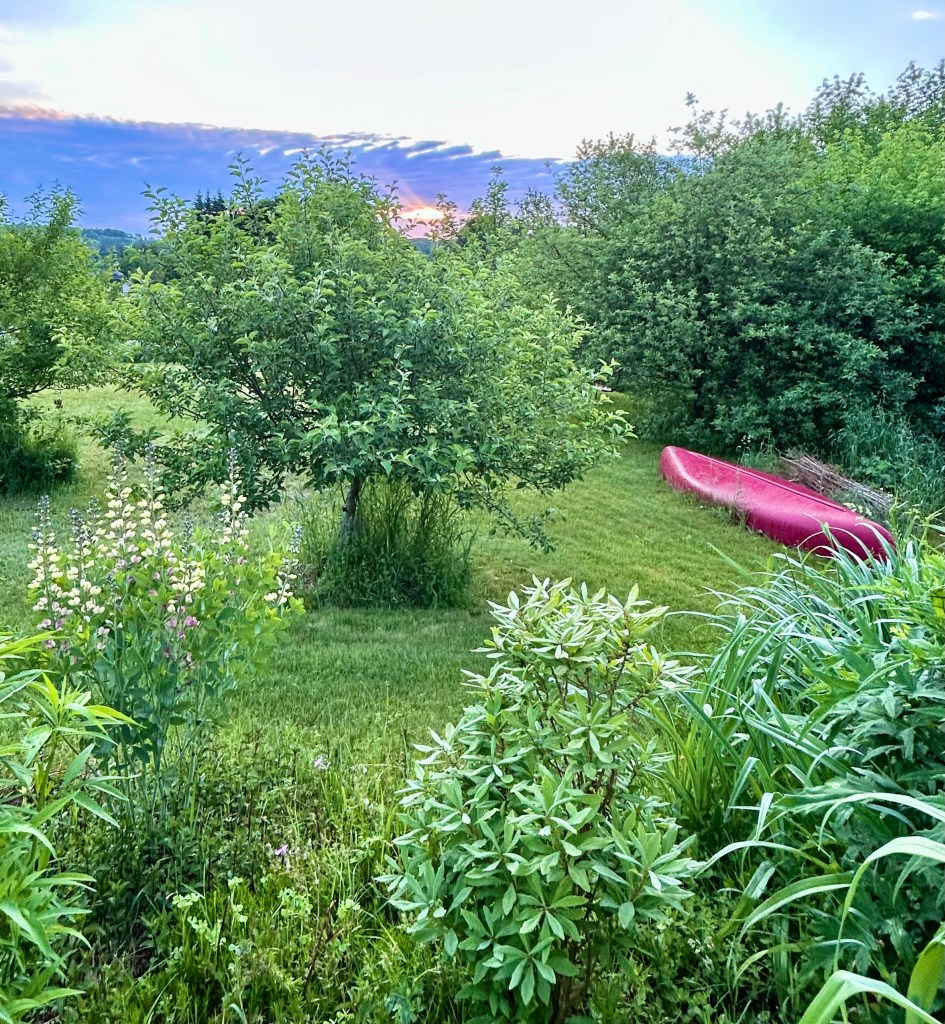
For readers who haven’t lived in northern Vermont, here’s a keyhole view of June: heat and humidity move in, and the earth thrusts out into leaf and bloom. Overnight, the loosestrife blooms yellow, the chard gains an inch in leaf. The lilacs fade. The Siberian irises spread purple.

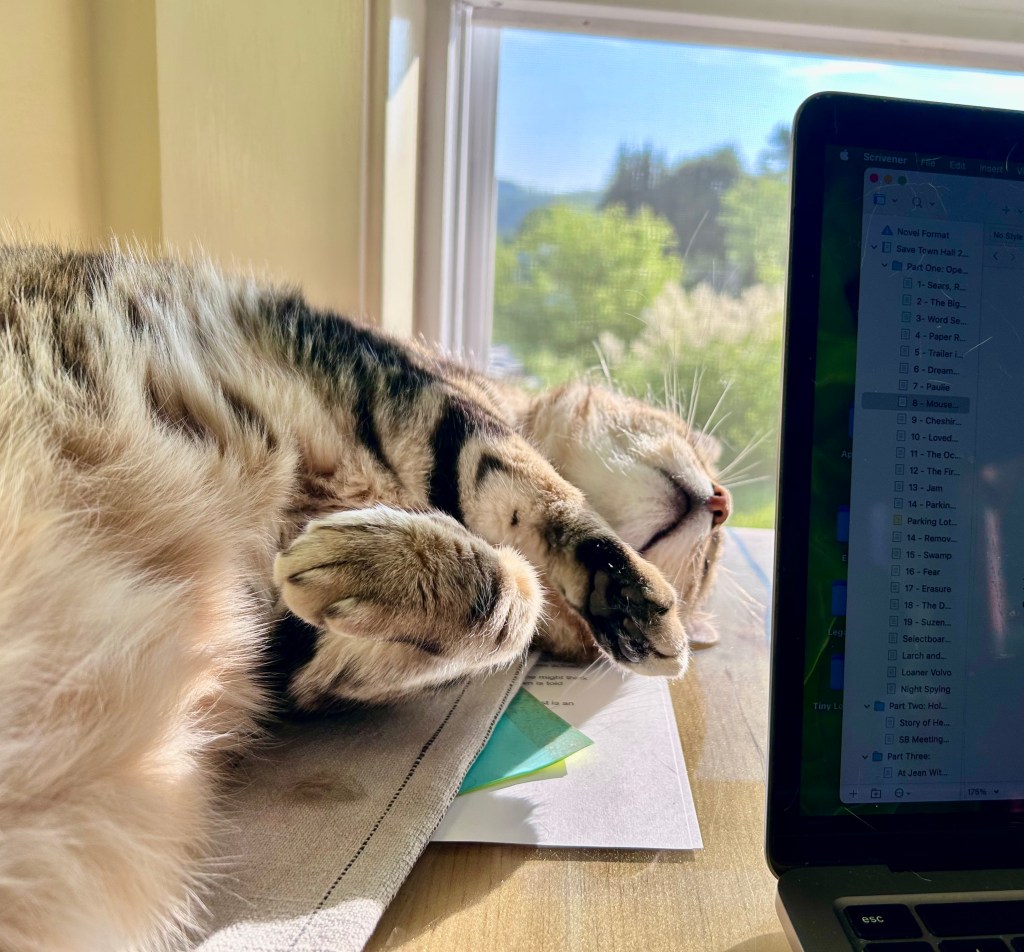
In the heat, listening to terrible news of the American Empire’s spread, I finish stacking next winter’s firewood. Sweaty and dirty, the cats and I admire my work, contemplating the frosty fall evenings. The cats, perhaps, are merely curious about my labor, or the next meal’s arrival, or perhaps a cat calculus I don’t imagine.

June, the songbirds serenade exquisitely. I mow the grass around the woodpile, the pink roses beginning to bloom, the brushy compass flowers that are now knee-high. Will the ancient mock orange leaf and bloom? Will the woodchuck devour the sunflower seedlings? Will I unclench my knotted heart and let myself fall in love, tumble into the next phase of whatever I may have in this lifetime?

Rain falls and the heat breaks as I finish mowing. I wander around, drinking a glass of water, the rain running through salt and chaff on my cheeks and biceps. 21 years ago, a friend labored to bring her baby into the world. I sat in her kitchen while our six-year-olds played under her front yard maples. Her mother-in-law made chicken soup that I ate while I nursed my own wee infant.

The world isn’t filled with ten thousand things. In the June afternoon’s rain, a rainbow elusive, math welds no teeth. A hopping robin in search of sustenance, unfolding hydrangea leaves, the bounce of a child’s basketball, the scent of sap bleeding from winter’s firewood.

For local folks…. I’ll be reading at Still North Books in Hanover, NH, Wednesday, June 17, 7 p.m. Yes — a lovely bookstore — and yes, a non-cancer visit to this lovely village.

Is not all the summer akin to a paradise? — Henry David Thoreau