A Story in Here…

I visit a woman whose family bought a house on a peninsula in a glacial lake. She invites me in — a stunning place of wood and glass and French doors — nothing polished, all preserved as if it’s still World War I. There’s an enormous stone fireplace. She tells me that, after a hurricane in the 1930s, the original owner (who lived elsewhere, New York or Pennsylvania) never returned after he heard that all the trees on the peninsula were destroyed, save for eight. He sold the house to this woman’s family. Great pine trees tower over the lawn and hydrangeas.

She says to me, Imagine the view of the lake in the thirties, when the trees were all gone? That must have been stunning, too.

I drive home in a sudden windstorm. I’m passing a stand of poplars, their leaves crinkled and finished with summer. The wind blows leaves through my open car windows, over a bucket of apples, on my library books, into the lap of my skirt. Ahead of me, two cars are pulled over, blinkers flashing. A branch smashed the windshield of one car. Two young woman stand in the road, the wind circling, twigs snapping, rain beginning in earnest. One woman raises her arms in a giant Y.

There’s a story (or two) in here for sure….
No Going Back.

July 1: I’m driving on a back road to a nearby town where there’ll be the traditional New England small town Independence Day festivities, when I suddenly realize I can no longer see the road before me. The road dips down and then rises up. I know this, because I’ve driven this road so many times. I know precisely where to swerve around the persistent pothole where the stream runs under the lowest point of the road. But the rise is hidden in smoke.

The day marks a line for me, a place I won’t forget. I’ve been here before; this is familiar territory. I remember the precise afternoon I knew I would severe my marriage. Likewise, today, it’s clear to me that this smoke, in what will likely be one unimaginable variation after another, will remain.

Nonetheless, I go on into the day, watch the parade with an old acquaintance and we catch up about kids, ruminate about our old college days. I talk to a woman who’s built a house of cans and bottles and tires. She asks me to stop by sometime. Heck, who could pass that up? Of course I will.

Then I’m back home again, working, working, on this third book, taking it apart, sewing it back together, phrase by phrase. I wind in how it feels to walk along the edge of a lake that may not be frozen and thread through the Himalayan blue poppy, a child’s nightgown, pebbles under a clear running stream. I’m after those same old things: how to salvage order and beauty from chaos and destruction and despair. A river of sadness is not the torrents of despair.

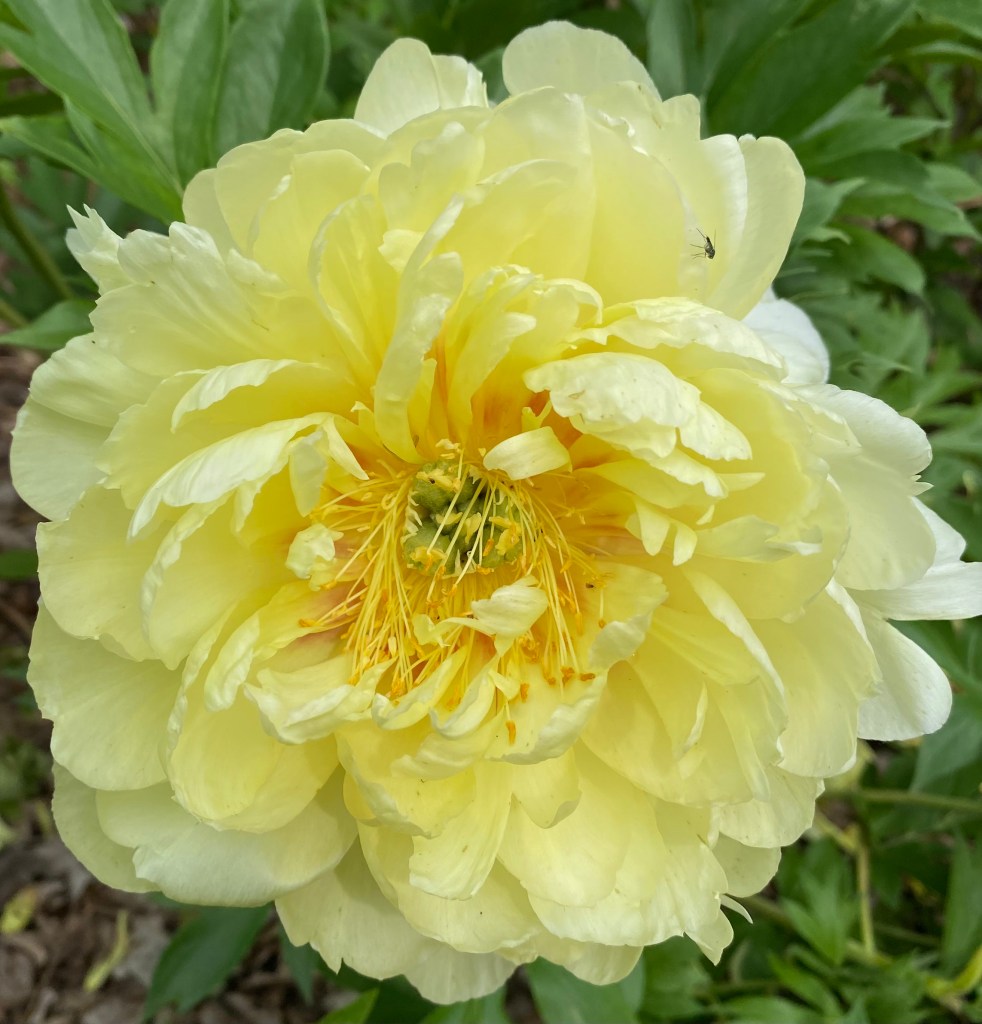
Swim. Bartzella peonies. My neighbor leaning out her door, green curlers in her hair, saying hello.

A Motorcycle is a Vehicle of Change…

On the cusp of the solstice, the evenings are chilly yet, mist pulling around our house.

I pull on a sweater — a wool sweater — as darkness falls and walk through the small stretch of woods into the cemetery. A stranger wearing a t-shirt and drinking a Fanta walks down. He looks at me as warily as I’m probably looking at him and then we exchange a mutual good evening and head each our own way, our mutual bit of our stories nothing but this.

Solstice — I’m hoping for sun and heat, for evening swims to stitch my summer together. I want to swim through pollen scattered on the still pond, glide through the ripples stirred by ducks, to have the mundane details of my life and my swimming companion’s life sewn together, swim by swim.

In the absence of swimming, I’ll sing the praises of those midday walks admiring the lupines and forget-me-nots, reading under the dwarf apple tree that’s long surpassed smallness, the fledgling robins clamoring for worms.

“A motorcycle is a vehicle of change, after all. It puts the wheels beneath a midlife crisis, or a coming-of-age saga, or even just the discovery of something new, something you didn’t realize was there. It provides the means to cross over, to transition, or to revitalize; motorcycles are self-discovery’s favorite vehicle.” 

— Lily Brooks-Dalton, Motorcycles I’ve Loved

Worms for the Body, Philosophy for the Soul.

A little light rain falls as I pull a few weeds from the Sweet William in my garden. I planted these flowers when I moved here, putting my shovel into this terrain, vying for flowers and vegetables versus lawn. At the moment, the flowers flourish. I’m thinking a little about a writers roundtable I participated in the morning before, how I urged writers to remember that cause and effect drive the world we live in. All the pretty and noble thoughts we have about ourselves are only illusions. Character lies in our actions, for good or ill, whether we chose to see this or not.

On this Father’s Day, I remember those conversations my siblings and I had with my father at our kitchen table, so many decades ago. This sense of the world comes from the Aristotle he had us read. It’s a lesson that I’ve been hammering out, over and over and over in my life, through garden (what truer way to learn cause and effect), through writing and childrearing, through work, divorce, friendship.

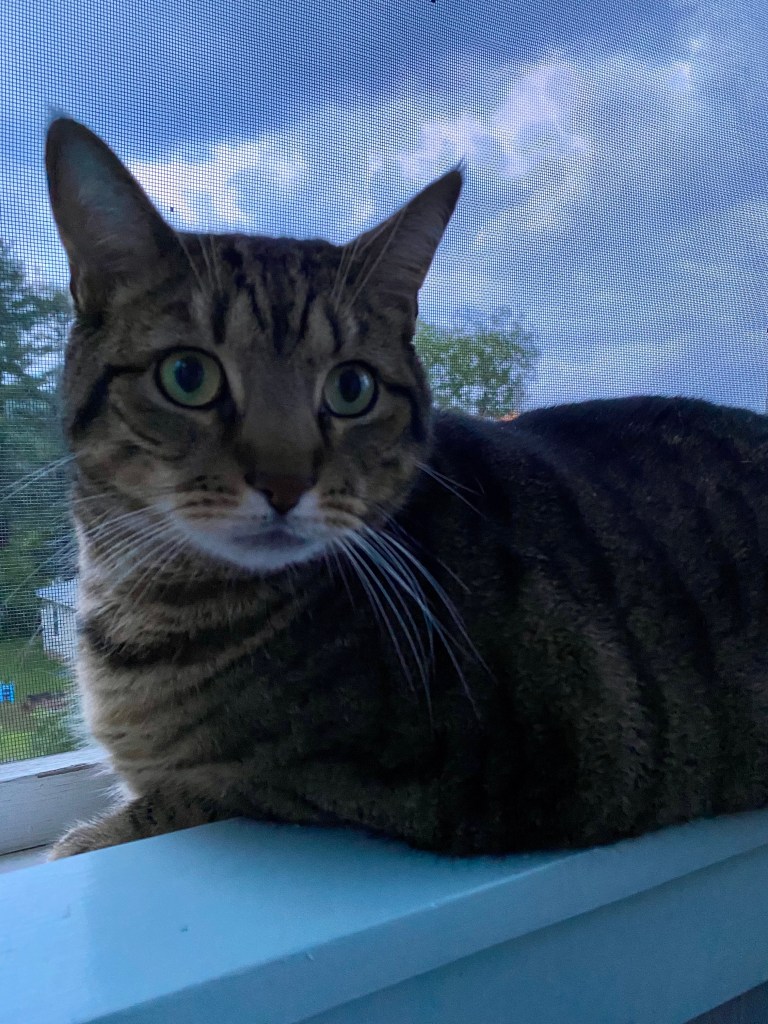
On my deck, the robins’ nest has open-beaked fledglings, tufted and mewling. All day, the parents fly in and out, worms draping from their beaks, feeding their young, this great Herculean parenting endeavor. My cat Acer lies on a kitchen chair, staring through the glass door, mesmerized. The robins, in their robin way, have taken a chance nesting just above my door. Will this pan out? Will the young survive?

Wendell Berry wrote that “Parenthood is not exact science.” Nor, by any means, is bird or human life. My father gave his three children worms and philosophy. He taught us to love bread for the body, wine for the soul.

Robin Survival?

This is now the sixth year we’ve lived in this house. I count these years by June 15th, the date I signed for the house, two days before my oldest graduated from high school, the date the sellers took us out to lunch and I stared through the diner window, wondering if buying this house was a good idea.

On this sixth year, a robin family has joined us, building what appears to be a well-made nest, strands of straw hanging from roof rafter. The nest is beneath the porch roof, covered from the weather. The nest is so close to our house that the mother robin flies away whenever we open the back door. My daughters and I wonder, Why not choose a rafter in the barn? A good old-fashioned tree limb?

The robins’ destiny is, of course, neither here nor there. We didn’t make the nest, and whether this family survives is largely beyond my purview. Certainly, my curious housecats will not harm these young ones. Yet I’m curious as my cats, wondering what drove this family to our porch.

June. We are surrounded by a hungry world that eats wee robins. I’m rooting for these young ones, hoping they’ll pull through. Come what may.

Fox Running Down the Road…

Midday, driving from here to there, a fox runs across a field towards me, its jaws clamped around what appears to be a yearling groundhog. I immediately slow my Subaru. The fox runs quickly, darting across the road. I pull over and jump out, watching the fox run along the shoulder. It’s backwoods Vermont, and no one’s around but me and this fox intent on carrying home its slain prey.

Surely the fox knows the road is empty of humans but for me, and I am no threat. Running, running, the fox disappears into the hayfield. In no great rush, I admire the lake through the trees. It may rain, or not. The hazy swimming weather has been usurped by cold, by the strange smoke from the Canadian wildfires so far from us. Here, this midday, it’s just me and the fox and the groundhog turning doubtlessly into fox kits.

Eventually, a pickup appears and stops. The driver’s an acquaintance, and he rolls down the window and asks what’s up. I lean against the door. He and I grouse for a bit about town business and human chaos. When he’s gone, I linger just a little longer, remembering the rushing fox, those moments of human and wild.

“It would have been better to come back at the same hour,” said the fox. “If, for example, you come at four o’clock in the afternoon, then at three o’clock I shall begin to be happy. I shall feel happier and happier as the hour advances. At four o’clock, I shall already be worrying and jumping about. I shall show you how happy I am! But if you come at just any time, I shall never know at what hour my heart is to be ready to greet you…” 

— Antoine de Saint-Exupéry, The Little Prince