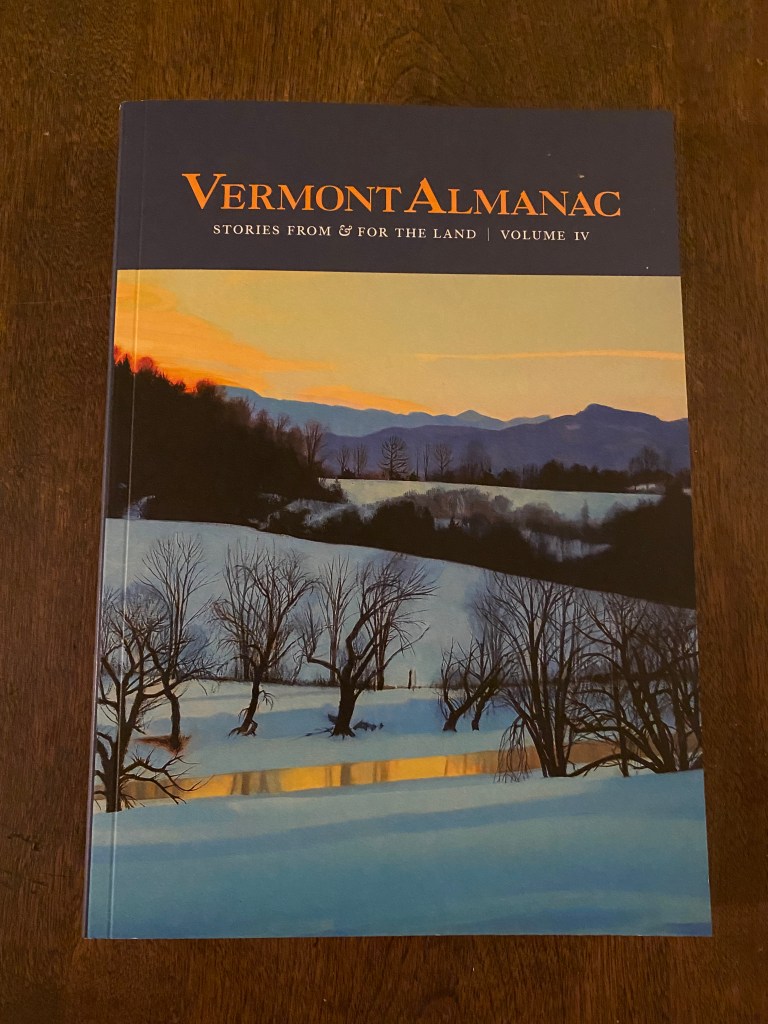
Vermont Almanac.

My copy of the fourth Vermont Almanac arrives in my mailbox. Remember real mail? I remember exchanging long letters with friends for years. Email is fine and dandy, but email has no smell. I open the book in my kitchen and breathe in the scent of ink and paper. I was fortunate to write and edit a bit for this issue.

These days, on my moonlit evening walks, living in Vermont is often on my mind. So much has happened in my own life and in this dear state: a summer of rain and wildfire smoke, a flood, beloved Montpelier drowned, a rise in violent crime. And yet, I’m tugged more deeply into this state I’ve called home nearly all my adult life. Reading this hefty book, I’m reminded, again, of how yankee ingenuity is so often yankee generosity, too. While our nation (and much of the globe) as a whole is navigating unsettled and often stormy waters, I’m heartened by Vermonters’ ruggedness, tenderness, and, so often, outright humor. Who could imagine a world without these fine things?

Hope is no mere aspiration that things will turn out well. Hope instead takes our hand, shines a light ahead, and pushes us onward into the messiness and uncertainties of life.

— Bryan Pfeiffer, Vermont Almanac, Volume IV
Two Bald Eagles.

After losing Yahtzee twice and then again to make a third, I’m in the passenger seat, heaing north for no particular reason at all. I’ve forgotten the library books I meant to return, and my bend of mind is that it makes no real difference at all.

Just out of town, I spy two bald eagles on the reservoir, hunched on the beginnings of winter’s ice, unmistakable with their dark bodies, the white of their heads. We drive around a bend, disappearing up the road that’s so narrow and tight there’s no good place to stop. By the time the road widens, I know the way back is impassable through thickets. And so we go on. Talking, talking.

The eagles are perhaps the best of holiday metaphors, utterly outside the realm of any camera lens. (Please, my family might beg, could you lay off the insistence of seeing the world in metaphors?)

This, then: two mighty raptors, the season’s early ice, the rising moon. The evening now is cold enough that the moon sprinkles frostily. I dump the compost in the bin and crunch back over the scattered snow, hungry for the embers in my stove.

Yet once being born there is no turning back.

— Hayao Miyazaki

Duskier and Duskier.

Chickering Bog

My brother and I have this odd (and likely annoying) habit of repeating the same word or phrase back to each other. In a November weekend interlude, he says duskier, which sums up these November days. I toss it back to him — duskier — then add gloaming.

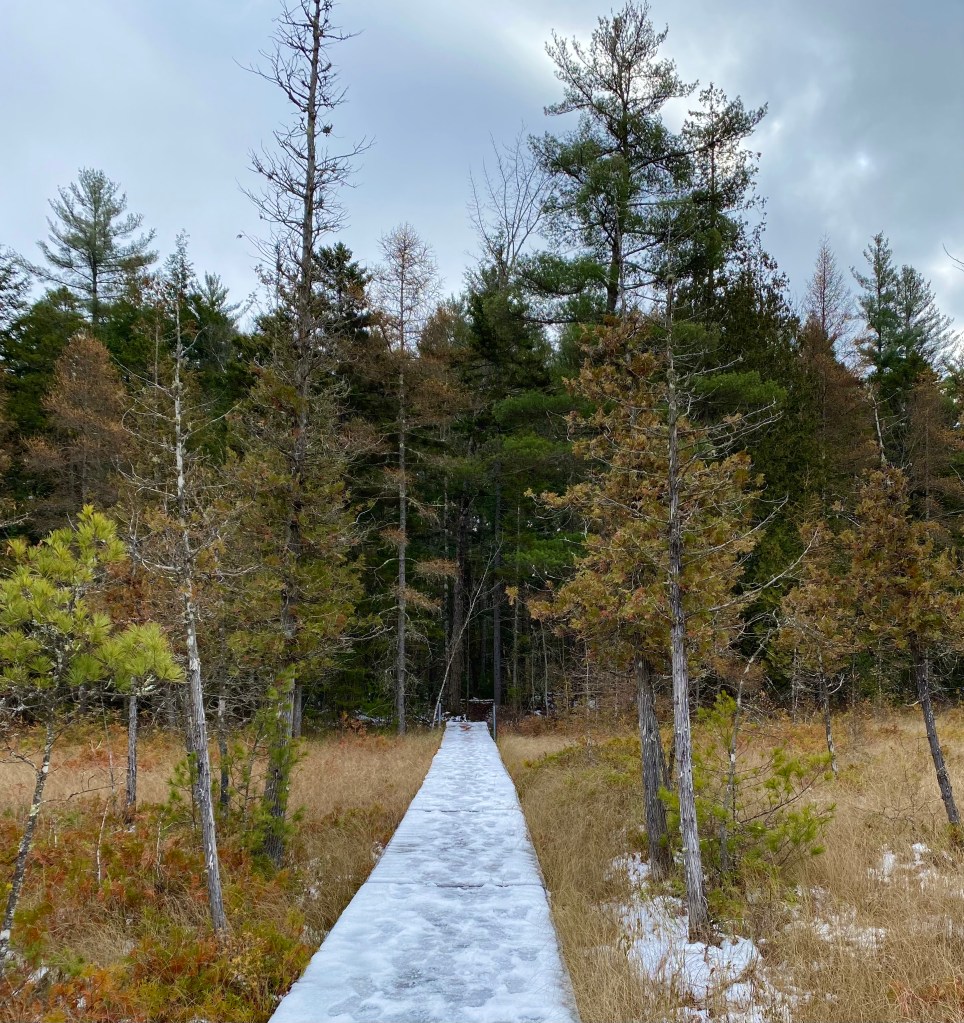
To break the gloom, we walk through woods not far from my house. Little streams run. Somone has built enchanting steps of fieldstones. At the path’s end, a bog stretches out, the tamarcks’ gold faded pale. Spring, summer, the birds sing wildly happy here. Now, the flutter of wings, nothing more.

There’s a place for all of this: silence and settling down, the drawing in for winter.

Come, for the dusk is our own….

— Lucy Maude Montgomery

A Story in Here…

I visit a woman whose family bought a house on a peninsula in a glacial lake. She invites me in — a stunning place of wood and glass and French doors — nothing polished, all preserved as if it’s still World War I. There’s an enormous stone fireplace. She tells me that, after a hurricane in the 1930s, the original owner (who lived elsewhere, New York or Pennsylvania) never returned after he heard that all the trees on the peninsula were destroyed, save for eight. He sold the house to this woman’s family. Great pine trees tower over the lawn and hydrangeas.

She says to me, Imagine the view of the lake in the thirties, when the trees were all gone? That must have been stunning, too.

I drive home in a sudden windstorm. I’m passing a stand of poplars, their leaves crinkled and finished with summer. The wind blows leaves through my open car windows, over a bucket of apples, on my library books, into the lap of my skirt. Ahead of me, two cars are pulled over, blinkers flashing. A branch smashed the windshield of one car. Two young woman stand in the road, the wind circling, twigs snapping, rain beginning in earnest. One woman raises her arms in a giant Y.

There’s a story (or two) in here for sure….

No Going Back.

July 1: I’m driving on a back road to a nearby town where there’ll be the traditional New England small town Independence Day festivities, when I suddenly realize I can no longer see the road before me. The road dips down and then rises up. I know this, because I’ve driven this road so many times. I know precisely where to swerve around the persistent pothole where the stream runs under the lowest point of the road. But the rise is hidden in smoke.

The day marks a line for me, a place I won’t forget. I’ve been here before; this is familiar territory. I remember the precise afternoon I knew I would severe my marriage. Likewise, today, it’s clear to me that this smoke, in what will likely be one unimaginable variation after another, will remain.

Nonetheless, I go on into the day, watch the parade with an old acquaintance and we catch up about kids, ruminate about our old college days. I talk to a woman who’s built a house of cans and bottles and tires. She asks me to stop by sometime. Heck, who could pass that up? Of course I will.

Then I’m back home again, working, working, on this third book, taking it apart, sewing it back together, phrase by phrase. I wind in how it feels to walk along the edge of a lake that may not be frozen and thread through the Himalayan blue poppy, a child’s nightgown, pebbles under a clear running stream. I’m after those same old things: how to salvage order and beauty from chaos and destruction and despair. A river of sadness is not the torrents of despair.

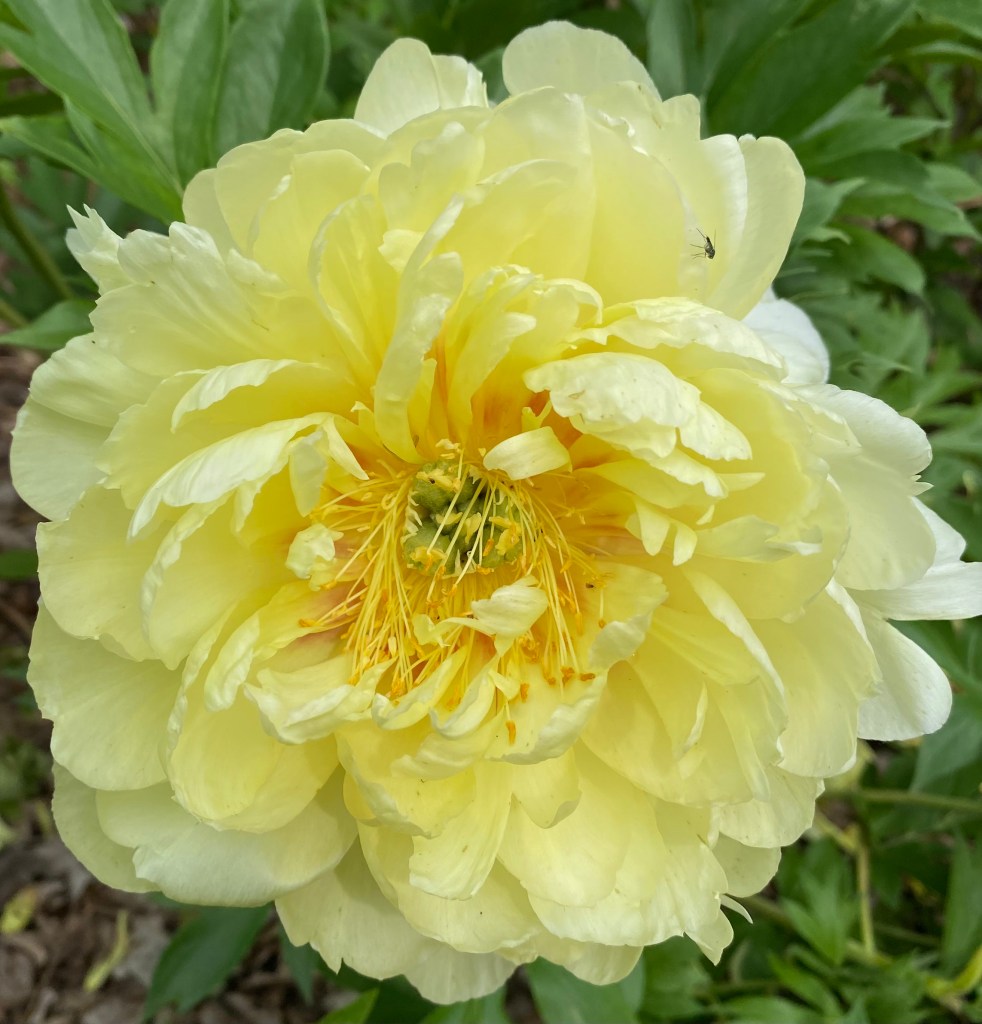
Swim. Bartzella peonies. My neighbor leaning out her door, green curlers in her hair, saying hello.

A Motorcycle is a Vehicle of Change…

On the cusp of the solstice, the evenings are chilly yet, mist pulling around our house.

I pull on a sweater — a wool sweater — as darkness falls and walk through the small stretch of woods into the cemetery. A stranger wearing a t-shirt and drinking a Fanta walks down. He looks at me as warily as I’m probably looking at him and then we exchange a mutual good evening and head each our own way, our mutual bit of our stories nothing but this.

Solstice — I’m hoping for sun and heat, for evening swims to stitch my summer together. I want to swim through pollen scattered on the still pond, glide through the ripples stirred by ducks, to have the mundane details of my life and my swimming companion’s life sewn together, swim by swim.

In the absence of swimming, I’ll sing the praises of those midday walks admiring the lupines and forget-me-nots, reading under the dwarf apple tree that’s long surpassed smallness, the fledgling robins clamoring for worms.

“A motorcycle is a vehicle of change, after all. It puts the wheels beneath a midlife crisis, or a coming-of-age saga, or even just the discovery of something new, something you didn’t realize was there. It provides the means to cross over, to transition, or to revitalize; motorcycles are self-discovery’s favorite vehicle.” 

— Lily Brooks-Dalton, Motorcycles I’ve Loved