In this early July heat, there’s one clear path of wisdom: subsist on watermelon. So I’m opening my car door in the co-op parking lot when I glance over my shoulder and a friend from long ago is sitting in his pickup beside me, eating a sandwich. I set the melon on my driver’s seat and lean against my car, and we catch up, mostly about kids. I know, in the randomness of what my memory snaps tight, that he’s just about my age, 58, and between us we know plenty—about broken marriages and houses we’ve sold and a terrible tragedy in the town that now lies hovering beneath the surface. He is the kind of father who showed up at school board meetings in dirty t-shirts and wondered, existentially, what was transpiring.
He tells me that he’d just heard that I had (I suppose, technically, do not curse myself, yet still have) cancer. In the fierce sunlight, I cross my arms along his open truck window and tell him what that was like, news of metastatic cancer in the ER, my 19-year-old running out, her sister immediately following, and me in my sweater I’d knit and worn so hard it was felted, in my jeans, with these two strangers, an MD and an RN, and sorrow. Around me, the void. I had been naive for all of my life thus far: the Reaper always surrounds us, escorting us in and out of this world.
It’s July, and I’m well at the moment—so well—full of sass and merriment. The sorrow that wreaths me is not at all my unique terrain. In this parking lot, me still holding a tomato I’d bought, too, and he with that sandwich of shredded lettuce and mayonnaise, we linger, talking, about the ineffable joy of parenting little girls into grown women and its counterpart: grief.
On this eve of this American holiday, maybe lay down the slogans and dictums, speak up or be kind, the opinions and beliefs we hold so dearly. Maybe widen the frame.
He wishes me luck with my new book, and I wish him luck haying. My little town has temporary stoplights as a crew labors to guard against the next flood. Waiting, the scorching air blows into my car, and I blink. What luck. Another day of human life. And watermelon, too.
“Sometimes life is merely a matter of coffee and whatever intimacy a cup of coffee affords.” ― Richard Brautigan
For readers who haven’t lived in northern Vermont, here’s a keyhole view of June: heat and humidity move in, and the earth thrusts out into leaf and bloom. Overnight, the loosestrife blooms yellow, the chard gains an inch in leaf. The lilacs fade. The Siberian irises spread purple.
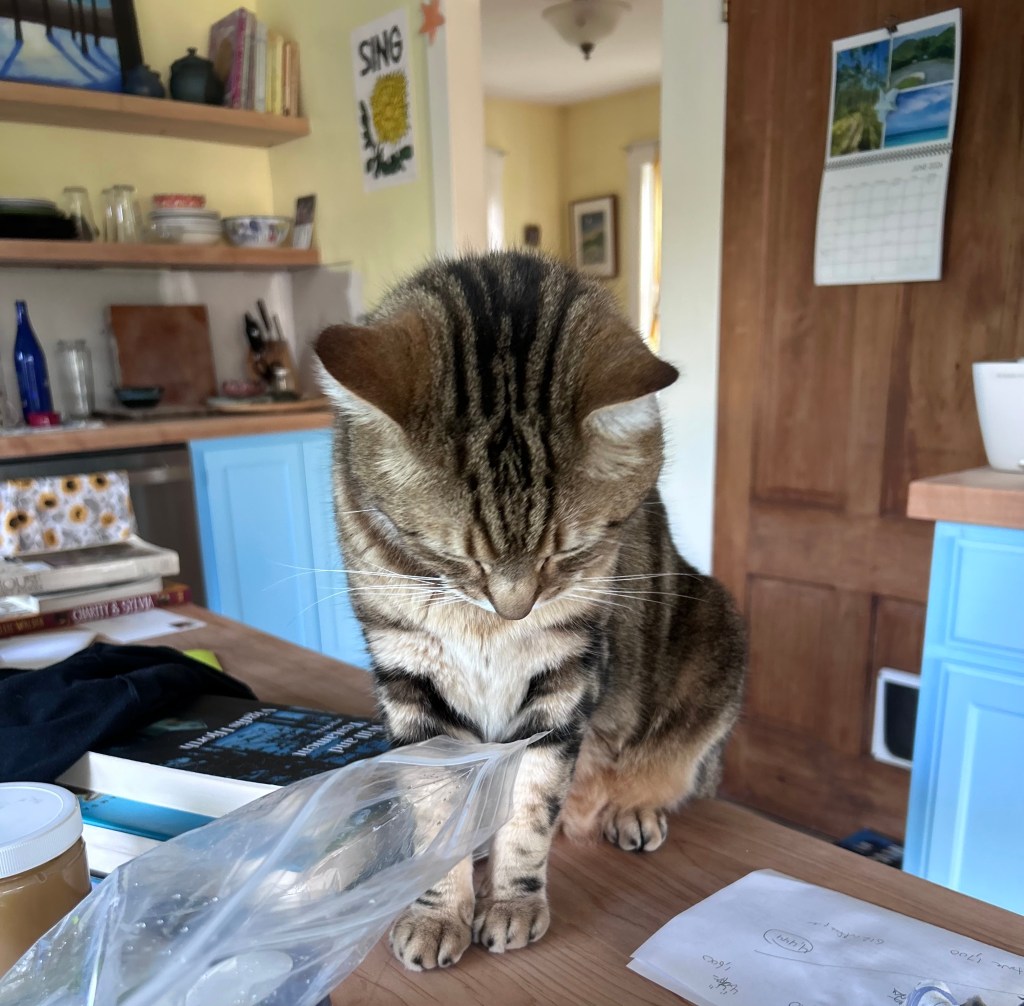
In the heat, listening to terrible news of the American Empire’s spread, I finish stacking next winter’s firewood. Sweaty and dirty, the cats and I admire my work, contemplating the frosty fall evenings. The cats, perhaps, are merely curious about my labor, or the next meal’s arrival, or perhaps a cat calculus I don’t imagine.
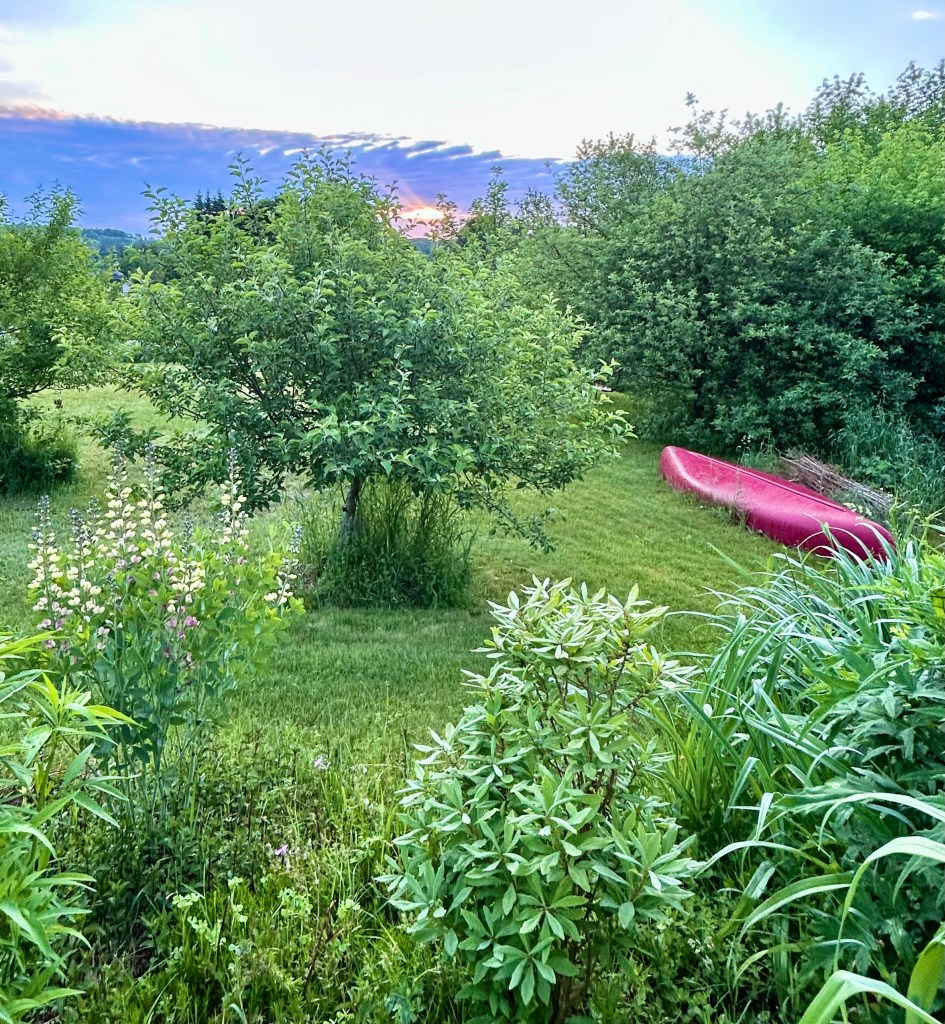
June, the songbirds serenade exquisitely. I mow the grass around the woodpile, the pink roses beginning to bloom, the brushy compass flowers that are now knee-high. Will the ancient mock orange leaf and bloom? Will the woodchuck devour the sunflower seedlings? Will I unclench my knotted heart and let myself fall in love, tumble into the next phase of whatever I may have in this lifetime?
Rain falls and the heat breaks as I finish mowing. I wander around, drinking a glass of water, the rain running through salt and chaff on my cheeks and biceps. 21 years ago, a friend labored to bring her baby into the world. I sat in her kitchen while our six-year-olds played under her front yard maples. Her mother-in-law made chicken soup that I ate while I nursed my own wee infant.
The world isn’t filled with ten thousand things. In the June afternoon’s rain, a rainbow elusive, math welds no teeth. A hopping robin in search of sustenance, unfolding hydrangea leaves, the bounce of a child’s basketball, the scent of sap bleeding from winter’s firewood.
For local folks…. I’ll be reading at Still North Books in Hanover, NH, Wednesday, June 17, 7 p.m. Yes — a lovely bookstore — and yes, a non-cancer visit to this lovely village.
Is not all the summer akin to a paradise? — Henry David Thoreau
On this Mother’s Day, I pull on my coat and wander into the early spring garden with hot coffee. Blue dawn, the birds are at their singing nesting work already. My cats, satiated with breakfast, sleep on windowsills, dreaming perhaps of red-breasted robins prying worms from the rain-soft earth.
My mother died two springs ago. She’d lived a long life, crammed full, from joyous passion to bitter despair. In the same year, I suddenly stared at my own mortality. In those first days of the cancer realization, I railed that I wasn’t done, that to die while my youngest was yet a teenager, was out of the natural order. Or what I wanted to believe was the natural order. A belief which had, of course, no bearing on any natural law, whatsoever.
Severe illness returned me to childhood again. Too weak to boil water for oatmeal or tea, with hours upon days upon weeks upon months, lying in bed or on the couch, watching sunlight and shadows move across the maple floors in my house, the hospital tiles. There was an old tradition of slipping a knife beneath a laboring woman’s mattress to cut the labor pains. In those months I fought to remain alive, I slowly realized my mother and father had each slipped me a knife: my father gave me that writing and fortitude, my mother a wily stubbornness that was sometimes silly and often tenaciously sharp. Invaluable.
Yet here I am, lucky enough to have another act of my life unfolding. The daffodils I planted last October are blooming, brilliant yellow against the row of lilacs that are just beginning to bud. In my kitchen, I washed last night’s dishes, discovered a white quartz left as a gift on the table.
The First Green of Spring
Our walking in the swamp picking cowslip, marsh marigold, this sweet first green of spring. Now sautéed in a pan melting to a deeper green than ever they were alive, this green, this life,
harbinger of things to come. Now we sit at the table munching on this message from the dawn which says we and the world are alive again today, and this is the world’s birthday. And
even though we know we are growing old, we are dying, we will never be young again, we also know we’re still right here now, today, and, my oh my! don’t these greens taste good.
As part of the 2050 project, I’m asked to read at Newbury’s Tenney Library, surely one of the prettiest Vermont libraries, and Vermont has plenty of these. The crowd is full and cheery, the snacks are sweet, the librarian gives me a tour of this enchanted place, built inside as a series of arches. The original gas lamps have been converted to electricity, and I ponder what it was like in 1910 or so, coming in from a slushy afternoon to a warm and glowing library.
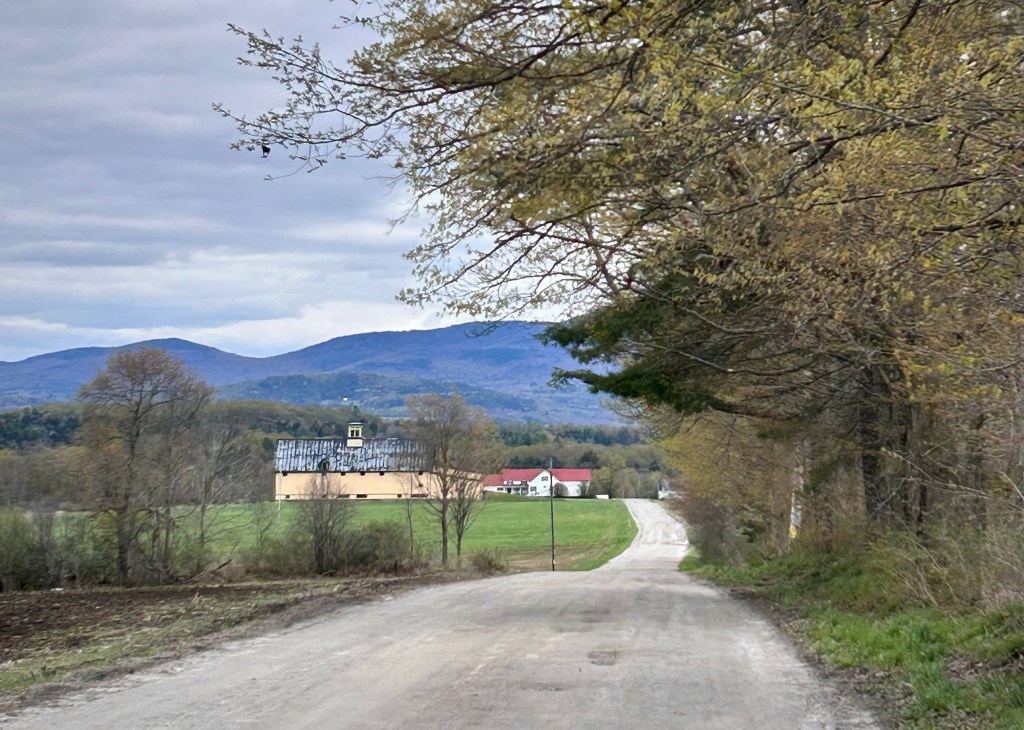
Newbury is a town on the Connecticut River, the village high on a bluff. Before I head out, I walk across the street and behind a church. Through the trees and brambles that are just tufting with green, enormous fields stretch along the river, long rectangles of emerald, others black earth harrowed up for planting.
I linger, shivering a little in my wool sweater, hands jammed in my jeans pockets. Early May, spring season of promise. That plowed-up land, the blue swoop of the river, the invincible thrust of spring pushing mightily through the chill — such happiness here. I head not back to the interstate, but up a mountain’s dirt road, to a house surrounded by green and blooming daffodils and a tangle of apple trees. A lovely couple invited the readers to dinner. The couple is both humorous and gracious, the conversation full of the idiosyncrasies of local talk and global concerns. The pleasant evening drifts into night, from eggplant to lemon tart. Exhaustion, my now familiar, weighs my bones. After thankyous, I stand outstanding in the cold wet, breathing what might be the spicy scent of daffodils growing, threading through in my mind the unfamiliar roads I’ll follow home. Then I let that worry go and simply breathe, damp spring holding me, as if I’m a daffodil, too.
“Like daffodils in the early days of spring, my neurons were resprouting receptors as the winter of the illness ebbed.” ― Susannah Cahalan,Brain on Fire
About a decade ago, when I was first navigating single parenting (so many unfun challenges!), I held to the notion that every time a door slammed in my face, I’d scramble through a window. In my novel that will be published next year, a character says Really? We’re taking life advice from The Sound of Music? But it’s a darn useful approach. Small and scrappy, I’ve been tumbling through windows for years, although admittedly wounding myself on broken glass sometimes.
These balmy autumn days, raking leaves over garden beds, I’ve had a whole sun-rich summer of remission, of cancer survivor, of figuring out how to walk and eat, work and sleep again, these simple things that often eluded me all winter. A summer of learning to live within the bounds of this alive-but-more-broken body. By chance, I meet an old friend who comments about my short hair, and I spill a snippet of my lymphoma which she had not heard. Our lives, connected through kids now grown up, have taken different paths. I’m on the edge of saying that I don’t know how I survived last winter, but I hold back.
Last night, I stepped out of our warm house where the cats are again sprawled in their favorite place before a toasty wood stove and walked out to the nighttime garden to look at the half moon, hung in the sky among the constellations like a profound mystery, cream tinged with autumn’s gold, loveliness incarnate. The cold held me. One of my earliest small-child memories is looking through my father’s telescope at the pocked moon, wondering, wondering…
Mid-October, and the crickets are still singing. The elements for my survival include so many of you here, who sent me letters and cookies, books and cards; access to medical care (a great privilege); friends and colleagues and my dear family… and my own scrappiness, my fierce desire not to slip away from this world and this patch of acreage, the half-moon sailing silently over my frost-gnawed garden.
“You own everything that happened to you. Tell your stories.” ~ Anne Lamott
An old friend unexpectedly appears at my door one evening as I’m folding laundry. We sit on my back porch and drink hot honeyed tea and watch the just-beyond-full moon slowly rise. September, the night’s chill creeps in around us. I grab my hat and coat and brew more tea.
All this fall, I’ll be thinking of a year ago, when I was getting sicker and sicker, with no real understanding why until that terrible night in the ER when a scan revealed cancer, so much cancer. Heading towards a year later, I’m admiring the moon sail over the mountain ridge and up through the trees. We keep talking and talking. It’s not so much the words that stitch us together but our chuffing breath that hangs in clouds between us, a howling neighborhood dog, a rustle in the ravine of a wild creature.
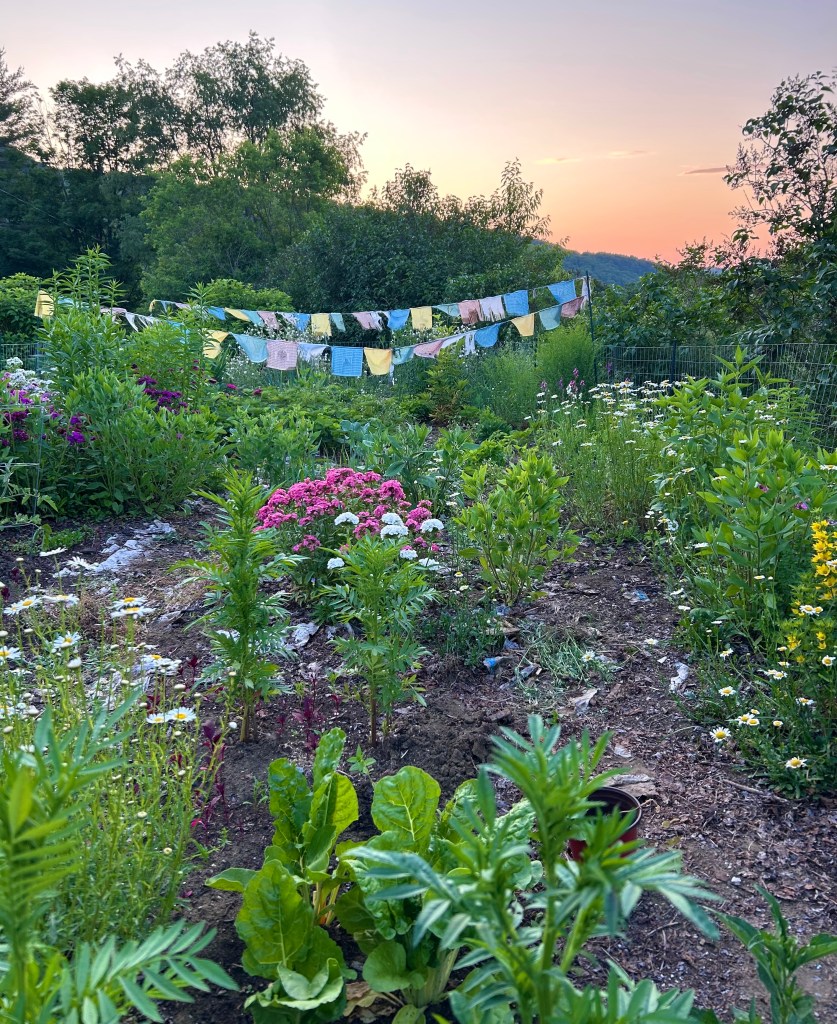
After my friend leaves, I wander around the moonlit garden, hands in my coat pockets, the tall amaranth a shadowy forest beside the closed four o’clocks. Frost is not far in the offing.
Inside, a daughter has texted me….. where are you?… Outside, breathing in the moonlight. Still here.
Instructions on Not Giving Up
More than the fuchsia funnels breaking out of the crabapple tree, more than the neighbor’s almost obscene display of cherry limbs shoving their cotton candy-colored blossoms to the slate sky of Spring rains, it’s the greening of the trees that really gets to me. When all the shock of white and taffy, the world’s baubles and trinkets, leave the pavement strewn with the confetti of aftermath, the leaves come. Patient, plodding, a green skin growing over whatever winter did to us, a return to the strange idea of continuous living despite the mess of us, the hurt, the empty. Fine then, I’ll take it, the tree seems to say, a new slick leaf unfurling like a fist to an open palm, I’ll take it all.