Under a Thousand Stars.

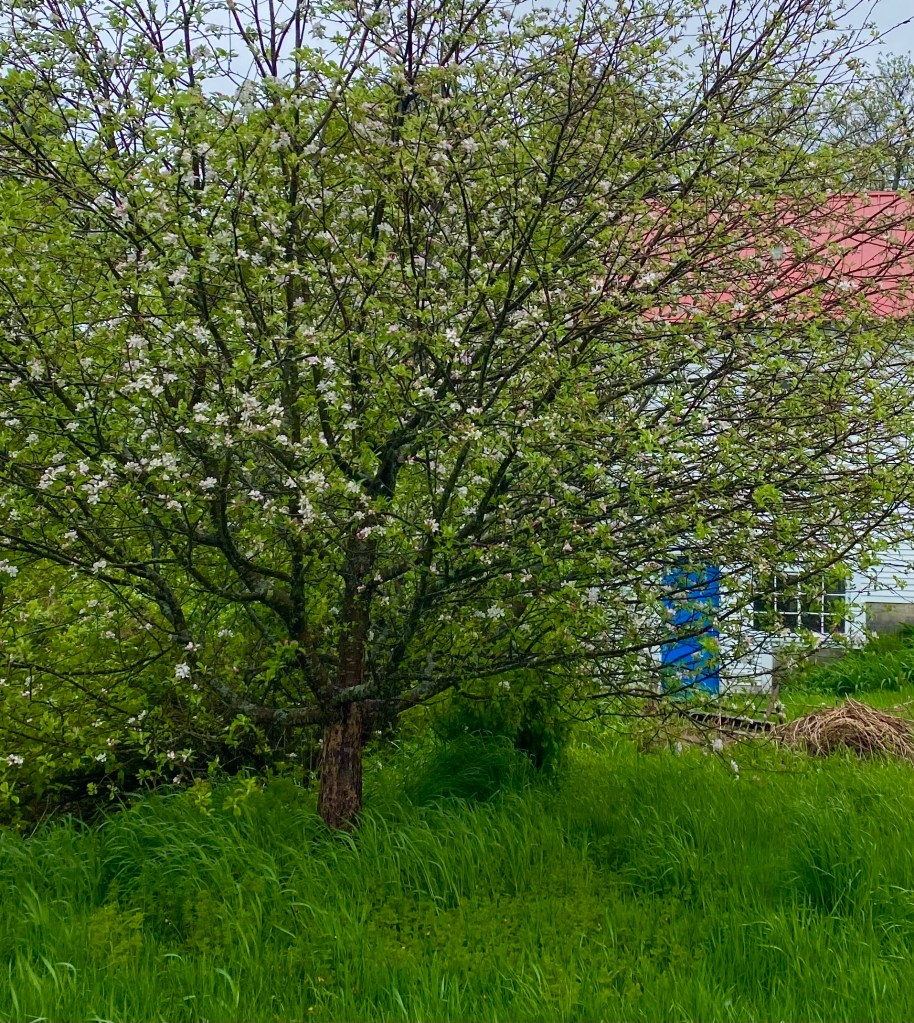
Walking home, I spy a smattering of white blossoms among a stand of pines, off the path. That short stretch is a strange area, more sand than soil, unusual on my Vermont hillside. Running theory is that someone stripped the top soil, years ago. Although I haven’t energy in excess, I’ve enough that I wander from the path. The blossoms are wild strawberries. Sweet mark of June.

For those not in New England, the common gripe is the weather. Every weekend, rain. Figures are tossed that there’s not been a fully sunny weekend since December; then I hear November. As for me, recovering, the days and weeks merge. Now, three weeks out from surgery, I’m easing back into work. The cats wake me at early light. In recovery, my old worries rekindle, but so does my drive and curiosity. I get up, eat cereal and maple syrup, brew coffee. I spread the manuscript of my fourth book over the kitchen table, cut, rearrange, stitch.

What’s changed, though, is a new slowness, a willingness to let the course of things unfold, to crouch beside those strawberry blossoms, wondering which birds will snag the tiny crimson berries. In a few weeks, I may wander here and sample this sweet delicacy. Half of this May, I lived in a hospital. Finally, I limped out the door with my brother. While he drove me home, I kept saying, “I’m out, I’m out,” and “The trees are leafing, the forsythia is blooming, the lilacs are opening.”

That surgery and that stay might likely have saved my life, again; and again, how immeasurably capable and kind was the hospital staff. Nonetheless, it’s June. The sky this morning is scrimmed over with smoke from wildfires. Under that dome, I have work to do. A friend will visit. I’ll move through this day, this Wednesday, happy.

I want to lie out

on my back under the thousand stars and think   

my way up among them, through them,   

and a little distance past them, and attain   

a moment of absolute ignorance,

if I can, if human mentality lets us.

I have always intended to live forever;

but not until now, to live now.

~ Galway Kinnell, “The Sekonk Woods”

Mending…

After nearly two weeks away, I return home to the trees in full leaf, the lawn gone wild with violets and strawberry blossoms. Drizzly, cold, my brother starts the wood stove. The cats uncurl themselves before the blaze, satiated. A cold May, but verdant, lushly and satisfyingly so.

In these post-surgery days, I limp from room to room, venture outside to tug down a lilac branch and breathe in. The weeds run rampart, but whatever… the garden, too, will be sorted and tidied.

I’ve written repeatedly about the lilacs around my house, but again, I reiterate my joy in the soaring bushes. When I was five, we lived in a small green rented house, its yard surrounded by chainlink fence. A lilac bush leaned over the fence from the backyard neighbors. My second-grade sister was in school afternoons, my toddler brother sleeping, and so, after kindergarten and lunch, I lay on the long grass, staring up through the quaking leaves. These bushes, so New Englandy quaint with lavender, violet, and white blossoms, remind me of those unbounded childhood hours. One o’clock, two o’clock? Who knew? Who cared? I had just learned how to tie my shoes.

Like the walking wounded, I hobble from couch to chair, through the long grass, out of the workaday world and, yet, far from being a child. In glorious remission, in recovery from surgery, I keep thinking of this poem below, as I begin, day by day, to mend my body and life.

“Da Capo”

Take the used-up heart like a pebble
and throw it far out.

Soon there is nothing left.
Soon the last ripple exhausts itself
in the weeds.

Returning home, slice carrots, onions, celery.
Glaze them in oil before adding
the lentils, water, and herbs.

Then the roasted chestnuts, a little pepper, the salt.
Finish with goat cheese and parsley. Eat.

You may do this, I tell you, it is permitted.
Begin again the story of your life.

— Jane Hirshfield

Reading After Twilight.

Quicksilver, the summer’s ended. Sure, there’ll be more long days, redolent with golden sunshine, but the air has sharpened, mist slinks through the valleys in the mornings, the flower petals are running towards ragged-edged.

Evenings, I read outside, the crickets tapping away at their slowing symphony, the mosquitoes on my toes, silent bees still sucking at sunflowers. The world moving along.

“It is not our job to remain whole.
We came to lose our leaves
Like the trees, and be born again,
Drawing up from the great roots.” 

— Robert Bly

August Gloaming.

The foxes that denned behind our house did not return this year. A neighbor who lives around our hillside shares that she saw a kit earlier this summer, and we speculate that the fox family set up summer quarters nearer her. It’s all speculation, neither here nor there.

Who has returned are the turkey vultures, roosting in the pines between our houses, reliable as the rain this summer.

Mid-August, and the kids are trickling back to school. A friend texts me that her son is headed into his senior college year. I remember when this kid was born. He used to come to our house and stand on a kitchen chair and bake cookies. In this soggiest of summers, still time unspools inexorably. In the evenings, we sit outside and watch the sunset sprawl crimson, the mosquitoes drawing drops of our blood.

The pollinators suck at my small garden’s calendula, gold and orange. A few years back, I sowed a few seeds. Gone wild, the calendula reseeded rampantly, nestling against tomatoes, among cucumber vines. I haven’t the heart or will to pluck a single flower.

It rained for three days straight, a relentless steady rain that kept up its monotonous rhythm day and night, there being no periods of waxing and waning or moments of imperceptible brightening…

— Mary Hays, Learning to Drive

Crickets

My daughter’s friend spends the afternoon on our back porch. When I come home from work, the girls are still chatting and doing crafts. The sunlight dapples through the box elders. Around us, tomatoes ripen.

We are ensconced in porch life, our half-covered deck redolent with drying garlic, the nasturtiums dangling their delicate, impossibly beautiful blossoms from hanging baskets. In the mornings, we read Henry IV, Part One aloud with my parents in Santa Fe, my sister and nephews in Virginia, circling back to Falstaff’s words — “A plague of sighing and grief! It blows a man up like a bladder.” Beside me, my 15-year-old rubs a finger over the scraps on her knees from blackberry brambles.

August is the sunshine month in Vermont, the season of wild berries, of warm lakes, of flowers in excess, of lying on the grass as the stars come out, of a great long pause before autumn sets in and winter grinds her teeth.

Our deck, our house, and garden might as well be the whole world, with the turkey vultures silently circling overhead, the wood thrush singing sweetly in the ravine. Before dinner, I toss a withering bouquet of giant zinnias in the compost and cut a fresh handful for our dinner table. August is our rainbow month. I know my daughter’s desire for school, for soccer, for this future none of us seem able to imagine — but long may August last, please.

The crickets felt it was their duty to warn everybody that summertime cannot last for ever. Even on the most beautiful days in the whole year – the days when summer is changing into autumn – the crickets spread the rumour of sadness and change.

— E.B. White

IMG_8152