Talking Past Dark.

A friend comes to visits, heads to my picnic table, and we commence talking. Hours later, a dewy dusk has descended. I’m shivering, my sweater cuffs pulled all the way over my hands. Inside, my cats are grousing for a fire in the wood stove.

I remember my friend’s oldest son sitting on my couch, about an eon ago. The boy was so small his legs didn’t reach the end of the couch. Now, he’s thinking of heading into a PhD program.

I haven’t seen this friend in months, since before I traveled to Europe and decided I was born on a continent that mismatches me. Yet, we start talking as though I was a young mother again, walking along the dirt road with a toddler, my hair unbrushed for days.

It’s a cliche of course, how the world changes and how it remains the same, that one long Heraclitus river — always the stream, never the same.

The foxes didn’t return to den behind my house this year. A few stray lilacs bloomed in late September. The harvest moon sails up in the sky. All our hours of talking and we solve absolutely nothing, not a single problem, except this, perhaps: a fattening of our friendship, this woman who assured me I would survive my divorce, that my life would continue. The sun heads down, and we keep on talking.

In Very Vermont Fashion….

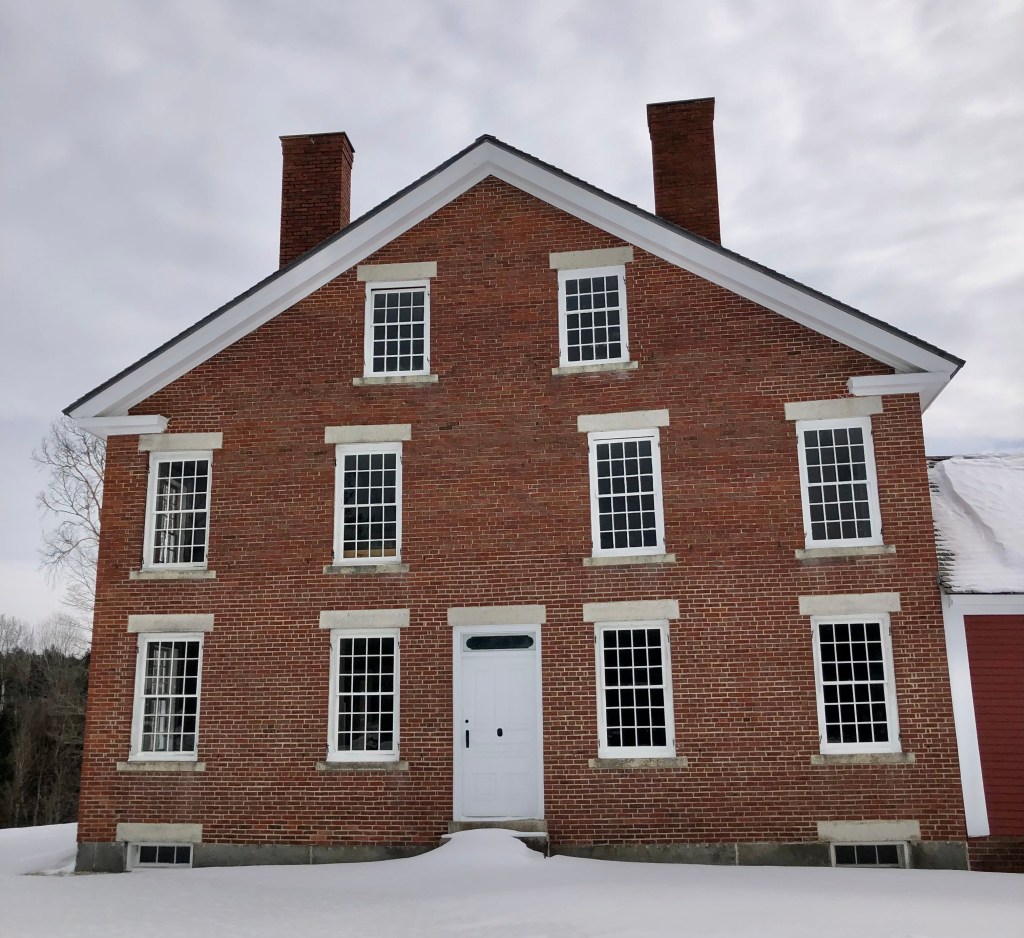
… I stopped by an art opening in a former brick stagecoach inn. In the Vermont way, the art was eclectic and superlative, the cheese local, the diminutive cupcakes homebaked, and the company excellent. My friend is the easy kind of person who doesn’t mind stepping forward with a plate of olives in her hand and introducing herself to a former library volunteer of mine whose name I can’t quite place….

Across the dirt road is an old barn where a stone labyrinth was placed a few years back. While my friend and I were talking, we watched two strangers do an excuse me, no, excuse me, sorting out who was going to enter the labyrinth first.

Small pleasures, friends, against the inevitable chaos of life.

Small Reckonings.

I’m sitting in the back of the school library on the wall heater when a friend I haven’t seen for years walks in. A large school board meeting has started, and we whisper to each other until I suggest we leave and talk. Early evening, the school is empty, and turn on the lights in a room where my daughters both had classes. I pull out two chairs from the student tables.

Almost immediately, we start in on what should be a simple math problem — March 2023 to March 2020 — which yields an unbelievable three. Before the pandemic we worked together and spent hours talking about literacy and kids, about schools and families, but we also talked about canning tomatoes, about parenting, and being women. We ask how this or that turned out for each other — some decisions, some simply a bend in circumstance.

By the time we leave, the school has completely emptied out for the night. The weather has turned mild, and we walk slowly under the dim lamplight to our cars. A mist rises over the soccer field. I get in my car and drive down the hill and across the river and up the hill to my house. The village lights sparkle in the mist. The moon edges around a break in the clouds. In the darkness I stand there, thinking about the numbers we put together, marking places in our lives, then adding and subtracting our lives—people and jobs and books and houses. The numbers all mesh together, consumed in our shared stories.

Interlude.

Checking out at the co-op, an acquaintance says she has a question for me. I follow her outside, and we stand in the falling snow, she with her bags full and me with the tomato and yogurt my youngest requested.

Through the snow, the mural across the street glows its brilliant rainbow of colors. Across Vermont, murals have appeared in the past few years, not just in the usual suspect cities — Burlington and Brattleboro — but in places where art seems least expected: a parking lot, or the roadside field in Jeffersonville where cement silos are beautifully painted with an old man sowing seeds, a red clover blossom. Half a decade ago, driving with four young teenagers, I pulled over and we walked around and into the empty cement tubes. Springtime, we splashed through standing water in the hayfield.

Now, snow swirls around us, my favorite kind of drifting snow, magical and full of possibilities. We talk for maybe ten minutes, while I hold that tomato and a paper bag of granola, shivering, while people trudge through the snow around us, buying baguettes and greens and bottles of wine. We’ll find no answers in our brief conversation that picks up those knots of privilege and power, of pretense and betrayal. This far along in our lives, there’s nothing textbook here. The questions shape our lives, the little world where we live.

I suggest a sliver of a solution, a tiny change, a minuscule movement, a small slice of good. By then, I’m shivering fiercely. The night’s falling down, and my small household will be hungry.

The painter’s vision is not a lens,

it trembles to caress the light.

— Robert Lowell, “Epilogue”

Bobcat. Saw-Whet Owl.

I arrive a few minutes early to meet my friend for coffee and look for a window table to open my notebook. A writer I know just a little is eating a ham and cheese sandwich and asks me to sit down. He’s old enough to be my father if he began fatherhood at a young age, which I know he didn’t. He immediately tells me two things: he’s waiting for his back road to be sanded and he saw a bobcat in a tree behind his house that morning. He describes the cat’s reddish fur, and I ask detailed questions about the wild creature’s size and location and poise. My friend arrives and they keep talking about San Francisco, and then he tells us about studying with Joan Baez at The Institute for the Study of Nonviolence.

The bakery is at a busy intersection in Montpelier. Through the window, I see people in colored winter coats. Until the pandemic, I often brought my laptop to work at this bakery and the one across the street that closed a year or two ago. Two blocks up is the public library where I wrote long sections of my last book. None of these places I’ve returned to work. Like everyone else, my life has changed, my habits recreated.

The bakery is closing. The day moves along. My friend and I walk through Bear Pond Books. She buys me a novel, hugs me goodbye, and heads on her way. I walk the long way back to my car. That night, I dream about the saw-whet owl my daughter and I glimpsed in the woods behind our house. A toddler, she pointed at the hemlock branch where the tiny bird was nestled in the greenery, its eyes wide-open. We stood there for the longest time, wordless, our breath frosty clouds in the winter air.

“… nothing is a promise, but that beauty exists, and must be hunted for and found.”

— Joan Baez

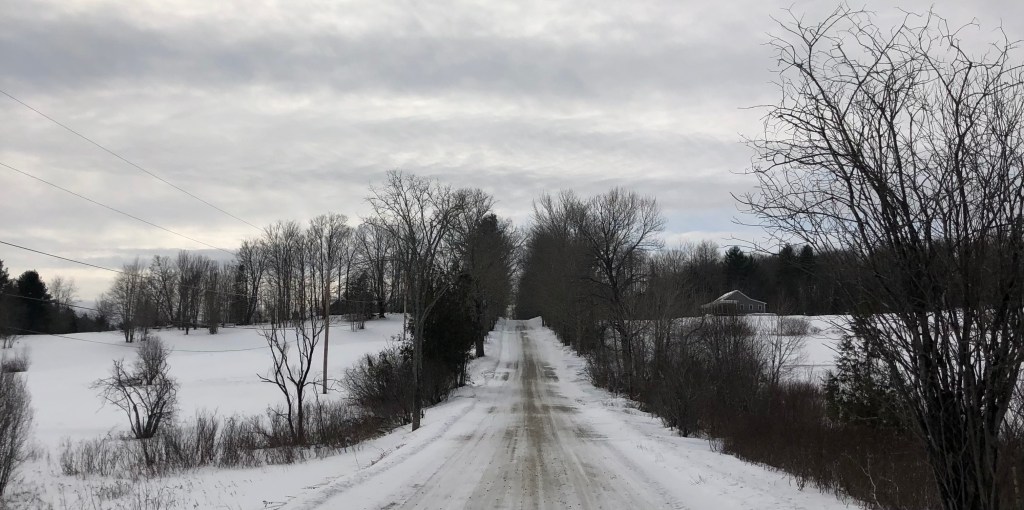
Somewhere in February. Dirt Road Land.

Kents Corners, Calais, Vermont

Every so often, a friend and I make plans to meet at a rural crossroads, at a brick inn that was once a stagecoach stop. I imagine in those days the crossroads was populated with chickens and horses, with people coming and going, not Priuses, but in wagons and on foot. My friend and I began this habit in the summer of 2020, and so the inn has been shuttered to the public all this time.

Walking, we pass a few other Sunday walkers bundled in coats and hats. But few people are out, and there’s scant traffic. In contrast, our conversation is packed — about raising kids and planning spring gardens, about relationships, about navigating the working world as a female in a patriarchy (why are these conversations still necessary, anyway??)

The thing about Vermont in midwinter is the stillness and what breaks that quiet. Icicles drip, freeze, and then thaw and drip again. Birds appear at our feeder in increasing numbers, then whisk away again. A rouge wind blows in a squall, soon chased away by the emerging sun.

Pandemic notwithstanding, robins return to our crabapple trees.

“Things are as they are. Looking out into the universe at night, we make no comparisons between right and wrong stars, nor between well and badly arranged constellations.” 

— Alan Watts

(And many thanks for Erika Nichols-Frazer for a review of Unstitched in the Valley Reporter.)