The repair of the world might, indeed, be impossible…

In a gray drizzle/not quite drizzle, I stop outside the co-op to talk, my hands full with peaches, mozzarella, and Clif bars for my daughter’s hike the next day. The prediction is for temps at high elevation in the thirties.

My conversation companion is a woman I run into randomly, usually on the sidewalk, and inevitably we jump right into talking. It’s August and dreary with wildfire smoke and a sudden cold rain. My hands are full with those peaches and sweets, so I’m blinking in the misting rain. I’m laughing a little, because why not? but I sharpened up quickly as she’s not laughing at all. The strange thing is she’s listing some things that have been rattling around in my mind for months now – the collective frustration that bends dialogue to anger or sarcasm, the way the town’s Center Road is so unkempt grass grows through its middle, and the recent property tax bills that are are you kidding me?

And even though my daughter is at home waiting for the cheese for that pizza we’ll make from onions and basil and tomatoes I’ll snag from the garden, I leave my few groceries in my Subaru and follow my companion through the damp woody patch behind the co-op. We stand at the river’s edge. She leans far out over the water. Look, she says.

It’s drizzling, and even though I’d gone running just before stopping in for what I thought would be a few minutes’ worth of shopping I’m starting to shiver a little. But I have this sudden vision of what’s happening with this town where I live, how the river threatens to wash away this downtown of brick and granite and asphalt, trees and roses. Years ago I realized that brokenness is never one thing; all these unfixable things – climate swings and decades (centuries?) of ill-use and reliance on the Feds to fund these fixes, when that amorphous federal government… well, why say more there?

A few years back, I interviewed a well-known writer who advised me that a writer should always acknowledge her time and place. The rain’s fattening. The repair of the world might, indeed, be impossible. At home, our kitchen is warm and bright, and the cats are half-sleeping as cats do on the rug before the kitchen sink. I’ve always believed in domesticity as the antidote to the world’s inevitable callousness. Later, I wander over to the neighbor’s house and lean in her doorway for a bit. We talk randomly about nothing much at all, catbirds and rose thorns, no repair, but a strengthening of heart, surely.

Late August, given heavy rain and sun
For a full week, the blackberries would ripen.
At first, just one, a glossy purple clot
Among others, red, green, hard as a knot.
You ate that first one and its flesh was sweet
Like thickened wine: summer’s blood was in it….

“Blackberry-Picking” by Seamus Heaney

Immensity taps at your life…

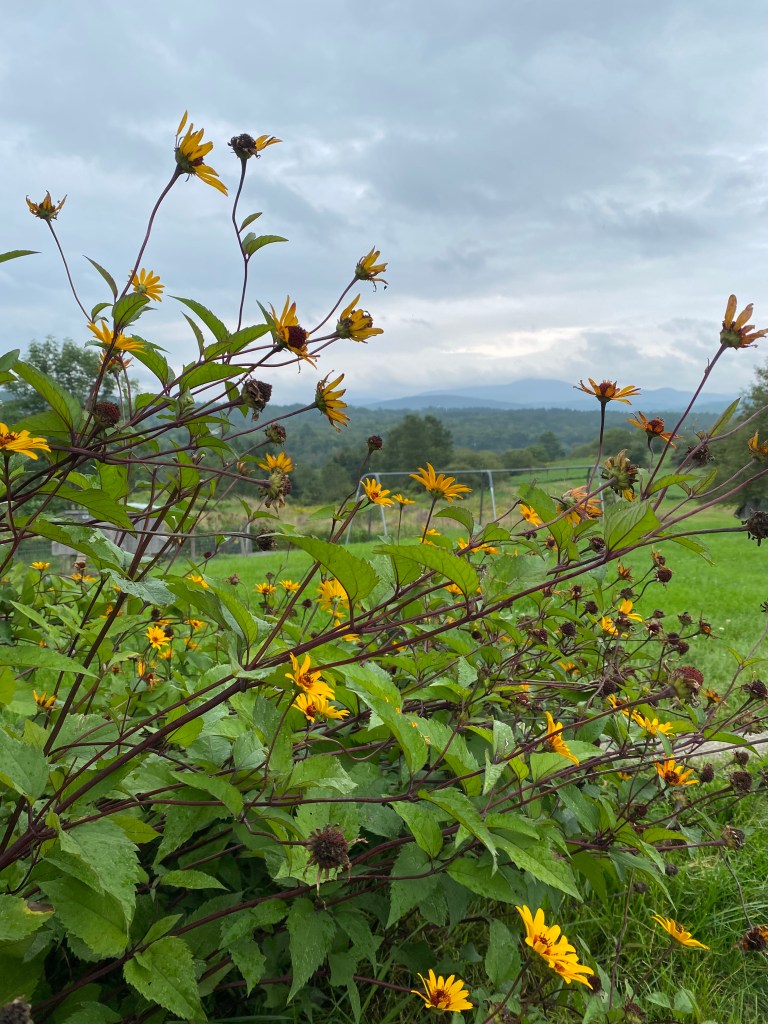
Nearing the end of August, the wild around our village house is mightily fortressing. The path behind our house has been given up this summer by friends; those who visit arrive via the street where the grass has broken the pavement, too, crisscrossed the gray with emerald. In the ravine behind our house, the foxes have kitted again this year. Randomly, the youngsters come out to chase each other. My daughter, who unexpectedly met the hissing mama fox, gave up that path a few years back. Only I now claw my way through the blackberry brambles, whistling, scraping my bare knees in some kind of penance for passing through their realm.

This year, while the human world on a great and local level has worked at its less admirable traits, the natural world has flourished. My daughters and I hold the apples and pears, gauging not yet, not yet. All around, a rioting of blossom and vine of what I’ve sown — sunflowers and morning glories, love lies bleeding — and the lushness of goldenrod, wild honeysuckle, creeping cucumber.

Oh, sweet illusion of Vermont’s August, as if stark November will skip her own visit this year….. On this dewy morning, smoke-drenched from wildfires so far distantly north, a favorite poem from Jane Hirshfield.

“Tree”

It is foolish
to let a young redwood
grow next to a house.

Even in this 
one lifetime,
you will have to choose.

That great calm being,
this clutter of soup pots and books–

Already the first branch-tips brush at the window.
Softly, calmly, immensity taps at your life.”
― Jane Hirshfield

The dark blossomings of chaos…

Again, this metaphor lens (how is it possible not to see the world in metaphors?) Paul and John’s Long and Winding Road, Dante’s gloomy forest, Sylvia Plath’s bees and beekeepers…

I lead a friend into a forest, a piece of Nature Conservancy land on a dirt road. We’re talking, talking, my eyes searching the forest floor for ephemerals (the trilliums folded shut, trout lilies still only leafy, no blossoms yet). I take one wrong turn, a second wrong turn. I backtrack, looking for the narrow stone steps. Our walking and talking — and my eventual smartening up to pay attention — takes us to Chickering Bog. In this pristine place, it’s just us and frog eggs, fat tadpoles, crimson pitcher plants — the confluence of ancient and freshly brand-new.

The strange thing is, I’ve walked to this bog half a dozen times, easily. Yet never in April when the sunlight drops down through the trees’ bare branches, when the winter-fall of broken branches strews over the paths. Or maybe I’ve never been here with this conversation about things tiny and great. The glassy water shimmers so clear the bog’s mucky bottom tantalizes, unreachable, so many centuries of so much life.

At the journey’s end, at the dirt road’s edge, the sprinkled gold coins of coltsfoot, a purple sprig of flowering Daphne.

On the reading front…..

“We must therefore be willing to get shaken up, to submit ourselves to the dark blossomings of chaos, in order to reap the blessings of growth.” — Gregg Levoy, Callings

Your own darkness.

An old friend from years ago sends me a message. She’s persistent, wearing down through my imposed or self-imposed hermitage, whatever this thing is I’m doing, and I drive myself out on muddy roads. She has such a lovely little girl, I’m smitten immediately. I sit down on the floor and chat up the child, and eventually remember my good friend and how much I enjoy her world. She’s funny, with boundless good will and cleverness, in a life that’s had her share of lemons.

End of March, nearly Easter, my perennials spike up further every day. How the earth desires green. I’m far enough along now in my own life that I know the cupboard of my mortal life will always hold certain grooves and scars, its beaten shape, the way the material in my life has shaped me. Aren’t we all that way, though? Maybe this is why spring is the dearest of seasons, that from mud and ice emerge tender shoots, the improbable made manifest every year.

Beginning

The moon drops one or two feathers into the field.   
The dark wheat listens.
Be still.
Now.
There they are, the moon’s young, trying
Their wings.
Between trees, a slender woman lifts up the lovely shadow
Of her face, and now she steps into the air, now she is gone
Wholly, into the air.
I stand alone by an elder tree, I do not dare breathe
Or move.
I listen.
The wheat leans back toward its own darkness,
And I lean toward mine.

— James Wright

“Writing is about breaking down…”

A book of Knausgaard’s essays makes its way into my house. On a snowy day, the cats and I finish putting together my taxes, then read. The snow piles and drifts. The next day, the snow melts and melts, running in sun-sparkling rivulets. Readers either love Knausgaard or despise him, like readers understand Halldór Laxness, or don’t, much in the same way that I have never understood Jane Austen. When I began reading Knausgaard’s Struggle books, a neighbor read at my breakneck pace, loving his words. She and I have long since traveled our own different lives. But reading these essays reminds me of her, how profoundly she believed in beauty as a force. Whichever way she’s traveled, I wonder how that’s worked out for her.

Writing is about breaking down what you can do and what you’ve learned, something that would be inconceivable to a craftsman, a cabinetmaker, for instance, who can’t possibly start from scratch every time.

— Karl Ove Knausgaard

Are you for real?!

The other night, I’m leaving a meeting in the high school library devoted, more or less, to hashing out what community means (nothing to be solved in a few hours). In the parking lot, a woman says Goodbye, Brett — and quicksilver, I shout, Are you for real?!

As the other folks empty out of the school into the spitting snow, she and I talk beneath the ghostly streetlamp. Very quickly, it’s clear to me how utterly wrong I am about this woman. What I believed was true was not. I once ate chocolate covered strawberries in her house with my youngest daughter. The woman packed up a bowl of these delicacies for one sister to give to another.

In ten minutes, we are speaking animatedly of matters of our hearts. We’re both shivering by then in the damp snow. We hug and head to our homes.

I don’t know what’s happening in the rest of the country, and I surely can’t speak for anyone else, but how glad I am that I called out in anger. And how much more grateful I am that she took the time to listen to me, to lend me her shoulder, and I could do the same for her. Indeed: real.

A community… is the knowledge that people have of each other, their concern for each other, their trust in each other, the freedom with which they come and go among themselves.

— Wendell Berry