Small Thing

While my 13-year-old chatted with a woman in an office today, I leaned back, yawning, thinking about another cup of coffee.

The woman’s low leather boots were worn at the heels. She was well-dressed with a silk blouse and gray slacks, in a professional position, and I assume lack of money was not the reason for her worn shoes. Love, likely. The boots probably fit her well, and she loved them.

How hard we can wear the things — and the people — we love most. Like this bowl, broken at the edge, that I keep filling. Fresh salsa — peppers, tomatoes, onions, salt.

There are three rules for writing. Unfortunately, no one can agree what they are.

~Somerset Maugham

IMG_3349.jpg

Fat Garden

A monarch butterfly followed me to the post office. Since the store closed last year, the village is quiet — only a garage and the post office remain open, and the post office keeps merely afternoon hours. Save for the elementary school, the town feels emptied out.

With no one around, I walked with the butterfly along the dirt road, until the winged beauty turned and fluttered over the weeds along the stream.

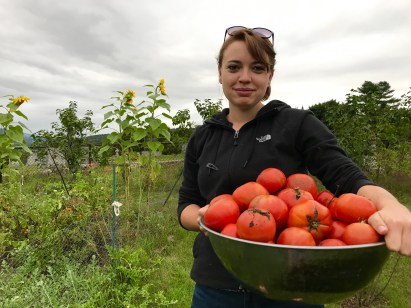
September: with the weather still warm, the frogs sang last night. Just before dusk, the girls and I picked a mountain — and then a mountain more — of tomatoes from the garden. More to put up. The younger daughter keeps track, satisfied, with our harvest.

IMG_3348

Home Work

Frost sprinkled around us last night. I hear the local reports on Goddard College-supported WGDR this morning while the cats stretch on the sunny kitchen floor. Alan LePage in his Curse of the Golden Turnip radio show takes calls and shares his farmer’s intel on climate change.

Halfway through the weekend, our house lies in actual physical chaos: the upstairs floor I bungled painting and must repaint. Failure, I remind myself, clasps hands with creativity.

In Vermont, season’s change — from a luxuriously warm summer to chillier fall where the shadows hold no light — begs interior reflection, too. Where are we headed? Or, what’s the plan?

As part of a larger writing project, I’ve been interviewing a woman in recovery from opiate use. Again, what impresses on me is the constant motion of life, that while our past imprints on us, marking each of us indelibly, life goes on.

A misprinted floor — wrong paint — is so minor, a mere irritant. A surmountable challenge. Perhaps, a sheer piece of luck.

With writing, we have second chances.

Jonathan Safran Foer, Everything is Illuminated 

IMG_3291

Friday Night, The Three of Us

Sitting on the back deck after dinner last night, in jeans and long-sleeved shirts, the girls asked if we were going swimming.

Well, why not?

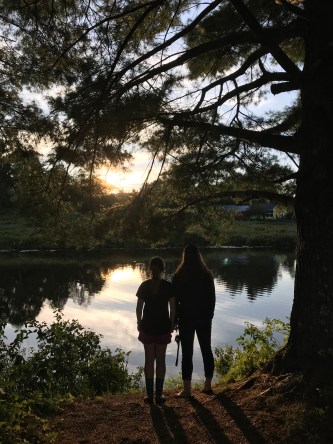
The girls sprawled on the grassy bank while I swam down the pond, from the shadows into the sunlight, the water warm, the surface rippling with feeding fish.

All summer long, we swam in this cupped bowl in the earth, our bodies both in all that dragonfly-filled sky and the water with muck and weed, minnow and turtles. A curled oak leaf floated on the surface. I floated on my back, staring up at the fading blue sky, a single cloud laced pinkly at the edges with sunset.

Later, knitting scrap yarn into a scarf, I shivered. Hours later, still cold, a cat crawled with me until the blankets while I read with a flashlight.

During the siege of Leningrad:

The heat in the (public) library gave out early, and the plumbing eventually froze and burst. In late January, the building finally lost its electricity. The librarians still searched the shadowed stacks with lanterns, and, when they ran out of oil, with burning pieces of wood. They still served patrons and sought out the answers to practical questions posed by the city government: alternative methods of making matches or candles, forgotten sources of edible yeast. As the building grew colder and more battle-scarred, they closed the reading rooms one by one. Finally, patrons and librarians all huddled in the director’s office, where there was still a kerosene map and a buzhuika stove.

— M. T. Anderson, Symphony for the City of the Dead: Dmitri Shostakovich and the Siege of Leningrad
IMG_0391

Hardwick, Vermont

Symphony of Our Small World

In high school, hidden in the upstairs of my parents’ barn, I read Russian literature — The Brothers Karamazov and War and Peace — I read about life behind the Iron Curtain, Darkness at Noon, Solzhenitsyn.

Late last night, the cats and I read M. T. Anderson’s Symphony for the City of the Dead: Dmitri Shostakovich and the Siege of Leningrad, a book filled with hunger, fear, and love.

These summery, hot days continue to unfold, a world apart from coal-less winters in Russia. Our days are busy, jammed with my multiple work endeavors, with a daughter in middle school, and soccer practices and games, with her babysitting and my older daughter’s tender young adult life — can I build a tiny house? will I fall in love? — with pickling green beans and putting up salsa and somehow painting the upstairs floors while listening to Rumblestrip podcasts, and swimming at the end of the day as often as possible.

This life, messy with creativity and doubt, with love and grief, is lucky beyond belief. Thank goodness, I remember this at times.

Shostakovich states that at the beginning of the Seventh (Symphony) he depicts the peaceful life before the war in the quiet homes of Leningrad. But to a listener in Iowa it could mean the meadows and the rolling hills around his home. After the fantastic theme of war, Shostakovich has put into his music a lament for the dead — and the tears of a Russian mother and of an American mother are the same.

IMG_3286.jpg

Loving Yellow

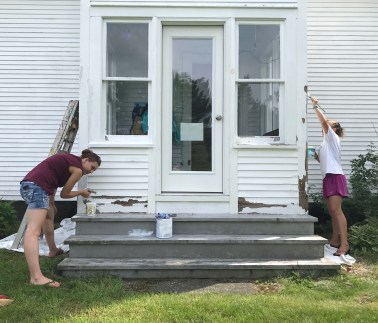
Lador Day Weekend, we’re all home Sunday — both girls and myself — and I followed in the family tradition instilled by my father: painting the house. Our previous house was cedar shingled, with paint only on the window trim. That house had many windows, so, most falls, I painted some of the trim or old storm windows, always the same exterior deep blue teal.

My daughter, when she was three, called this Mama velvet-tealing, a neat way of turning a noun into a verb.

While gray is a traditional New England choice for steps, I had picked up a remainder can of exterior floor paint for a mural on the barn door. When I opened it up, the paint sparkled the glossy richness of spring dandelions.

No, the girls said.

Yes, I said.

Later, when the new neighbors walked over for cake, they asked how long the steps had been so brilliant. Since today, said my older daughter.

Once again, I find myself wildly painting. Next, a deep yammish orange for the upstairs floors. Color, the consolation of fall.

…What is yellow? pears are yellow,
Rich and ripe and mellow….
— Christina Rossetti, from “Color”

IMG_3130.jpg