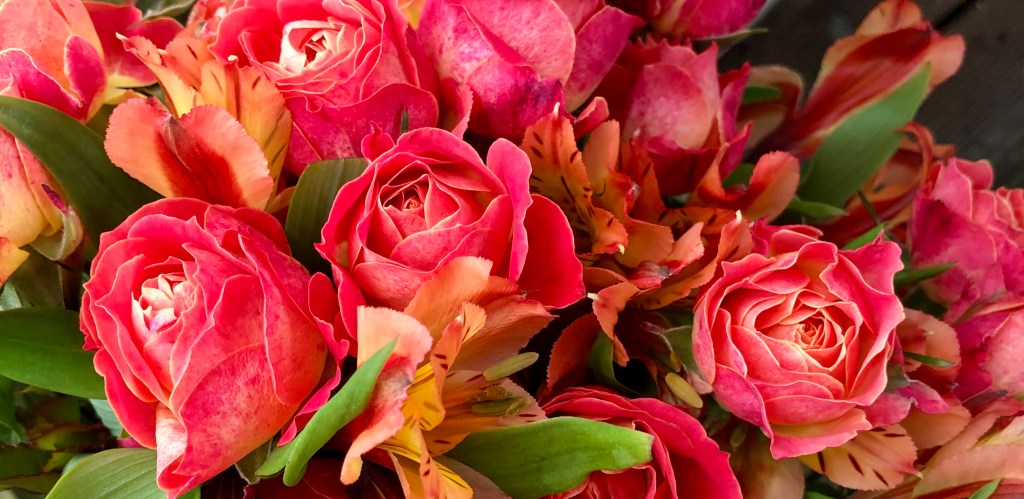
August: Complex Fatigue

On this August evening, a sparrow flies out of the wild raspberries along my walk and startles me just the slightest. Stunned a little from its flight through the leaves and small prickles, the sparrow fumbles from foot to foot on the path and then rises up on its wings and disappears. The swifts are out, too.

A downpour has fallen and the humidity has thickened right up again. I walk through the village, and folks are hanging out on porches. A three-quarters moon hangs over the empty high school soccer field, stunning. I’d write that it’s otherworldly in its beauty — but in this slow, sticky night it’s hard to imagine a sweeter world, even this one chockfull with chaos.

In the heat, tempers are either short or silly. Tomorrow is Vermont’s primary, so much fervor, and I wonder what all that might come to. In the evening, I talk to my cat, a tête-à-tête about why he cowers at the slightest noise, as if the house might be under attack by coyotes. You’re a housecat, I remind him, one of the most pampered creatures on the planet. He looks at me, poor ignorant thing that I am, and wisely keeps his ears pressed down and low like a spooked owl.

August. Time to share again one of the loveliest poems.

The world is a 

complex fatigue. The moth tries

once more, wavering desperately

up the screen, beating, insane,

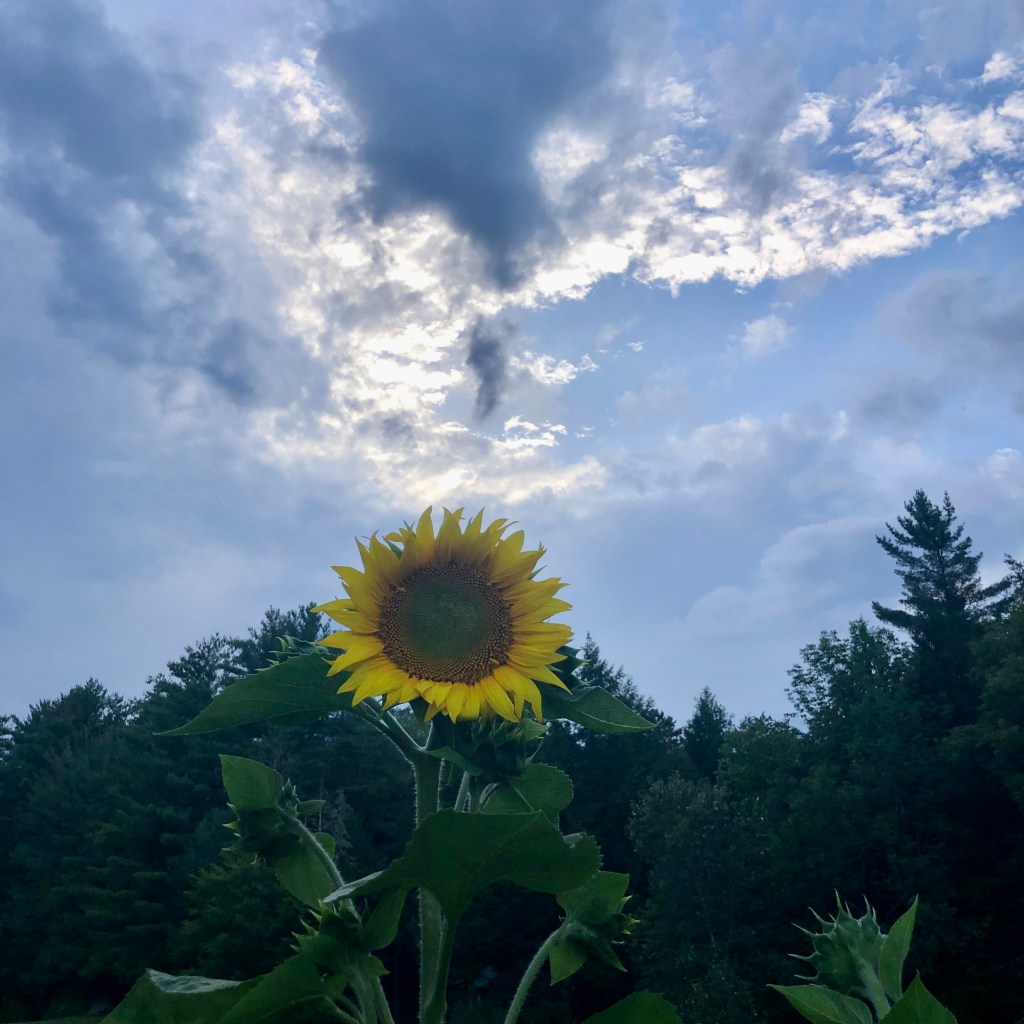
behind the geranium. It is an

immense geranium,

the biggest I’ve ever seen,

with a stem like a small tree

branching, so that the two thick arms

rise against the blackness of

this summer sky, and hold up

ten blossom clusters, bright bursts

of color.

Hayden Carruth, “August First”

Water. Sky. Lilies.

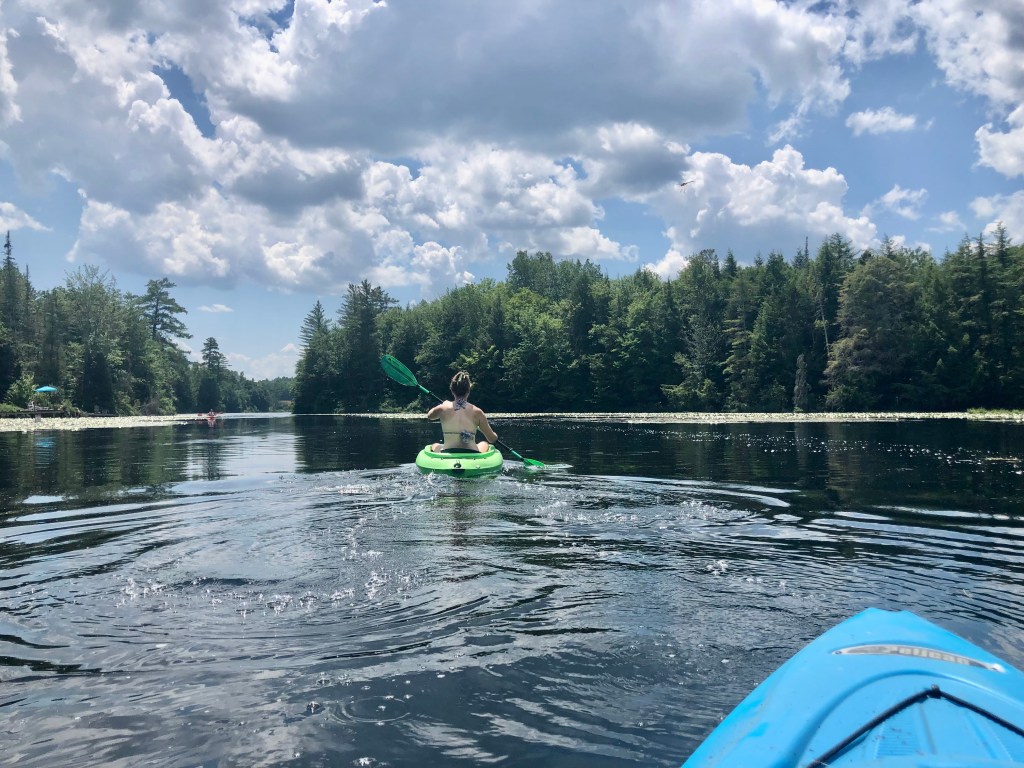
Sunday morning begins hot and out-of-sorts in our house. As antidote, we load the kayaks on the car. We paddle through a passage between floes of waterlilies in a breathtaking landscape — clouds reflected in water and all those perfect flowers. We’re not far from home, but the kayakers and canoeists we pass are all strangers who raise hands in quiet hellos.

In no rush at all, we paddle to the pond’s far end, where we drift for a long while, talking and handing a box of crackers between us. A loon and a single chick bob nearby. The other loon parent appears with a string of lunch in her or his mouth.

Later, we pull our kayaks on a shore and swim out to a raft where we lie in the sun and talk about where we might be five years, ten years, down the line. A man swims out with his two daughters, and we talk a little with him about the raft and the sun and the waterlilies that cover the pond.

I’m reminded of William Blake’s line about seeing the world in a grain of sand as we slowly paddle back to where we began. I’ve walked across sections of this pond in the midwinter around ice fishing holes. A number of years ago, a teenager drowned here, a boy I knew as a baby. His parents were vendors in the same farmers market where my husband and I sold maple syrup and ice cream. We all had little ones in those days. On those hot afternoons, we shared stories while swaying with babies on our backs.

The pond this July day reflects only sweetness and beauty. At the shore, my daughters load our kayaks back on our car. I rinse off my bare feet at the water’s edge. A little boy runs to the end of the dock. His father stands waist deep in the water. He raises his arms and says, Jump. I’ll catch you.

Small Kindness.

I buy a battery at the auto parts on my way home from work. The young man there asks if I want him to install the battery. Heck, yes, I do.

The afternoon is sunny and breezy, not too cold, not overly hot at all, just about perfect weather. An acquaintance follows me outside, asking about work. A few years back when I asked for a used trampoline on our neighborhood virtual bulletin board, he sent me links for a few, and I found one. His grandsons were some of my favorite readers in the library where I worked. The boys have grown and moved on, too.

The three of us talk about land and taxes, whether rain will fall tomorrow, and how everyone seems short of help these days. Eventually, as often happens these days, the conversation winds around to the price of land in Vermont and what that means for our future.

The young man pulls out my old, nearly given-up-the-ghost battery. He tightens in the new battery and has me start the car. I’m in the kind of rush I’m in too often these days — running from here to there — the kind of hustle I do between work and parenting. The engine starts easily. I thank him profusely for this small gesture of kindness. He gives me a thumbs up. I wish him good luck with his project, and that’s it. We’re each off to our ways.

“Writing is work. Anyone can do this, anyone can learn to do this. It’s not rocket science; it’s habits of mind and habits of work.” 

— Alexander Chee

Somewhere in the Pandemic.

A colleague and I discuss our somewhere-in-the-pandemic plans: gardening and creativity and as much outdoor time as possible. We’re somewhere in the pandemic; that’s our determination. This somewhere might extend for a very long time yet.

This week, I was invited to a FB event where people all over the country signed in. I began by talking a little about my own dear state — tiny Vermont — whose entire population of 650,00 souls is less than many cities in this country. Some villages have a post office and a single paved road, a scattering of houses, streams and trees, gardens and swing sets. Since I was talking about my book and addiction, I spoke about how the wide world seeps into the most hidden places in my world, too. And yet, our lives go on. That same, age-old question — how to find meaning in our lives?

Memorial Day in Vermont is a big deal. The town cemetery beside my house is freshly mowed. New flags wave near stones. All week long, families have been tending gravestones. May is the season of lilacs and green. I make notes for the weekend: tend my garden. Make friends with the new neighbor and the scary dog.

Stranger Aid.

Retreat Meadows, Brattleboro, Vermont

A stranger in the post office asks me if I can free her mail from her box. It’s a narrow box, nearly at the bottom of the wall. I crouch down, extracting envelope by envelope, taking care not to tear the paper. It’s clear she hasn’t collected her mail in some time. She waits patiently while I tug with some effort. While I hand up envelopes and fliers and magazines, I talk and talk, rambling on about the mail and whatever inane thing drifts into my mind. Around us, people open their boxes, collect their stuff, and disappear. I keep at my project, now kneeling. Finished, I shut her box door.

She thanks me, and we go our separate ways. Walking home, I keep thinking about that simple thing, how easy it is to give to a stranger. There’s likely an obvious lesson here. But one thing is clear, I got as much from the mail extraction as this woman.

… A cold and soggy April. Miniature daffodils push up through black soil. I keep feeding my wood stove.

Breaking Ice.

On a midday walk around the lake, I hear bits of breaking-up ice crash against a cement pier. Vermont spring — ice and green shoots, rain and rouge snow and sometimes sun.

This time of year — school break and tail-end-of-winter doldrums — many folks have flown to warmer and sunnier climates, seeking the old stand-by of the geographical cure. Around the lakes where summer folks own the large houses, hardly anyone is there, save for carpenters and roofers and painters, their pickup trucks clustered in driveways.

But the lake keeps on with its own steady world, the fierce ice gradually giving up its ghost. By the time these summer folks return, the water will have warmed again. For now, though, ice clinks as it breaks apart.

I tie my long hair back with a rubber band I found in my coat pocket. The breeze carries the damp scent of the earth, the dream of unfurling leaves, the memory of children crouched among the cedar tree roots, playing.

“The sun was warm but the wind was chill. You know how it is with an April day.”

~ Robert Frost