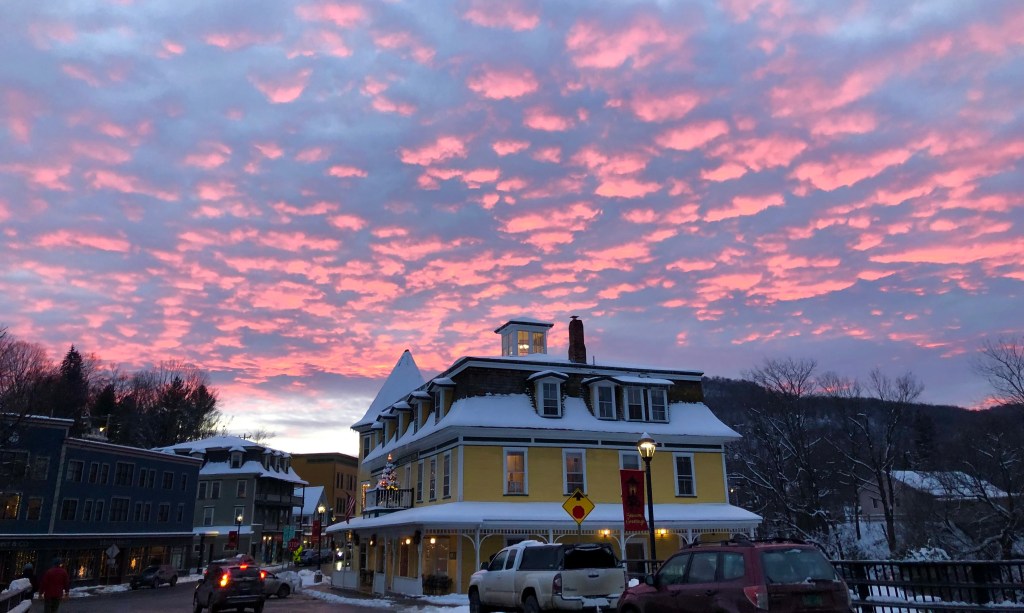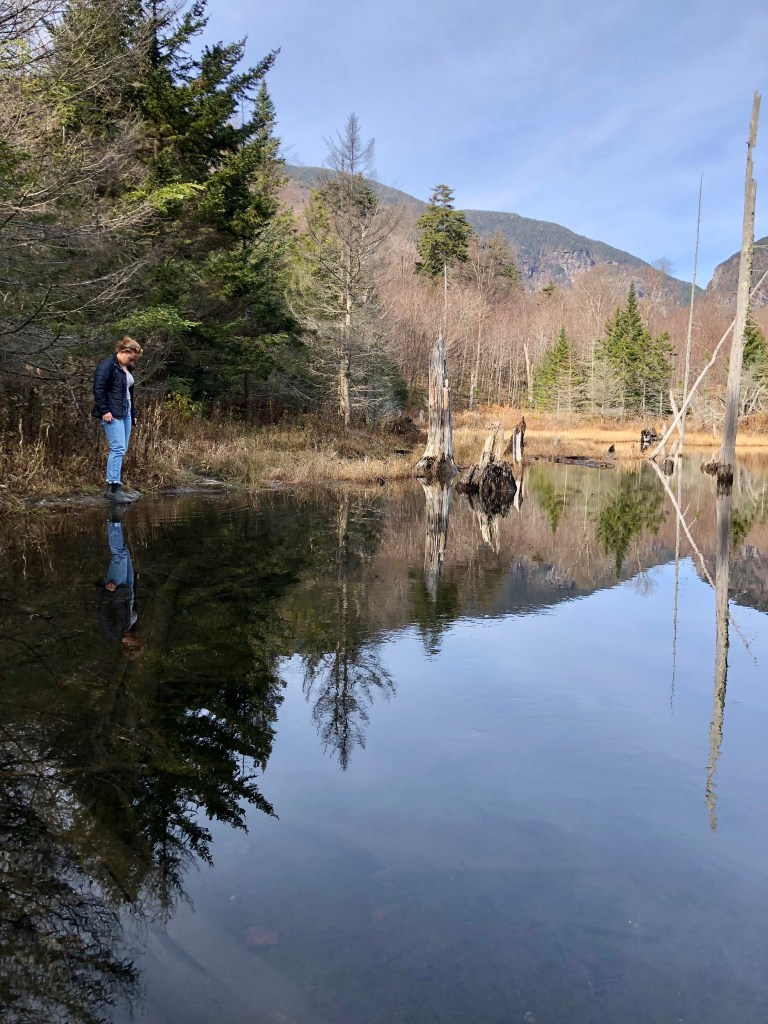
I met a friend yesterday, and we took a walk we’ve journeyed in various seasons — in bright green spring, in the summer when we admired flower gardens along houses. Yesterday, we walked through frozen mud ruts and sprinkles of rain, the jumbled up season and time of where we are.
On this New Year’s Day, I’m passing along a VTDiggerstory written by Kevin O’Connor about a Vermont couple’s 4,000 World War II letters. A history lesson and a love story — isn’t that what we need right now?
I’m sitting on the little coffee table a friend and I picked up in a free pile a few summers ago, watching my wood stove rekindle through the glass and talking to my father on my little phone. There’s this forty minute window before my daughters return from work with stories of their days. Cauliflower and potatoes are roasting in the oven, and we’re talking about all kinds of things, like this incredible novel Let the Great World Spin.
Because my father and I talk about things like this, we talk about suffering. The fire suddenly flares up, and does its beautiful wave thing through the pipes in its top, rippling in waves and emanating heat into our house. My cat rubs against my feet.
In an everyday epiphany, this great world spins around me, and I’m abruptly released from the pandemic and from the imminent holiday itself — so complex, so multifaceted, in a culture driven to the reductiveness of images and consumption.
I see the logs I’ve split from a fallen tree, consumed by flame, transmogrified into heat, and headed as ash into my garden. For this moment, I remember all those cold winters in our other house, and how blessedly happy I am that I bought this stove, and I live in a house with yellow walls, with two daughters, two cats, and all the tangledness of our lives.
That forty minutes is irrelevant. It might be ten minutes, or six hours. There’s just this moment, my father talking about Homer and Socrates, these stories that have followed me all my life.
My daughters’ preschools had a sweet November festival called the Lantern Walk. The little kids each made their own lantern, from a mason jar or metal or wax, and strung it through with a wire. On a dark November evening, always right about now, the families arrived, and everyone took a walk through the woods with these candlelit lanterns, singing. The metaphor was, and is, immensely appealing.
In all my daughters’ lantern walks, the route often changed. One year, the teacher led the families down a steep hill. Rural Vermont is dark, dark, dark, on these November nights. The parents whispered to each other, fence here, and watch the big root.
These November days and nights, the wood stove is again glowing in our house and the wind blows over our hillside. Like Shakespeare’s play within a play, I remember those walks as Lantern Walk within a Long Lantern Walk.
On another note, State 14 ran an excerpt of Unstitched. It’s always such a pleasure to appear in this Vermont publication.
Here’s where we are in the world of tender gold tamarack needles and cold mud.
For two nights, I got up and read Andrea Elliott’s Invisible Child, unable to leave that world, needing to know how Elliott ended her book. I won’t reveal that. But here’s a few lines worth an extra mention:
“The world ‘understand’ comes from Old English — understandan. Literally, it means ‘to stand in the midst of.’ It does not mean we have reached some ultimate truth. It means, to my mind, that we have experienced enough of something new, something formerly unseen, to be provoked, humbled, awakened, or even changed by it.”
These words ring true for me in my own writing and, I’ll add, my experience of parenting. Elliott goes on to write, “Almost nothing counts more than the person who shows up.”
Here’s hoping you’re all weathering the weather wherever you are.
In the midday heat, my youngest drives us north, following vague directions, and we hike along two small ponds. The merest wind blows, ruffling sunlight over the water like sparkling scales.
Through the woods, we follow a trail up and then sit on a rocky ledge, admiring the view, drinking water and eating crackers and talking. The humidity reminds me of summers in southern New Hampshire, and how a summer seemed so long as a kid.
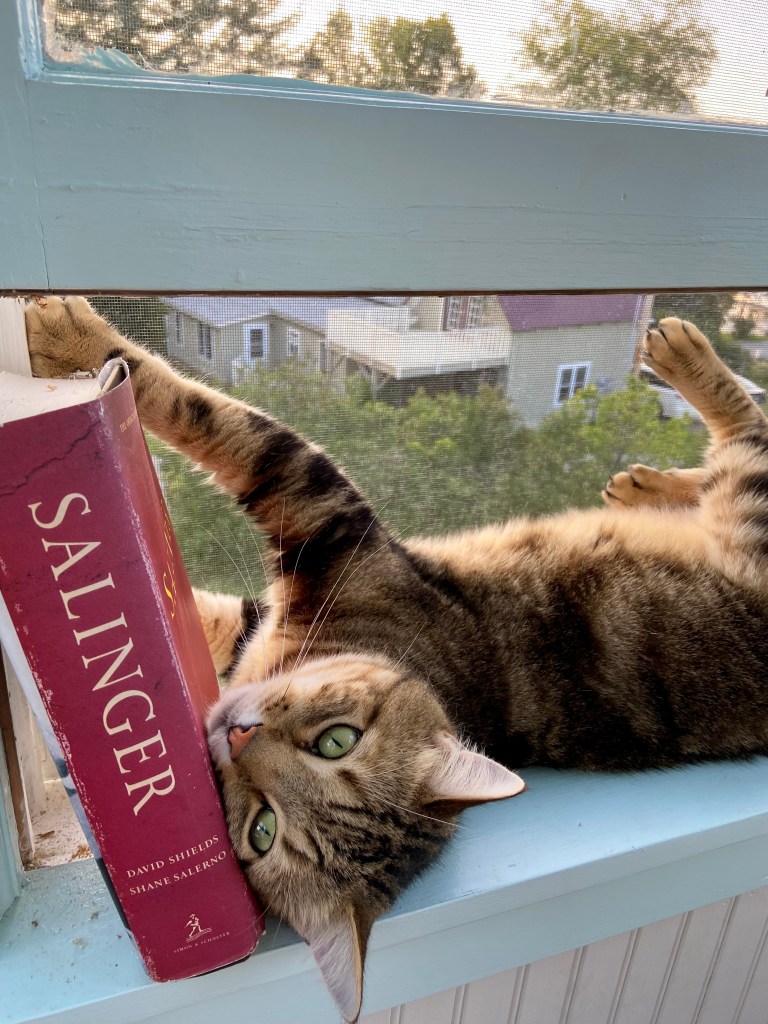
The sticky heat spreads out this day, elongates it. There’s plenty more ahead — my daughter heads into work and then goes swimming with a friend; I write on the back porch; my oldest returns from work and attends class on the upstairs porch; our cat catches his claw on the window screen. Rain falls.
But before all that, my youngest and I stop by a farmstead, and eat drippy and creamy-delicious vanilla ice cream cones. As we get into her car to leave, my daughter bites into a fresh peach. A friend pulls up beside us, and we talk for a bit. Our conversation winds quickly to work and misogyny. My friend apologies to my daughter for our conversation flying around.
My daughter asks politely, What? and pauses with that half-eaten peach in her hand.
My friend says, Oh, she’s in that lovely peach world.
In the town building where I work, there’s a room upstairs called The Giving Closet, jammed with the town’s cast-offs and free for the taking. Clothing, dishes, puzzles, books (from self-help to Isabelle Wilkinson’s brand-new Caste that I snapped up.
The space is infinitely fascinating — who gives, who gives what, and who takes. The wealthy who donate boxes of never-worn clothes. A widow who wept when she dropped off her husband’s suits. Those who leave handmade quilts or winter boots, to empty their house, but also hope that someone else might use these things. One woman handed over a pair of child’s boots, saying, But there’s so much use left in these…
The takers (mostly women) form an unending stream. In an unintentional way, The Giving Closet bucks capitalism. Need a coffee pot? A packet of seeds? A child’s snowsuit? This is the place.
It’s a place without policies, cobbled together, that moves along the uniquely local story of humanity — a solid plan.