Overheard.

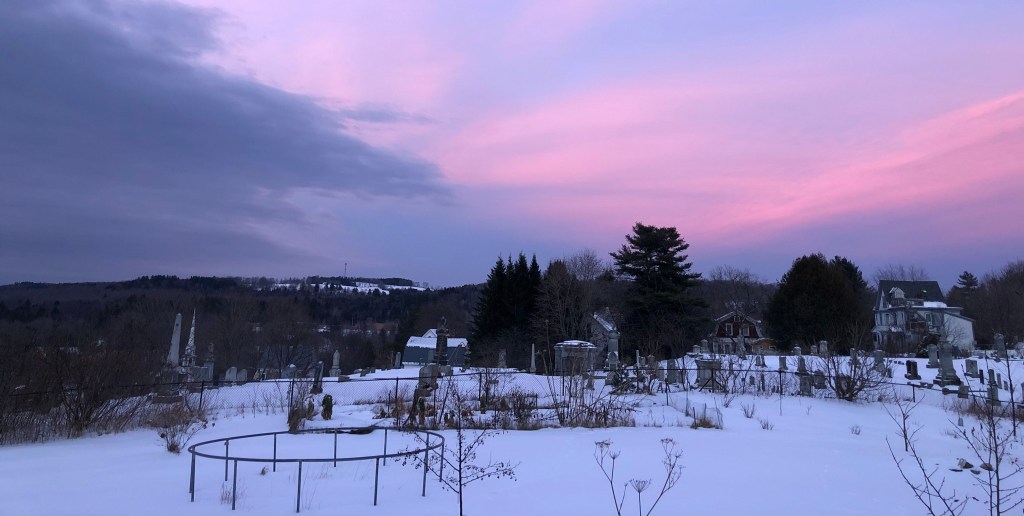
Far enough after twilight that the darkness has set in for the night, I walk up to the library to leave my returns in the book drop. The bitter cold has snapped, worn down by the day’s warmth. Cold in February will return — it nearly always does — but the tide of winter has pushed over.

Spring in Vermont is a long ways off. This is a rude truth, and it’s also true that this is the time of year I begin hungering for green. I take my time, walking back through a neighborhood. Hardly anyone is out, save for a man standing on his back step, drinking a beer and smoking. The smoke curls upward in the lamplight just above his head. Down the street, a small child comes running at me, his or her head hung down a little, tired perhaps. The child wears a knit cap and a dark coat and hurries along, keeping a wide berth from him. At the house with the man and the cigarette, the child leaps the snowbank. The man says, “Hey now, been waiting.”

The boy rambles about “sledding gone soft.” As I turn the corner, the man’s deep voice follows me. He says kindly, “Wait a week, kiddo.”

Good advice for kiddo, I think. I follow the steep street up to my house, where the cat is waiting in the windowsill for me, and the daughter is solving math equations.

Collectively, I think, we’re all in a waiting period.

January. Twenty Below Zero.

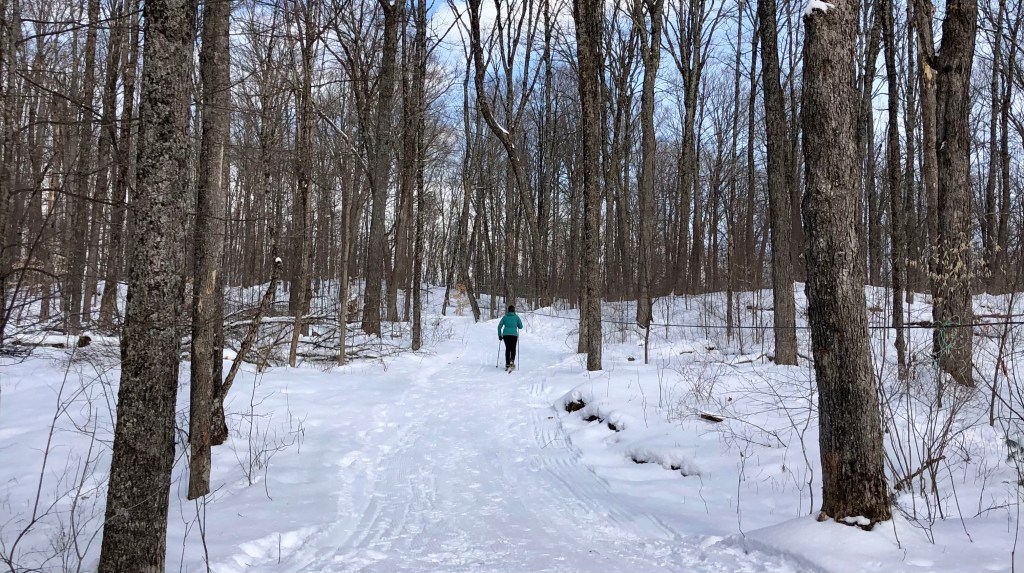
Daughter and sap line

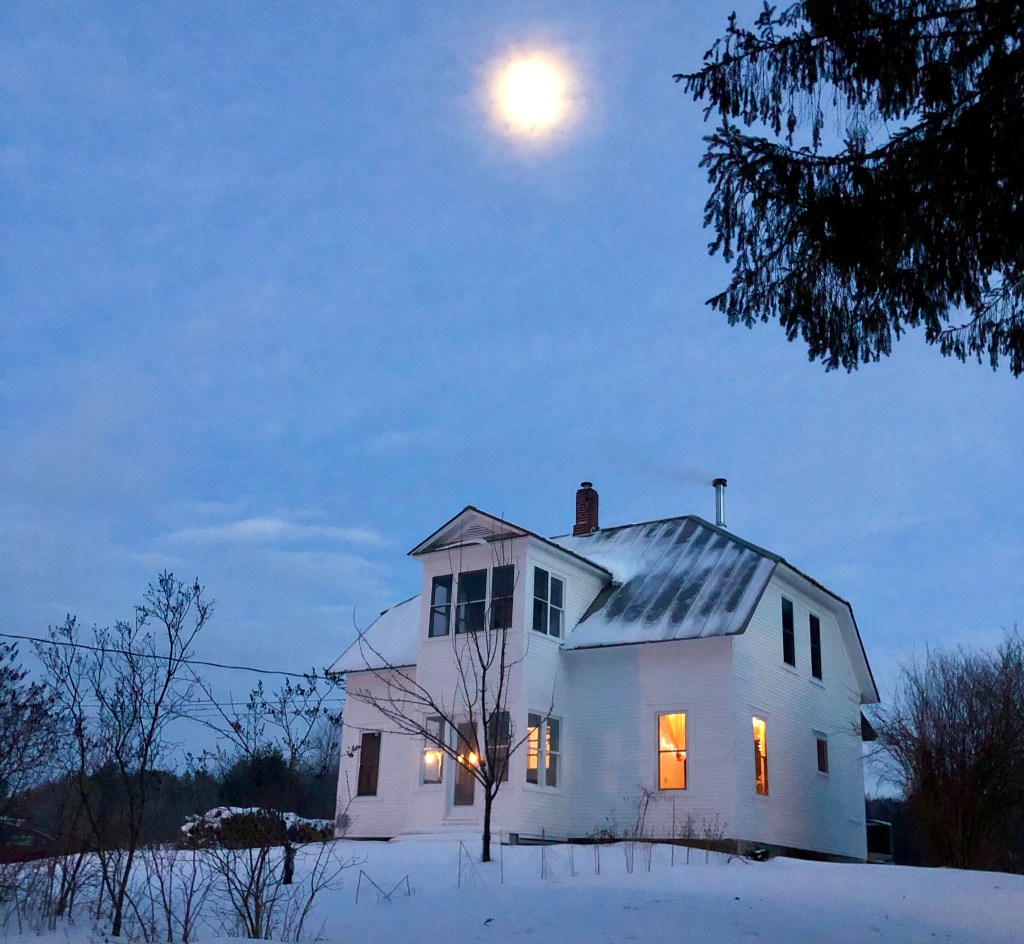
20 below this morning as I head out to start my car. The moon hangs in a crescent over our house, visible through the smoke from our wood fire. In January, Vermont, the days creak along with the cold.

In an evening meeting, it’s just me at the town hall, holding that physical place as an open meeting law requirement, everyone else virtual from their living rooms or home offices. From the hallway, I pick through a box of cast-offs and take a pair of Teva sandals. A kind of promise, for another season.

Tonight as it gets cold 

tell yourself 

what you know which is nothing 

but the tune your bones play 

as you keep going. 

— Mark Strand

‘Ask Me.’

Twilight drags out again — not a sign of spring by any means but a hopeful sign. The light’s returning to us. After work, I rush through my outside chores, then keep walking and walking. I’ve somehow slightly twinged my knee, and so I walk with the faintest of limps, which amuses my athletic daughter no end. Why wouldn’t your body hurt? she asks me.

We live in such a crazy, mixed-up time. Some of this is just us — a high school student, a grown daughter, four jobs between us, an EMT class, a recently published book and another I’m writing, an absent father, my single motherless — and then a world where the Expected Everydayness is suddenly flipped inside out. The rules have all changed, or at least it’s worth rethinking all the rules.

No phones, ever, at dinner. But then my youngest asks why? and we call my brother. He’s working at his brewery and steps into a quiet place. My daughter and I eat calzones and talk skiing and Covid. We talk bread making. And that is really darn nice.

“’Ask Me’

Some time when the river is ice ask me
mistakes I have made. Ask me whether
what I have done is my life. Others
have come in their slow way into
my thought, and some have tried to help
or to hurt: ask me what difference
their strongest love or hate has made.

I will listen to what you say.
You and I can turn and look
at the silent river and wait. We know
the current is there, hidden; and there
are comings and goings from miles away
that hold the stillness exactly before us.
What the river says, that is what I say.” 

— William Stafford

Order. Gratitude. And Other Things.

Sunrise, Hardwick, Vermont

January — the time of year when ash from the wood stove has settled into the crannies of our house — beneath the couches and along the woodwork. I listen to The Daily about FBI files released about the insurrection a year ago and take a soapy rag to my house.

I tell my daughters I’ll paint the walls of the upstairs hall spring grass green and stencil dandelions around the doors. What are you doing? they ask.

Some people are drawn to chaos. I crave order, a schedule, neatly pencilled lists to guide me through my days. To write, I travel to hard places, and I want to return to order. All around us now, chaos streams in, as the pandemic turns our world inside out. In the midst of this, I rearrange my woodpile. In the evening, while my daughter writes a school paper, I take the compost out to the bin. A light snow falls, sparkling in the light through our house windows. There’s no one out, and I keep walking. I head down the road and stand on the sidewalk. These neighbors have fully decked out their crab apple trees with twinkling colored lights. In my younger years, I would have scoffed at the use of electricity, much as I once hated paper plates.

Now, in the dazzling bits of snowflakes, I stand there for the longest time, thinking of nothing at all, just taking it in.

On a different note, Dr. Mark Levine, Vermont State Health Commissioner, read and blurbed Unstitched. I am among the many, many Vermonters who look to Dr. Levine as a beacon of calm, rationality, hope, and decency, as he’s guided our state through two years of a pandemic. In the mist of this, he took the time to read my book and called it a “tour de force.” Endless thanks, Dr. Levine.

Unstitched “…is both a page-turner and a primer in understanding the many complex dimensions of the opioid crisis in a rural state, where the reader accompanies the author in her own recovery and process of discovery. Ultimately, it is impossible for any of us to be totally disconnected from the impact opioid use disorder has on our communities, and it is through reading Stanciu’s skillful, compassionate and thoughtful rendering of personal stories that we can all gain valuable insight, diminish harmful stigma, and foster true healing.” — Dr. Mark Levine, Vermont State Health Commissioner

Stacked Deck.

In the evening, we play cards. For years, I had this inner narrative unspooling, about living on the edge of the wilderness, the cold a near constant companion for a good portion of the year. Now, returning from work to a chilly but not cold house, I remember keenly how that narrative began when I was a young woman, living in an uninsulated apartment, reading about polar expeditions.

The cold, indeed, makes us more alive. Too much cold, however, deadens us, too.

Our deck of cards has a few duplicates — additional sixes and eights and two Jacks of Diamonds. We have another, unpadded deck, but I have a particular fondness for this one that bends the rules and mixes our games in funny ways.

January. My inner narratives keep unwinding. Cold. Kids. Cats. Writing that nourishes my soul.

William Carlos Williams’ lines about this winter month:

Again I reply to the triple winds
running chromatic fifths of derision
outside my window:
                                  Play louder.
You will not succeed.