Find

My running route leads me into the woods behind the town’s community gardens, through a path flanked by frost-nipped goldenrod. A hundred years ago, the town’s granite industry spread over that field. Just before I cross a wooden bridge into the forest, I always pause at a historic sign marking where an industrial building once stood.

Really? I think. Only dog walkers and I, an occasional kid fishing, wander along there now.

My route follows the former railroad bed, its tracks ripped up for scrap metal in WWII. Yesterday, just over the bridge, I see the rain and erosion have revealed a chunk of granite, about the size of a library book, the number 12 marked on it.

Whose hands printed that? And with what indelible ink? I tried to pry the rock up and carry it away. The rock was determined to remain — for a while longer, at least.

An empty day without events.
And that is why
it grew immense
as space. And suddenly
happiness of being
entered me.
Anna Swir

IMG_6608

Scarlet and Gold

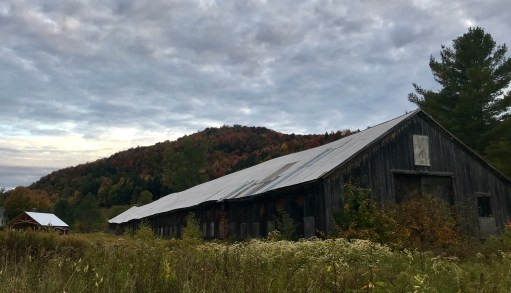
On my way to pick up my daughter from soccer practice, I leave early and take a walk behind the community gardens, where the wildness of Woodbury Mountain meets the edge of town.

All day, rain has drenched us, and the scent of broken leaf and dogshit and the hummusy, earthy fragrance of wet soil mixes. There’s no one here, in the woods where I’m sheltered somewhat from the downpour, walking among the giant pieces of granite — debris from the town’s former claim-to-fame industry — among the brushy goldenrod, asters, and burdock.

The thing about Vermont foliage — every year — is that I expect the season to be done, finished, dulled to gray, over, and suddenly the red appears. Silently, stunning, often brought out in its finest with a cold rain.

Every year, it’s the same nostalgic sensation — I’m a third-grader again, walking home from school, scuffling through knee-high piles of leaves, happy to be free from the classroom and play outside all afternoon. Every year, the season change is tinged with sadness at the passing of time, and yet, silently, fiercely, beautiful.

In a handful of seasons,
water and cold and dirt

get under the paint and it falls
from our houses like old bark.

— Kerrin McCadden

IMG_6634.jpg

Listening

Two parents once came up to me after a school board meeting and thanked me profusely. They felt so much better. At the time, I thought I hadn’t done anything. No decision had been made. But I had done something. I had simply let them talk; I listened; I empathized.

Recently, I emailed my former neighbors — rabidly, on the attack — and asked how dare they employ my ex-husband? How dare they pay him cash when he hasn’t paid child support in years? I expected my former neighbors to be defensive and angry, but, instead, the email I received back was kind and thoughtful and incredibly insightful. They’ll likely keep employing him, but at that point, I didn’t even care. Their empathy for me had opened up my heart to be empathetic for their plight, too.

What makes me remember this on a breezy autumn is maybe nothing but my own unhappiness about the adult world, both in general and in particular. Recently, I realized with the work I’m doing now, I could actually pack up and take a geographical cure from my immediate adult world, head somewhere else to work for the next four months. Like, perhaps, a desert cave.

Bad idea, I think. Those former neighbors and I have finally made our peace, and this one is likely to be lasting.

On a withered branch
A crow has alighted:
Nightfall in autumn

— Basho

IMG_6591

Late Night Reading

As summer blended into autumn, the days were warm enough to swim, but we simply didn’t.

Instead, I lie awake at night, listening to the tree frogs thrip, thrip, thrip, singing as though this season will linger on and on, and then it’s me and the cat lying on the couch in the middle of the night, reading about economics and slavery, and when that’s too much for those tiny wee hours — while the stars pass over our roof — the cat suggests Alan Watts, which has somehow been shoved down the back of the couch. The book is an old paperback that I either swiped from my dad’s shelves when I was in college, or he passed along to me. Which of us can remember any longer?

Finally, the rain pours down in an enormous wash.

You didn’t come into this world. You came out of it, like a wave from the ocean. You are not a stranger here.

~ Alan W. Watts, Cloud-hidden, Whereabouts Unknown 

img_6609.jpg

Photo by Molly B.

What Are You Saying?

The other day, I let a very pregnant woman and her little daughter who was eating an ice cream sandwich step ahead of me in line at the co-op. Outside, on the street, the woman buckled her child into a carseat. I stepped into the passenger seat of my daughter’s car.

It doesn’t seem that long ago that my daughter — now fully an adult with adult responsibilities — was a little girl, too.

Yesterday, on a rocky hike in the White Mountains, she and I walked down the mountain together, while my younger daughter and my brother outpaced us.

At four, ice cream sandwiches were a very big deal. At four, this daughter was obsessed with snipping up paper with kid-sized scissors. At twenty, we talk about what it’s like to be a woman in this world, about going to school and work, about family and friends, and how things sometimes go awry.

Beneath all this, while we walked from the ridge down into the cool forest where the leaves were just beginning to turn an autumn gold, I kept thinking of Malcolm Gladwell’s new book, Talking to Strangers. Since she became a teenager, I’ve returned to this thought over and over — what are you really saying? What’s the subtext beneath your words? Some of that subtext I know, some tugs at my own guilt and trepidation, and some is just pure joy, knowing this young woman in a richer way.

What is required of us is restraint and humility.

— Malcolm Gladwell

IMG_6574

Woodchuck

Geese fly overhead in the dark evening, so near I hear their wings beating. Frost hovers, gathering strength.

Yeah, my daughter says, that’s what geese do. They’re out of here!

The garden’s gone wild at the end of the season, its queen the mightiest and heaviest sunflower head I’ve ever grown. Its stalk might rival a sturdy sapling.

The woodchuck’s gnawing my cabbage heads near the garden gate. In another year, I might have set the trap, but this year…. Gnaw on, chuck. Winter’s coming. The cabbages are profuse.

A touch of cold in the Autumn night –
I walked abroad,
And saw the ruddy moon lean over a hedge
Like a red-faced farmer.
I did not stop to speak, but nodded,
And round about were the wistful stars
With white faces like town children.

— T. E. Hulme’s “Autumn”

IMG_6550.jpg