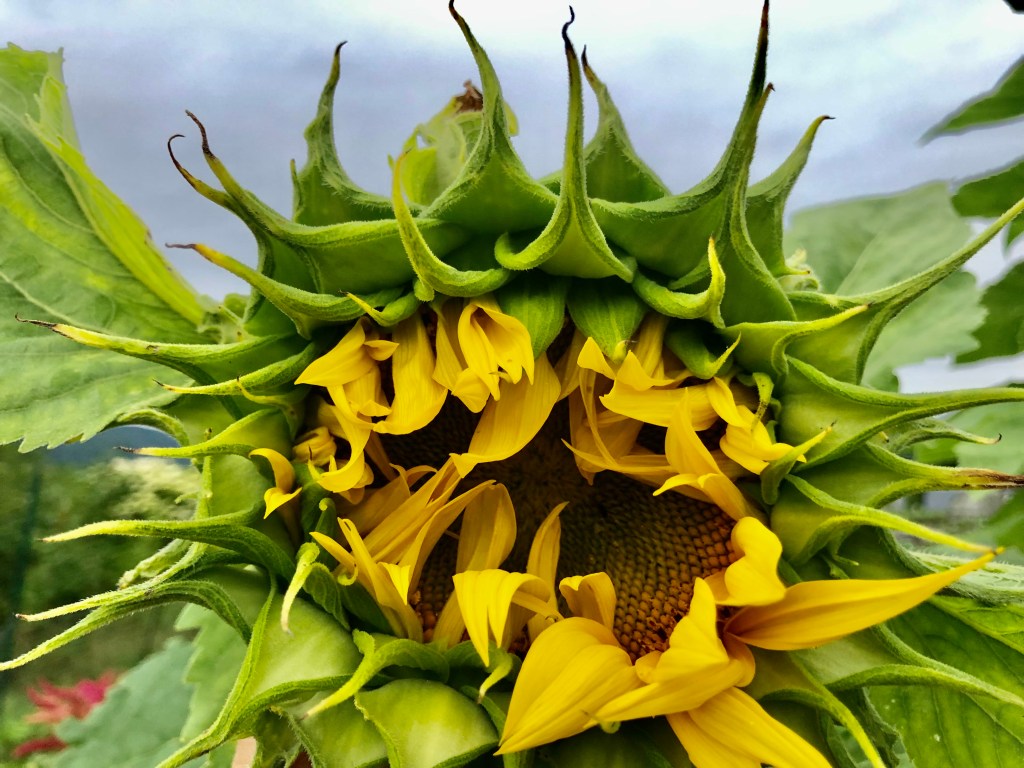
Petal. Stone. Blood.

Just before school starts this year, we spend a Sunday driving to the other side of Vermont, down along Lake Champlain, and crossing at the Crown Point bridge. There’s little traffic anywhere. We stop in Bristol for coffee, and then I keep driving, my friend and I in the front, our three daughters with their long legs sprawled in the back.

We’re headed to Fort Ticonderoga. Our daughters are taking an intensive history course this year, and I’m thinking the girls view the trip at first as a combination of the dusty past and an Instagram opportunity. Very quickly, we realize this is a site of stone, metal weapons, rammed earth, strategy, and bloodshed.

In the day’s sultriness, we wander behind the fort and discover the Fort’s immense gardens, now given over almost entirely to flowers. There’s few visitors and apparently no staff.

Below us, the lake lies still as a photograph, blue surrounded by the green hills. The crickets unfurl their slow late summer song. We’re in absolutely no rush at all, lingering among these flowers petals while, up on the hillside, someone bangs a constant dirge on a drum.

This ruined temple

should have its sad tale told only

by a clam digger.”

— Basho
Mount Defiance, New York

Sunday Morning Reading.

On my drive a few weeks ago to New Hampshire, I listened to Donald Antrim’s essay in The New Yorker about his hospitalization shortly before he published a memoir about his mother’s death. He was eventually treated with electroconvulsive therapy, partly at the urging of David Foster Wallace.

In this sticky August weekend, I’m reading that memoir, The Afterlife.

Here’s a line from this fiercely written book:

People are fond of saying that the truth will make you free. But what happens when the truth is not one simple, brutal thing?”

— Donald Antrim
Greensboro, Vermont

One Word.

Yesterday, I kept remembering when we took our youngest camping beside a pond when she was two. She pointed to a purple flower growing in the water and learned to say pickerel. For days, she practiced that word, pick-er-el, saying it slowly and carefully, over and over.

Fourteen years later, she’s mastered that name and much more, working for days last spring at what appeared to me to be pages of math. She won’t remember one bit of that trip, but it’s in her, still.

In the evening, my daughters disappear to go running. I wash up dishes, then sit outside near the garden and where the wilderness edges up behind our world, with milkweed and raspberry brambles. As the dusk filters in, I read. The late summer crickets chirp their songs, and the world keeps moving on and on at what it does.

Sunflowers. Japanese beetles in the green beans. Tomatoes red on the vine. The rich scent of the promise of rain moving in.

Come

Let us dine on barley grain

On a journey nowhere

— Bashō

Sweet August…

August. On a run after work, I remind myself August would be a good month to step away from work and the revolving paddlewheel of our daily lives. I’ve pretty much always failed at vacations, but I fold that idea somewhere away in my memory. As I walk home and cut across a little league field, I have a sudden memory of eating grass as a young child. I remember pulling long, slightly sharp-edged blades and nibbling on these, like a goat or a cow, eating straight from the earth.

In my garden, green beans are fattening on the vines in force. We eat those in the sunlight, straight from the vine. Cucumbers. Tomatoes. Wild blackberries and the few lingering raspberries we’ll find as stragglers for weeks yet.

August is good eating.

And a few lines from poet Hayden Carruth…

“The sky

is hot dark summer, neither

moon nor stars, air unstirring,

darkness complete; and the brook

sounds low, a discourse fumbling

among obstinate stones…”

— Hayden Carruth, “August First”

Burlington, Vermont

Reading Aloud.

Steerforth Press asked me to read the audiobook version of my book, Unstitched. I’ve never recorded a whole book before, so it’s been an intense experience to read the entire book, word by word, just a few feet from a stranger. The book blends both nonfiction and intensely personal memoir. I’m not talking about writing about memories of weeding a garden, either.

Now, in the last phase, while I’m listening to the final version, it’s a fascinatingly educational experience to hear this book I wrote read aloud to me, in my own voice.

One thing that jumped out immediately at me is that much of this book is about being a single woman with two teenage daughters, and how much I’ve figured out in my life without a man. I wouldn’t categorize this as a triumphant, let’s banish the men story (my God, I feel like I can and do whine like there’s no tomorrow), but that theme of woman threads all through this book.

Here’s a snippet of a review in the Deerfield Valley News by Laura Stevenson:

The book’s title comes from the conversation between Stanciu and the father of the girl who overdosed. Looking at the church that will become a social center not just for those in recovery but for everybody in town, Stanciu remarks “everyone’s so busy working that no one seems to have time or energy to put into groups … that used to keep people connected.” He replies, “We’ve come unstitched, … We’ve got to stitch the darn thing back together.” … This is a deeply compassionate and extremely important book. Every Vermonter should read it.”

Road Tripping in the Back Seat

Yesterday, standing in a parking lot in the summer sun, waiting for daughter who had gone back to the car for her wallet, I started thinking how many pivotal scenes in my life have taken place in parking lots around the country, and how much just everyday living has taken place in these innocuous roadside places, too.

I remembered my father drinking kefir in a parking lot in Boulder, Colorado, and passing the bottle around to me and my siblings. Kefir was not then a common product in the New Hampshire village where we lived, and my brother and sister and I had never tried it.

With my first pregnancy, I labored in a parking lot.

In my twenties, I wrote about road trips because I took a lot of road trips, and road trips inevitably contain those fascinating moments where you step outside the car in an unknown place and look around, wondering where you are.

Now, in my early fifties, I’m sometimes in the backseat of a daughter’s car, still looking around and wondering where I am. The view is different here — I’m going to readily note that — but it’s a view worth having, nonetheless.

Happy Sunday, all.

(And, I’m still having trouble with WordPress’s updates. Send me an email, please, if you notice anything off, or have advice to give, too.)