Foxes. Writing.

Foxes set up kit-making and housekeeping in a den behind our house again this year. Last year, three kits scrambled around. This year, two kits tumble over each other, already growing long-legged.

Their den is in the woods not far from our yard and garden, beyond a patch of weeds and across a stretch of sand. On a recent hot afternoon, I saw a kit stretched out on the sand, sleeping or half-sleeping, soaking up the rays.

A naturalist and his class make arrangements to stop by one evening and see my wild neighbors. Before they arrive, I’m reading outside when my friend stops by. The foxes appear. Near my garden, the neighbor’s gray cat watches, too, in the disdainful way cats do so well. My friend and I marvel at the juxtaposition of wild and domestic, and then the foxes scamper away. We’re knitting and talking when the others arrive. Not on the human agenda and with other things to do, the foxes do not re-appear.

Besides myself and my daughter, I’m not sure who else has seen these foxes. I’ve witnesses these creatures roll over each other and hunt baby woodchucks. They’ve doubtlessly seen me wander about, doing my garden chores. For long moments, we’ve stared at each other over that distance of milkweed and pin cherries, sizing each other up as a potential threat. Each of us appears to have drawn conclusions.

When the naturalist and his companions disappear, I’m slightly sorry they haven’t met and admired the foxes. But there’s also a part of me that relishes this secret world, this relationship devoid of human words.

Last…. here’s the essay I finished reading just before my friend appeared. This is from the final essay (‘On Becoming an American Writer’) in Alexander Chee’s How to Write an Autobiographical Novel.

‘Only in America do we ask our writers to believe they don’t matter as a condition of writing… To write is to sell a ticket to escape, not from the truth, but into it… All my life I’ve been told this isn’t important, that it doesn’t matter, that it could never matter. And yet I think it does. I think it is the real reason the people who would take everything from us say this. I think it’s the same reason that when fascists come to power, writers are among the first to go to jail. And that is the point of writing.’

Girl on a Bicycle.

Walking to mail a package, I hear pebbles grinding under bike tires and step back to let a girl on a bicycle pass by. She’s about ten or so, and she shakes her head and slows. I step back on the grass and tell her to go ahead. She swoops around me, wordlessly, then cuts out from the sidewalk to the road.

We’re along a busy road, but for this moment, there’s no traffic. She heads down the center of the road, crossing back and forth over those the double yellow lines. She doesn’t wear a helmet on her dark curls, and she’s riding a beat up old bicycle. She pedals quickly down the hill, the wind lifting her hair.

In a world so burdened by fear, encumbered by care, this girl flies down the pavement, heads into the parking lot of a storage facility, and disappears.

Still on the Installment Plan.

A woman I’ve never met starts speaking to me on a street corner in Brattleboro. I’d been staring across the street staring at windows on the second floor above the Shin La Restaurant where I lived when I was 20. On my 21st birthday, I walked down the street, drunk, to visit two friends. They lived in a house just a few blocks away. I was sleeping with one friend, in love with the other. The man I loved has long since died. His housemate has disappeared back into his moneyed world of investment banking and whatever that might mean. He was a decent guy, and I hope his life has gone well.

The woman says she sees a break in the traffic, and we should cross together. I tell her I’m a confirmed jaywalker. She tells me that she is, too, but not alone. “I like to cross with someone.” She’s about my height, which is in the Land of the Little People at around five feet.

On the other side, she heads one way and I go the other. It’s brilliant May, and hallejulah for this. Birds sing in the many trees. Lilacs and fruit trees bloom. For a moment, my body feels light — as if I leaped across a stream. Thirty years have passed since I lived in those rooms. Here I am again, in all this sunlight, remembering with what I joy I read Céline for the first time in that apartment. I was a philosophy, not a literature student; I was reading Heidegger and Kant and furiously writing. The apartment’s previous student was a lit student drop-out, and he had left shelves of books in the closet. Death on the Installment Plan? Good lord — no one has ever written a better book title. I read the book in a few long gasps.

“In the whole of your absurd past you discover so much that’s absurd, so much deceit and credulity, that it might be a good idea to stop being young this minute, to wait for youth to break away from you and pass you by, to watch it going away, receding in the distance, to see all its vanity, run your hand through the empty space it has left behind, take a last look at it, and then start moving, make sure your youth has really gone, and then calmly, all by yourself, cross to the other side of Time to see what people and things really look like.” 

― Louis-Ferdinand Céline

Daffodils: Verb?

I’ve been a patient at numerous Planned Parenthoods, in three different states, since I was a young woman. These days, I keep remembering a nurse practitioner I met in Bellingham’s Planned Parenthood. I had waited a long time. It was a very hot afternoon. Dust blew in through the open window. She apologized as she washed her hands and simply said it had been a busy day.

I was in my early twenties, had brought a book to read, and I didn’t care.

The staff at Planned Parenthood gave me information I needed when no one else did. This was information and advice that shaped my entire adult life. I was never turned away — even when I had nothing to offer as payment — never denigrated, never treated coldly. My oldest daughter is now the age I was that afternoon. In those young optimistic days, I believed inherently in progression. I didn’t see then that history repeats itself, turns back and bites the same wounds.

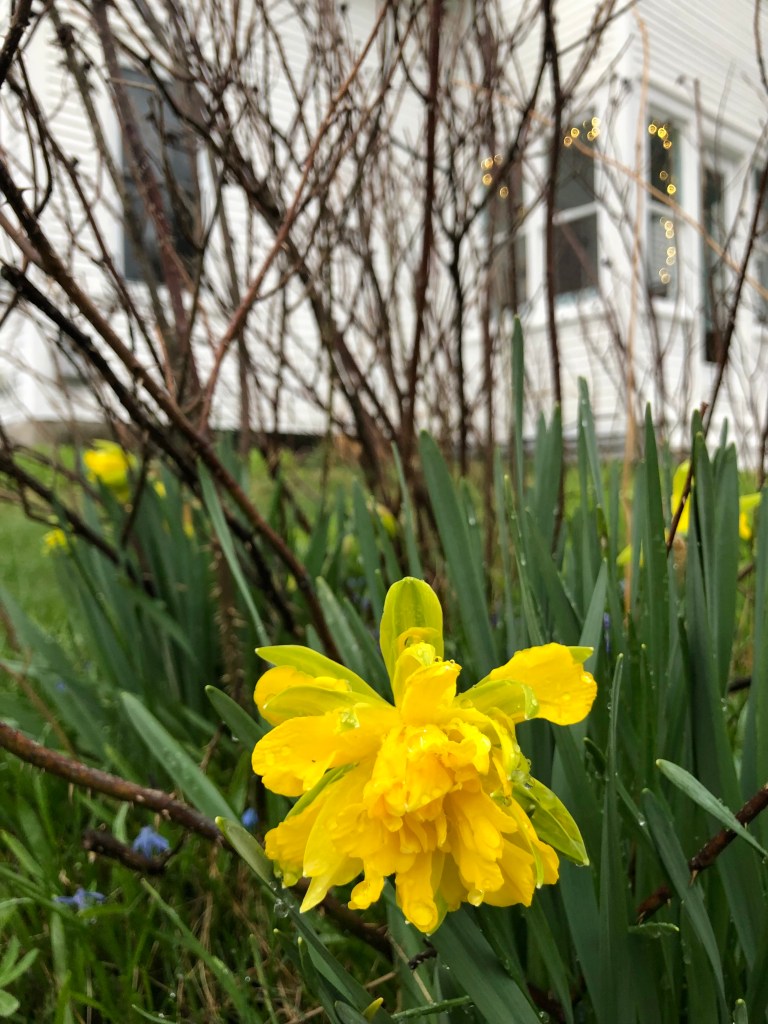
In this sunny, hopeful month of May — daffodils. Maybe I’ll think of this as a verb, not a noun: daffodilling.

Running.

Fisher Railroad Bridge, Wolcott, VT

Twice in one Friday, I’ve met acquaintances from long ago — the first at the coffee shop, the second at the transfer station. Now, having lived here for thirty years, I run into people who I’ve known in the past — maybe not well — but I know deep parts of their stories. I wonder what parts of my life they remember — and if I remember my story as they do.

On the way back from the transfer station, I stop along Route 15 and admire the Fisher bridge, the last of the covered railroad bridges in Vermont. Such effort went into building this infrastructure, and it was used for such a comparatively short time.

Because I’m wearing my running shoes, I follow the graveled rail bed. I cross the highway and follow the former track bed behind the lumber yard that smells sweetly of sap and freshly milled boards. There’s no one around on the rail bed at all. I run on the path right beside the river. The river is wide and slow moving, relatively tame for April. We’ve had little rain and less snow. I chance upon a pair of nesting ducks, and the mallard leads me away. I imagine in the heat of July how lovely it might be to swim across this water.

I stop to catch my breath. It’s me and the glossy mallard and the breezy cold afternoon. I wonder if we’re pulling out of the pandemic, truly. The brisk late afternoon takes my wondering and tosses it downstream. Eventually, I turn around and head back to wherever it is I need to be.

“It’s lovely to live on a raft. We had the sky up there, all speckled with stars, and we used to lay on our backs and look up at them, and discuss about whether they was made or only just happened.” 

~ Mark Twain

Stranger Aid.

Retreat Meadows, Brattleboro, Vermont

A stranger in the post office asks me if I can free her mail from her box. It’s a narrow box, nearly at the bottom of the wall. I crouch down, extracting envelope by envelope, taking care not to tear the paper. It’s clear she hasn’t collected her mail in some time. She waits patiently while I tug with some effort. While I hand up envelopes and fliers and magazines, I talk and talk, rambling on about the mail and whatever inane thing drifts into my mind. Around us, people open their boxes, collect their stuff, and disappear. I keep at my project, now kneeling. Finished, I shut her box door.

She thanks me, and we go our separate ways. Walking home, I keep thinking about that simple thing, how easy it is to give to a stranger. There’s likely an obvious lesson here. But one thing is clear, I got as much from the mail extraction as this woman.

… A cold and soggy April. Miniature daffodils push up through black soil. I keep feeding my wood stove.