Order. Gratitude. And Other Things.

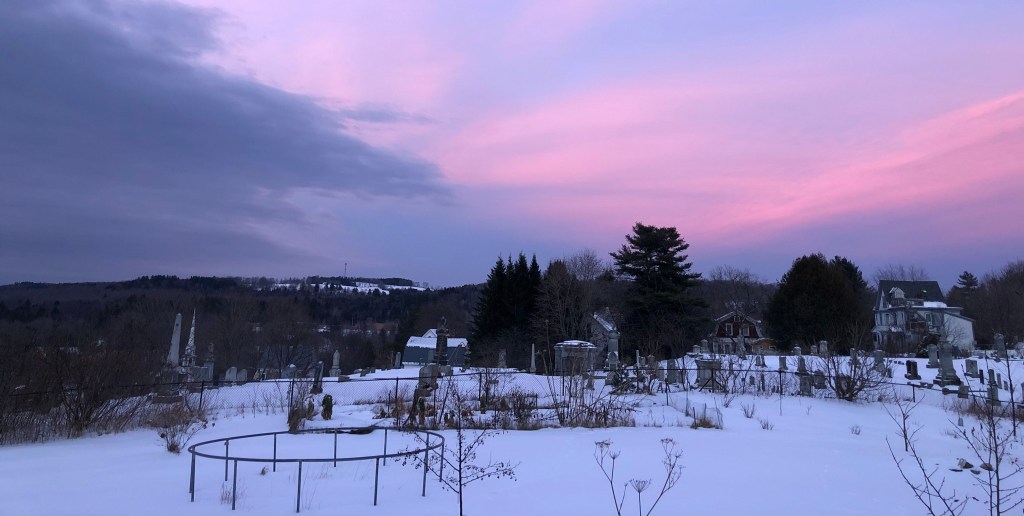
Sunrise, Hardwick, Vermont

January — the time of year when ash from the wood stove has settled into the crannies of our house — beneath the couches and along the woodwork. I listen to The Daily about FBI files released about the insurrection a year ago and take a soapy rag to my house.

I tell my daughters I’ll paint the walls of the upstairs hall spring grass green and stencil dandelions around the doors. What are you doing? they ask.

Some people are drawn to chaos. I crave order, a schedule, neatly pencilled lists to guide me through my days. To write, I travel to hard places, and I want to return to order. All around us now, chaos streams in, as the pandemic turns our world inside out. In the midst of this, I rearrange my woodpile. In the evening, while my daughter writes a school paper, I take the compost out to the bin. A light snow falls, sparkling in the light through our house windows. There’s no one out, and I keep walking. I head down the road and stand on the sidewalk. These neighbors have fully decked out their crab apple trees with twinkling colored lights. In my younger years, I would have scoffed at the use of electricity, much as I once hated paper plates.

Now, in the dazzling bits of snowflakes, I stand there for the longest time, thinking of nothing at all, just taking it in.

On a different note, Dr. Mark Levine, Vermont State Health Commissioner, read and blurbed Unstitched. I am among the many, many Vermonters who look to Dr. Levine as a beacon of calm, rationality, hope, and decency, as he’s guided our state through two years of a pandemic. In the mist of this, he took the time to read my book and called it a “tour de force.” Endless thanks, Dr. Levine.

Unstitched “…is both a page-turner and a primer in understanding the many complex dimensions of the opioid crisis in a rural state, where the reader accompanies the author in her own recovery and process of discovery. Ultimately, it is impossible for any of us to be totally disconnected from the impact opioid use disorder has on our communities, and it is through reading Stanciu’s skillful, compassionate and thoughtful rendering of personal stories that we can all gain valuable insight, diminish harmful stigma, and foster true healing.” — Dr. Mark Levine, Vermont State Health Commissioner
Math Matters.

Photo by Molly S.

My daughter gets her car inspected, but the mechanic has no inspection stickers. The stickers aren’t here yet, he explains. She texts me this, asking, What am I supposed to do?

Nothing, I answer. The stickers will come in when they come.

That sums up a strand of 2021 — there’s plenty more to this year, oh, boy, is there plenty more — but doing nada is definitely a 2021 strand. I’m not much for new year’s resolutions. I’m a compulsive list writer, and I tend to get a chunk of the stuff right before my eyes done. But there’s rain forecast for New Year’s Day when a deep freeze generally sets in. The world around us is unraveling.

This afternoon, I drove to the high school to pick up a rapid test for my daughter. The health department had taken over the parking lot with orange cones and bright vests. The tests were gone, of course. I talked with the health department employee for a few moments. He raised his hands, palms up, to the twilight settling in.

We commiserated about the strangeness of March weather in late December. Then I drove around him and headed home.

Small stuff. Big stuff. Proportion matters.

Imaginative Life.

When my first daughter was four, my mother gave her a babydoll that I had when I was little girl — Baby Tenderlove — which my daughter promptly shortened to Tendy.

Tendy, by the time my daughter carried her around, was ratty-haired, bald in places, forever dirty, and generally well-worn. My daughter was a single child then, and Tendy morphed into the desired baby sister. Tendy inhabited a unique imaginative place in her life. One afternoon, I was driving through Montpelier when my daughter insisted I pull over now, Mama! as I had driven by Tendy who was allegedly walking on the sidewalk. Without thinking, I pulled over, open the passenger door, instructed Tendy to get in please, and buckle up.

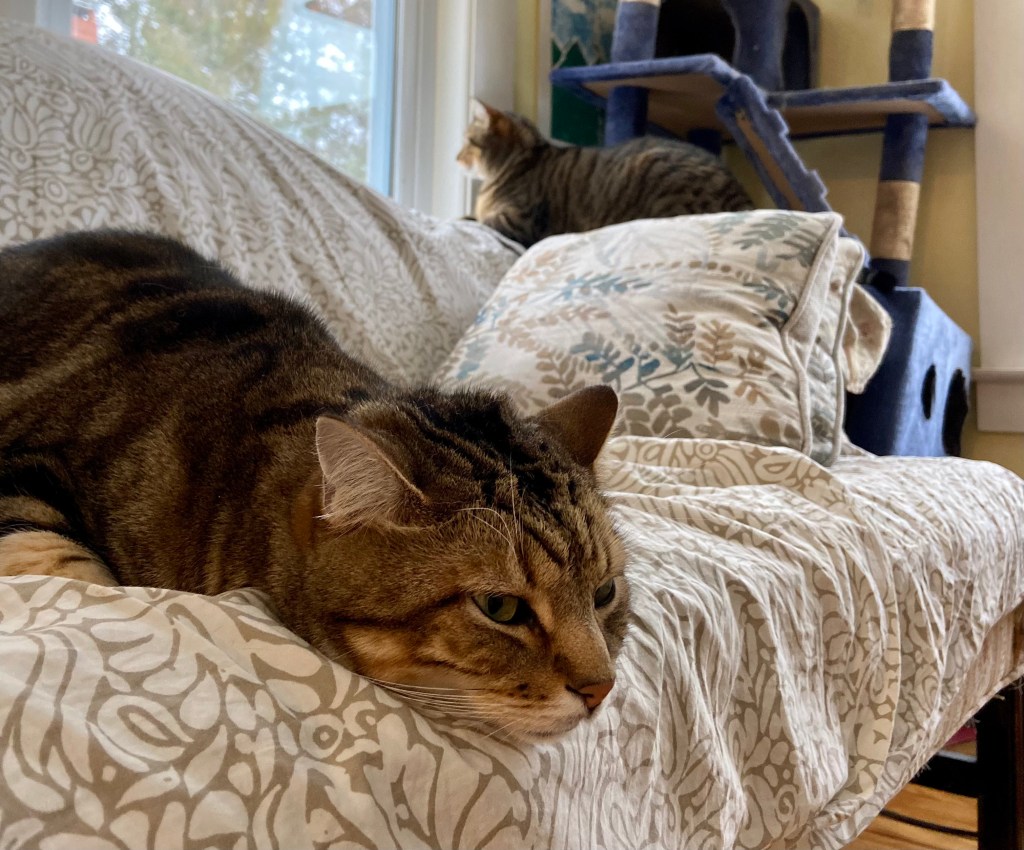
Our household is no longer in the realm of little kids, and yet this imaginative world has spread to our cats now. One is in a PhD program, writing a dissertation on epistemology, while the other is a lifer in preschool. Both enjoy a fresh toy mouse.

….. The cold hammers in around us. I hope you’re all warm, wherever you may be.

Everyday Epiphany.

I’m sitting on the little coffee table a friend and I picked up in a free pile a few summers ago, watching my wood stove rekindle through the glass and talking to my father on my little phone. There’s this forty minute window before my daughters return from work with stories of their days. Cauliflower and potatoes are roasting in the oven, and we’re talking about all kinds of things, like this incredible novel Let the Great World Spin.

Because my father and I talk about things like this, we talk about suffering. The fire suddenly flares up, and does its beautiful wave thing through the pipes in its top, rippling in waves and emanating heat into our house. My cat rubs against my feet.

In an everyday epiphany, this great world spins around me, and I’m abruptly released from the pandemic and from the imminent holiday itself — so complex, so multifaceted, in a culture driven to the reductiveness of images and consumption.

I see the logs I’ve split from a fallen tree, consumed by flame, transmogrified into heat, and headed as ash into my garden. For this moment, I remember all those cold winters in our other house, and how blessedly happy I am that I bought this stove, and I live in a house with yellow walls, with two daughters, two cats, and all the tangledness of our lives.

That forty minutes is irrelevant. It might be ten minutes, or six hours. There’s just this moment, my father talking about Homer and Socrates, these stories that have followed me all my life.

Tasting Snow.

Where we are now….

In fresh snow, I walk through the little neighborhoods around us. One man shovels snow. A few plow trucks hurry through. It’s nearing dinner, and streetlights are turning on, one by one, in the December twilight.

It’s been a week of phone calls and problems with no clear solutions, simply the inevitable change that comes to all our earthly doings. I’ve wandered on this walk without real intention, drifting away from chopping firewood and shoveling paths.

I turn a corner and see a house where I once bought sugaring equipment from a man who lived there. He’s passed on, and his wife sold the house and moved away. A family lives there now. Two little boys call at each other in the street. There’s no traffic about, and they’re standing beneath the streetlight. As I walk closer, I see their heads are back, and they’re catching falling snowflakes in their open mouths. Their voices are loud and excited about this small thing.

A man comes out and says, Get in the car. They get in the backseat of an idling car, and he drives away. Back at my house, my daughters have brought in the night’s firewood and swept the floor.

And because bell hooks was so amazing, another line from her:

For me, forgiveness and compassion are always linked: how do we hold people accountable for wrongdoing and yet at the same time remain in touch with their humanity enough to believe in their capacity to be transformed?

Auto Parts Store Revelation.

Photo by Molly S.

On my way home from work, I stop in at the auto parts store down the road from house and buy a set of wiper blades. I’ve known the manager there for years, in the way you know often someone in a small town, in bits and pieces. He must know me the same way, in snippets.

He disappears into the back, getting my parts. I stand there, looking thorough the plexiglass at the open shelves of boxes of parts. It’s a quiet moment in a long day. In that moment, I feel surrounded by utter opulence — the twinkling Christmas lights in the window, the balmy December air, and the simpleness of heading home to daughters and cats and home after a day at work.

When he returns, he asks if I want him to put on the blades. I glance out the window. The December rain has briefly paused. It’s nearing five, and pitch dark.

You mind? I ask.

He doesn’t. He has a young man working there, too, and asks him to come outside. This, he says, as he pulls off my ripped wiper, is how you do this.

And a few lines from bell hooks….

I will not have my life narrowed down. I will not bow down to somebody else’s whim or to someone else’s ignorance.” 

No black woman writer in this culture can write “too much”. Indeed, no woman writer can write “too much”… No woman has ever written enough.”