The Shape of Things.

In the early 1600s when Samuel de Champlain was bunking around the fire with people who lived on the shores of an enormous and beautiful lake, Champlain remarked in his journal how surprised he was that these strangers discussed their dreams every morning as if their dreams were as real as the waking world. I’ve been thinking about Champlain’s observance and how easily we can narrow our vision, completely discounting or ignoring pieces of our past and present.

A blog reader who sometimes mails me terrific books sent me Jane Alison’s Meander, Spiral, Explode: Design and Pattern in Narrative. As I’m finishing up a draft of my novel, the book has made me look harder at the novel’s structure. As a writer, I can’t help but look at my own tangled story — and those around me — and the way plot lines and patterns, how chance and opportunity, blend and shape our lives.

For Ray Carver fans (and who isn’t a fan, really? if not, you might want to be!), there’s a terrific essay on one of my favorite stories, “Where I’m Calling From.”

So often fictions that experiment formally do so at the expense of feeling. They toy on surfaces or are purely cerebral affairs, don’t explore human complexities. But the mostly unconventional narratives I’ve been discussing have dealt powerfully with core human matters.

— Jane Alison
Pique.

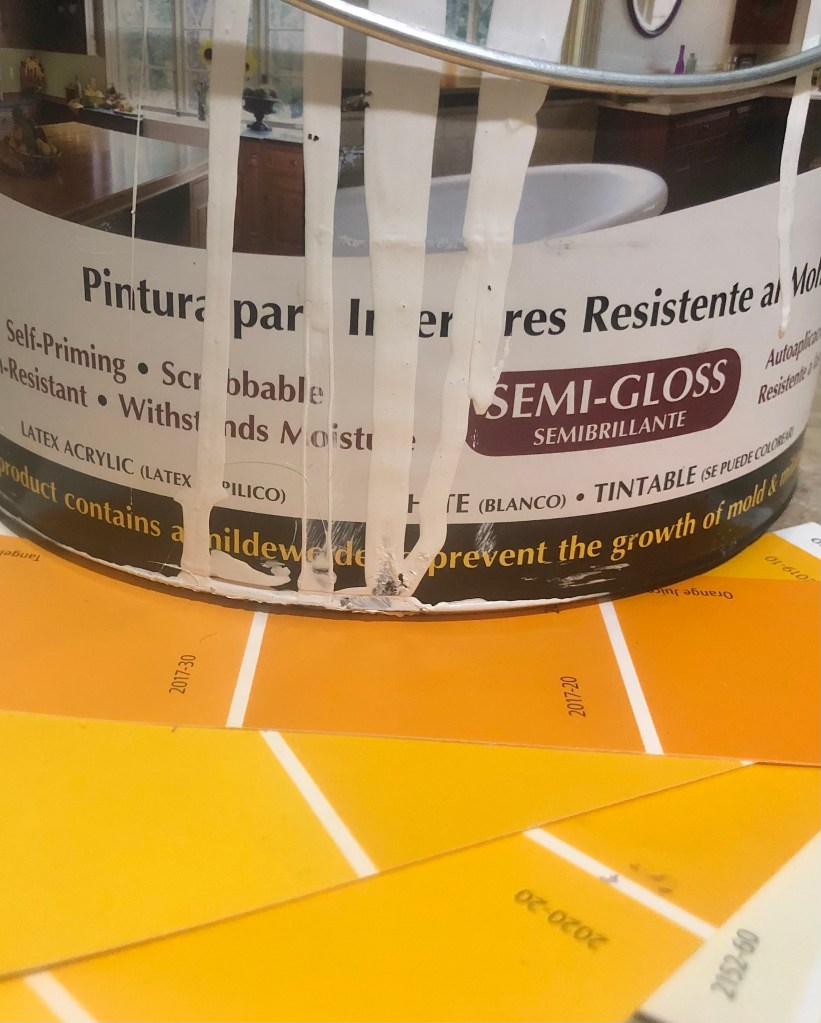
Anyone who knows me knows that winter pulls out my mania for painting. In a fit of what I can only describe as sheer irritation, I bleach mold from the bathroom ceiling and then ask for primer advice at the hardware store.

The store is darn near empty, save for two clerks and a black cat who rolls on its back on the counter and flicks a pearl-tipped tail at me. A clerk walks back with me to the paint section. She and I have been on a first name basis for years. While my gallon of primer is on the shaker, she shares her bathroom ceiling painting experience, and I offer this small problem and ask her to solve it. We walk back slowly to the front counter. She’s been my height for years, but as we walk and talk, I realize she’s slipped down below my height, and my height is definitely (as my brother might claim) substandard.

A man in logger’s chaps pays for discounted Christmas tree lights and a Twix bar and grouses about the rain and the mud, and how can there be a January thaw when we’ve had no winter?

The clerk spreads my paint samples over the counter and asks if I’ve narrowed down any color choices. She lays one finger on the color named Sunshine. “This one,” she suggests.

I gather my primer, stir stick, the lightbulb for over the kitchen stove, and head out. Ahead of me lies an afternoon of careful work, of NPR and stories from around the world, so many places hemorrhaging in ways that far outstrip my tiny mold project. As I’ve always done, I join my head and hands in a creative project. My own imagination won’t heal the world, but surely it won’t harm.

Stitches and Snippets.

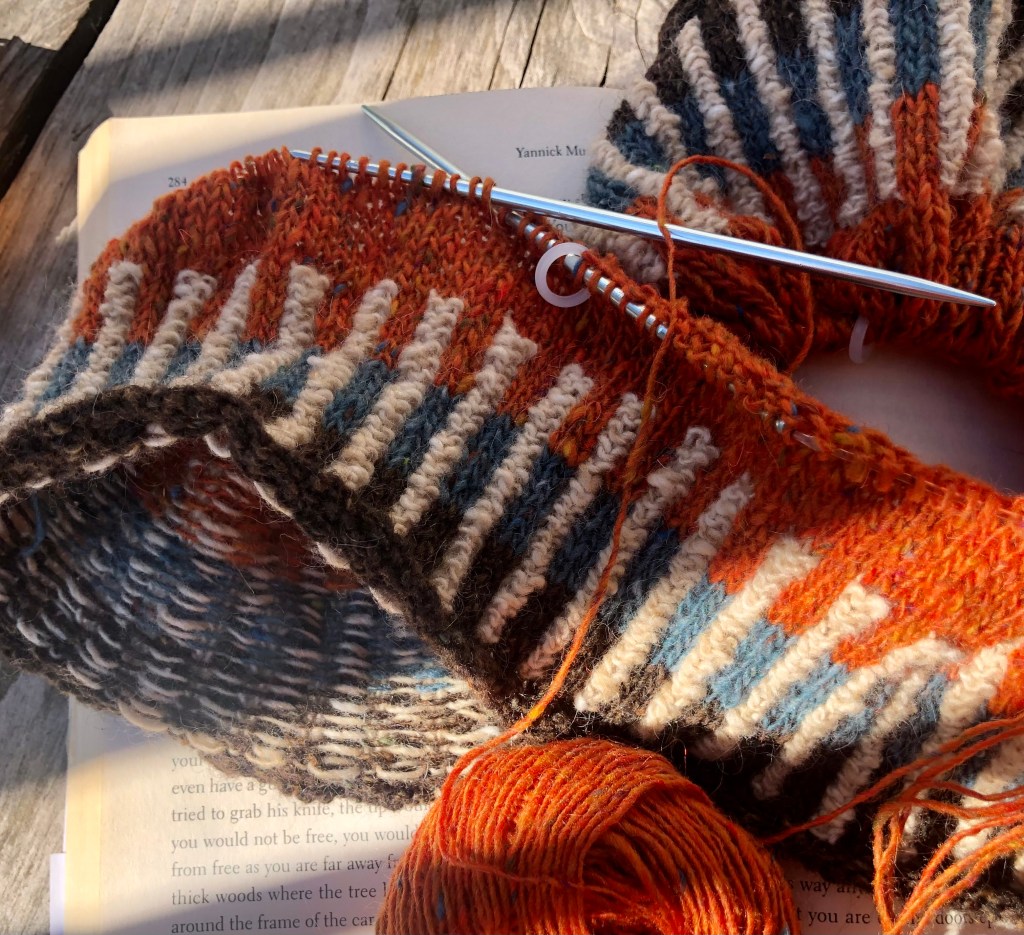
At night, I knit and read, diligently counting stitches two-by-two before beginning the yoke pattern. I read about witches in 18th century New England, about muddy roads and fieldstone chimneys, about hunger and families and the complicated passions of small communities. About fear and remorse.

Around my house, the wind howls, lifting pine needles and crows’ feathers. November is the season of reckoning and looking towards the new year, of town and school budgets, of placing what you have beside what you want, of financial cost-and-benefit analysis, of a personal reckoning, too.

I remain awake unreasonably late, determined to proceed carefully this time to avoid ripping apart these stitches, anticipating the pattern work, the joining of color to color. Outside, I imagine smoke rising from our chimney, dissipating into the starry sky. A mouse nibbles in the wall. I keep counting.

“Writing a novel is a terrible experience, during which the hair often falls out and the teeth decay. I’m always irritated by people who imply that writing fiction is an escape from reality. It is a plunge into reality and it’s very shocking to the system.” 

— Flannery O’Connor

Last the third Vermont Almanac —one of the loveliest (and most useful) print publications — is out. The Almanac folks are virtually kicking off the third edition at Burlington’s Phoenix Books Thursday night, 7 p.m. You should come!

Sunday.

My father emails me a Chris Hedges’ article, “Death of an Oracle,” about the recent death of poet Gerald Stern. I toss a few slivers of bark on my stove’s embers and listen while my cat stares out the window at two cardinals in the twiggy mock orange. The birds are brilliant crimson in the merciless November gray.

I’ve just submitted a 100-word story of Thankfulness to the zillion and more that the New York Times will receive this week. Mine is precisely 100 words, drenched with gratitude and, honestly, rage. My little cat flicks his tail at me, as if asking if I, too, see that pretty bird my cat would like to hunt. Indeed, I do. The birds are wise enough to understand the merits of glass and peck away at the grass, unperturbed. Sunday morning, and my list lies on the table. A long week looms ahead. As I listen, however, a kind of peace settles around me, and not simply because of the warming fire. I’m reminded that I never sought a life of blandness.

My cat yawns and naps. The cardinals disappear. I brew another pot of espresso. My brother’s coming for Thanksgiving, bringing steak and endless conversations about the utterly mundane, like Wordle, the downright silly, and gritty existential pondering about the afterlife. November is looking up.

If the Buddhist’s job is to be detached, I think that the artist’s job is to be both detached and attached.

— Gerald Stern

Geometry.

Strangely warm weather prevails. 28 years ago when I moved northward from southern Vermont, snow fell by the end of October and stayed until April. That April, I walked in a warm rain and wondered if I had made a mistake.

This afternoon, red clover in the fields, Johnny-jump-ups in the garden. I walked to the co-op and paid my tab and bought a loaf of bread for dinner with a crosshatch baked into its crust. At the register, we talked about the mysteries of calculus. Someone wondered if a radius calculation — r = √(A / π) — meant the center would never reach the edge of the circle, as π is an infinity? I volunteered to phone my brother or father and then steered the conversation to the surely more pressing question of color. Through the co-op’s wide windows, the autumn twilight sprinkled down in its charming way that intimated of the night’s stars yet to come, its gray scattershot with the remnants of this summer’s lingering gold leaves.

I went out and slipped through the side streets and up the hill behind the house that was once a nursery school. A woman with New York plates sat in her car at the ballfields, talking on her phone, staring up through the windshield at the turkey vultures circling over the pines where they nest.

Home again, I stood on the back porch and drank a glass of water. Dead curled leaves sprinkled the back deck.

Will the center reach the edge? Surely, a question of importance.

“Great things are not done by impulse, but by a series of small things brought together.” 

— Van Gogh

Stitch, Stitch.

As the days shorten, I appraise my woodpile. Borrow knitting needles. Read outside in my coat, the sun on my face. Our cats sprawl before the wood stove, savoring radiant feline bliss.

My brother comes to visit for my daughter’s final soccer game. Nine years of games and uniform washing, and I still don’t understand fully the rules of the game. Vs of geese cross the sky. As we idle afterwards, talking, a flock of starlings sweeps low over our heads and disappears around the school.

Back at our house, I gather my things from the car — my jacket, her gifts of balloons and chocolates, the signs her sister made. Photographs. Near sunset, the sky is a luminescent pink that will endure for a few minutes, no more. Their coach, son of glassblowers, made each of the senior girls a glass. In our kitchen, we admire my daughter’s beautiful gift. I wonder how she will fill it.

“Great things are not done by impulse, but by a series of small things brought together.” 

― Vincent Van Gogh