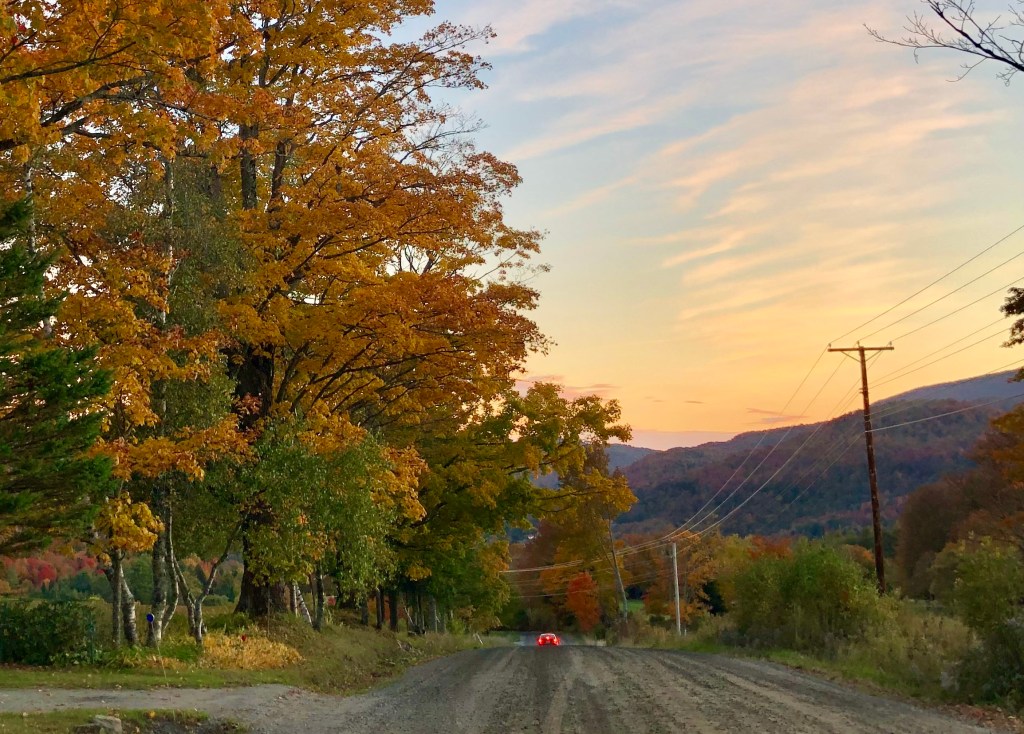
Autumn, Moon, Small Town.

While my daughter washes the dinner dishes, I head out for coffee. That morning, I finished the last of the grounds. I pull on a sweater and cut through the back woods to the cemetery. A gibbous waxing moon hangs like a splash of cream over the cemetery and keeps me company as I cut through the elementary kids’ ballfield.

As I walk down a side street, I see the co-op below, lit in the falling twilight. Last year, the co-op moved from its tiny Main Street store — packed literally to the ceiling with stuff — to a much larger boxy grocery store around the corner. A number of years ago, the co-op quit selling bottled water after a staff member complied compelling reasons to quit. Instead, the co-op offered cups of free water. Now, the co-op sells local veggies and cheese and meat and wine and so on — and Cocoa Puffs.

As a long-term co-op shopper, I’ll simply note that people don’t know how to use this larger parking lot. For whatever reason, we keep tangling up ourselves, backing out into Route 15, nearly colliding.

In the parking lot, I stand for a moment, admiring the moon and the scent of autumn. All day, the sun has shone brilliantly, unseasonably hot, and rain will be pushing in Friday. The man who lives in the apartment across the street opens the co-op door and gestures for me to walk in ahead of him. We stand talking for a few moments about that drop-of-cream moon and how the scent of fallen leaves reminds us of childhood.
Peak Foliage, Thursday 1:35 p.m.

… or so I predict. Such a silly thing. The branches of some trees have already blown bare, others are just beginning their radiance. It’s later that the torches of tamaracks will begin.

On these stunningly beautiful autumn days, the cats and I wake early. They’re easily satisfied with a few morsels of cat food, a rub on their furry heads, a few more sticks in the wood stove. The two of them stretch on the rug before the stove, worshipping.

Daughter and I go about our day. Coffee and dishes and firewood. At night, I dream of spring peepers.

Here’s not the famous lines from Robert Frost that rattle through my mind these days. Instead, Ezra Pound:

IN A STATION OF THE METRO

The apparition of these faces in the crowd:
Petals on a wet, black bough.

— Ezra Pound

Gifts.

Before I leave for the North Danville Library on Tuesday, I sit for a moment with my daughter at our kitchen table. She eats a quesadilla, and we talk about things that matter — who’s behaving in what way and why that might be. The rain has knocked off for a bit, and I drive the way I often knit, more by feel and memory than anything else.

At this time of year, the farm fields are their deepest green. Sunflowers appear in gardens and along houses, their yellow leaves weathered by cold nights. I passed the house where my former sister-in-law lived when her four children were little. In the backyard, we built a playhouse. Her oldest daughter slept in the upstairs bedroom, and milk trucks rumbled down the road in the very early mornings.

The Brainerd library is housed in a former schoolhouse. I parked and stood for a moment in the lot shared by the library and a church. Cows ambled in the field behind the parking lot. Across the street, children pushed each other in a swing hung in an enormous tree. I imagined these were a few after-dinner moments gleaned in the falling twilight before bedtime.

I had been generously invited to talk and read a little about my book Unstitched. Driving over, I remembered the two years I spent writing this book, much of these hours at my kitchen table. Writing a book can be such a long and lonely process. So these moments of connection and resonance, of meeting readers and other writers, are manna to my soul. The library was well-cared for and had a real sense of so much living that had happened in those walls.

Unstitched is about hard things — addiction and guilt, poverty and illness. But I left that night and drove back home along the roads that had no traffic with my heart full of happiness kindled by an evening of literature and discussion and homemade cookies in a beautiful library with kind people. At home, the stars sprinkled over the sky, and the night was still warm enough that I could pretend winter was not in the near offing. Inside, my daughter and I picked up our conversation where we had left off.

Some Miles.

So many miles passed this weekend. Two trips to Vermont’s big city of Burlington for the Green Mountain Book Festival — Saturday as a participant, Sunday as audience. One trip alone, one trip with a friend. This past summer, I put some genuine effort into what I named my own personal healing project from the isolation and sadness of the pandemic — a project I admittedly dabbled in, without real expectation of success.

Here’s what I did: I gardened, spent as much time outside as possible, swam whenever I could, slept under the stars, and basically tried hard not to care very much (or maybe be distracted) by things that don’t mean very much.

What a pleasure to be back among the literary world, where people walked in and out of rooms in the lovely Fletcher Free Library, listening to poets and writers, the young and the very old, talk about writing. In an innate kind of way, these are my people.

Outside, rain fell in a dismal September day. I’m not a cardholder at this library and have only intermittently walked through its doors. Sitting in the main reading room in my raspberry-jam-hue sweater, I could have kept listening to the stories, language pared down and muscular, judicious with adjectives, evocative of Vermont and the people living here.

Media spin notwithstanding, the pandemic hasn’t vanished. Our world has been upended. And yet we move on.

A few lines from Jay Parini who graciously read beside me this weekend:

“It is not an easy thing to alter the trajectory of your life. People have expectations on your behalf. You come to believe them yourself.” 

And, last, I’ve kindly been invited to the North Danville Library this coming Tuesday, 7 p.m.

Take Joy.

There’s a line in a Raymond Carver that describes a woman as a long tall drink of water. The line reminds me of my oldest daughter — a kind of welcome draught. Myself, I’m more like a splash in the face.

She and her friends are in their early twenties and have lived an amount of life that surprises me at times. At her age, I’d had a whole, full childhood and was drifting through young adulthood, through college and graduate school and what amounted to an awful of driving around the country and sleeping in the back of our Volkswagen Rabbit. I’d sandwiched in a number of jobs, but the economy was sparse in those days. The pre-internet world was slower, less fierce, less competitive. In the collective vocabulary, the words climate change, pandemic, trauma, were never bandied around.

So on these balmy, early autumn weekends, it’s a pleasure to see her strap the kayaks on her car and head off for a pond ringed by mountains. Summer in Vermont is always too short. But this year, in particular, has been especially brief. Maybe it’s where I am in my life, with my youngest about to fly from the proverbial nest. But the stresses of the pandemic — hardly just for me, but collectively — have worn profoundly into our world. A delayed car part on order seems something hardly worth considering. As a personal sanity strategy, these lovely, golden autumn days, I pause outside and listen to the cricketsongs, the ruffle of wind on leaves that aren’t long for this world.

One thing I wish I knew in my twenties is that happiness matters. At that age, I had a whole confused theory about happiness versus pleasure, saving my soul and the planet, writing and sacrifice, and a narrow view of good parenting. Silently, I think to myself, Take joy where you find it. Surely our world needs more laughter. And rowing your narrow boat makes you strong.

…. Last, Streetlight published an essay of mine today. Many thanks!

Today. Yesterday. Tomorrow.

Sunday, we drive across the Connecticut River into New Hampshire. There, the mountains are much taller and rugged than Vermont’s shorn down ridges. I grew up (mostly) in New Hampshire, and granite in boulders and quarried slabs is as familiar to me as my kitchen knives.

I sit in the backseat, knitting, and all the way there and all the way back, I have the strangest sensation of a sewing needle linking these two states and the pieces of my life — girlhood and young motherhood and the cusp I’m on again as my fledglings head off gleefully into the wild. In New Hamsphire, we meet my brother for lunch in a leisurely way, nothing serious, batting around trips and ideas, family stories. We sit outside in the shade. As we leave, he tips back his head and says, What perfect weather.

We return home with tiny cheesecakes in jars, a few groceries, a kind of sleepiness and fullness from the drive. We’re back in time to feed the hungry housecats their early dinner. In the garden, I pull up some gone-by marigolds and cucumber vines. Working, I think of all these little bits and pieces of our lives, how I often struggle to put these together. And yet, sometimes, how our lives are sewn together, as if miraculously. End of August. And now onto what I hope is a long sweet autumn.

Some things will never change. Some things will always be the same. Lean down your ear upon the earth and listen.

The voice of forest water in the night, a woman’s laughter in the dark, the clean, hard rattle of raked gravel, the cricketing stitch of midday in hot meadows, the delicate web of children’s voices in bright air–these things will never change.

— Thomas Wolfe