Daffodils: Verb?

I’ve been a patient at numerous Planned Parenthoods, in three different states, since I was a young woman. These days, I keep remembering a nurse practitioner I met in Bellingham’s Planned Parenthood. I had waited a long time. It was a very hot afternoon. Dust blew in through the open window. She apologized as she washed her hands and simply said it had been a busy day.

I was in my early twenties, had brought a book to read, and I didn’t care.

The staff at Planned Parenthood gave me information I needed when no one else did. This was information and advice that shaped my entire adult life. I was never turned away — even when I had nothing to offer as payment — never denigrated, never treated coldly. My oldest daughter is now the age I was that afternoon. In those young optimistic days, I believed inherently in progression. I didn’t see then that history repeats itself, turns back and bites the same wounds.

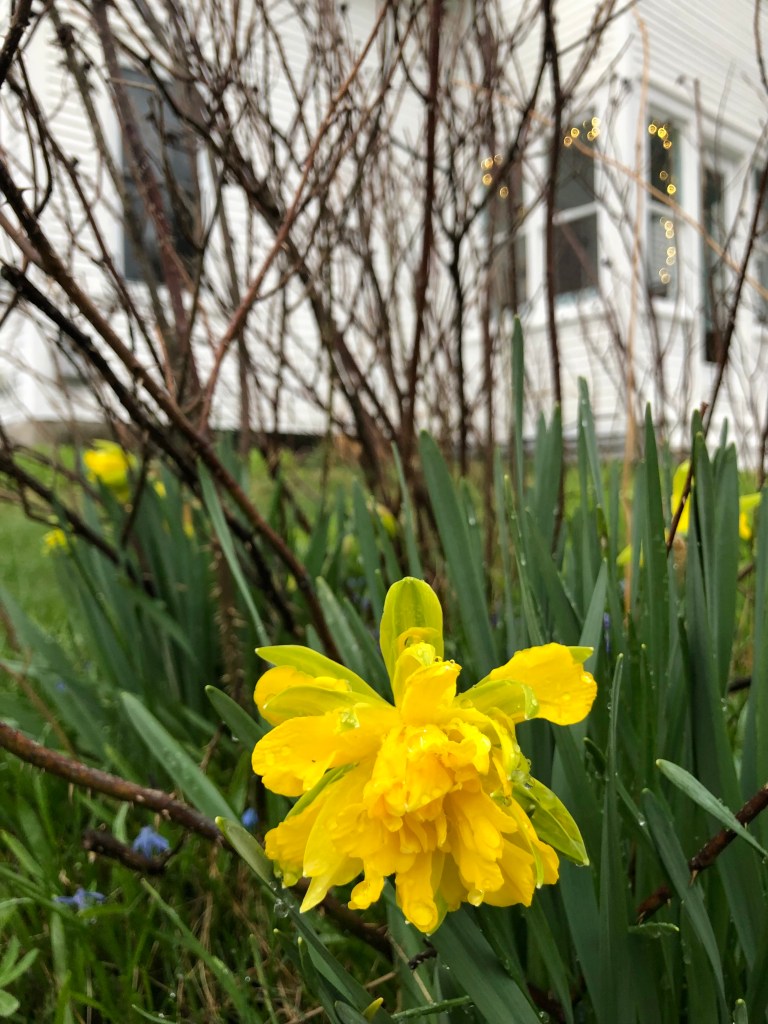
In this sunny, hopeful month of May — daffodils. Maybe I’ll think of this as a verb, not a noun: daffodilling.

Running.

Fisher Railroad Bridge, Wolcott, VT

Twice in one Friday, I’ve met acquaintances from long ago — the first at the coffee shop, the second at the transfer station. Now, having lived here for thirty years, I run into people who I’ve known in the past — maybe not well — but I know deep parts of their stories. I wonder what parts of my life they remember — and if I remember my story as they do.

On the way back from the transfer station, I stop along Route 15 and admire the Fisher bridge, the last of the covered railroad bridges in Vermont. Such effort went into building this infrastructure, and it was used for such a comparatively short time.

Because I’m wearing my running shoes, I follow the graveled rail bed. I cross the highway and follow the former track bed behind the lumber yard that smells sweetly of sap and freshly milled boards. There’s no one around on the rail bed at all. I run on the path right beside the river. The river is wide and slow moving, relatively tame for April. We’ve had little rain and less snow. I chance upon a pair of nesting ducks, and the mallard leads me away. I imagine in the heat of July how lovely it might be to swim across this water.

I stop to catch my breath. It’s me and the glossy mallard and the breezy cold afternoon. I wonder if we’re pulling out of the pandemic, truly. The brisk late afternoon takes my wondering and tosses it downstream. Eventually, I turn around and head back to wherever it is I need to be.

“It’s lovely to live on a raft. We had the sky up there, all speckled with stars, and we used to lay on our backs and look up at them, and discuss about whether they was made or only just happened.” 

~ Mark Twain

Stranger Aid.

Retreat Meadows, Brattleboro, Vermont

A stranger in the post office asks me if I can free her mail from her box. It’s a narrow box, nearly at the bottom of the wall. I crouch down, extracting envelope by envelope, taking care not to tear the paper. It’s clear she hasn’t collected her mail in some time. She waits patiently while I tug with some effort. While I hand up envelopes and fliers and magazines, I talk and talk, rambling on about the mail and whatever inane thing drifts into my mind. Around us, people open their boxes, collect their stuff, and disappear. I keep at my project, now kneeling. Finished, I shut her box door.

She thanks me, and we go our separate ways. Walking home, I keep thinking about that simple thing, how easy it is to give to a stranger. There’s likely an obvious lesson here. But one thing is clear, I got as much from the mail extraction as this woman.

… A cold and soggy April. Miniature daffodils push up through black soil. I keep feeding my wood stove.

Appetite.

Before it’s warm enough, I open the open to our glassed in porch. This porch (nor its upstairs counterpart) isn’t heated. In Vermont’s long winters, we simply close the door and leave the space be. I think of this as a standard New England practice. I store empty canning jars, summer flip-flops, things like old blankets I don’t really want any longer, but nor do I want to cast away.

All day long, doves and cardinals, juncos and chickadees and sparrows, dip and fly around our house. The crocuses struggle upward. I should be cleaning our house, I think, taking a broom to the cobwebby corners before the spring sets in mightily and I’m in the garden as much as possible, happy as I could ever be, the warming soil between my toes.

Now, snow falls intermittently. The robins dig into the earth hungrily.

Consider the tulip,

how it rises every spring

out of the same soil,

which is, of course,

not at all the same soil,

but new.

~ Rosemerry Wahtola Trommer

Promise.

Hurray! A whole day (Covid card and mask required) devoted to a workshop at Jenna’s Promise. I haven’t been to a full gathering in, well, about two years. The workshop was about the future of recovery in the Green Mountain State.

One of the key speakers lifted a blue vase. Her daughter, now passed away from an overdose, had brought home the vase from India. The vase had broken in her luggage on the return flight, and it had sat on a shelf in pieces. The speaker raised the vase and explained how her grandson had suggested they repair the vase with super glue. Together, they mended the beautiful vessel.

The thing about this audience — the recovery crowd — is that the rose-colored glasses have long since shattered for everyone in the room. Any wet eyes are likely to be from tears — from sorrow or laughter — either is likely. Hardly any rational human would disagree that the pandemic broke our world where it was already ailing. While I’ve long since relinquished any belief in magic, I do know the power of super glue. And I do know what’s broken can sometimes be repaired.

(And, I heard the inimitable Johann Hari read….)

April. Spring. Robins mudding those fat-walled nests.

“It isn’t the drug that causes the harmful behavior—it’s the environment. An isolated rat will almost always become a junkie. A rat with a good life almost never will, no matter how many drugs you make available to him…. Addiction is an adaptation. It’s not you—it’s the cage you live in.” 

— Johann Hari, Chasing the Scream

Somewhere in March.

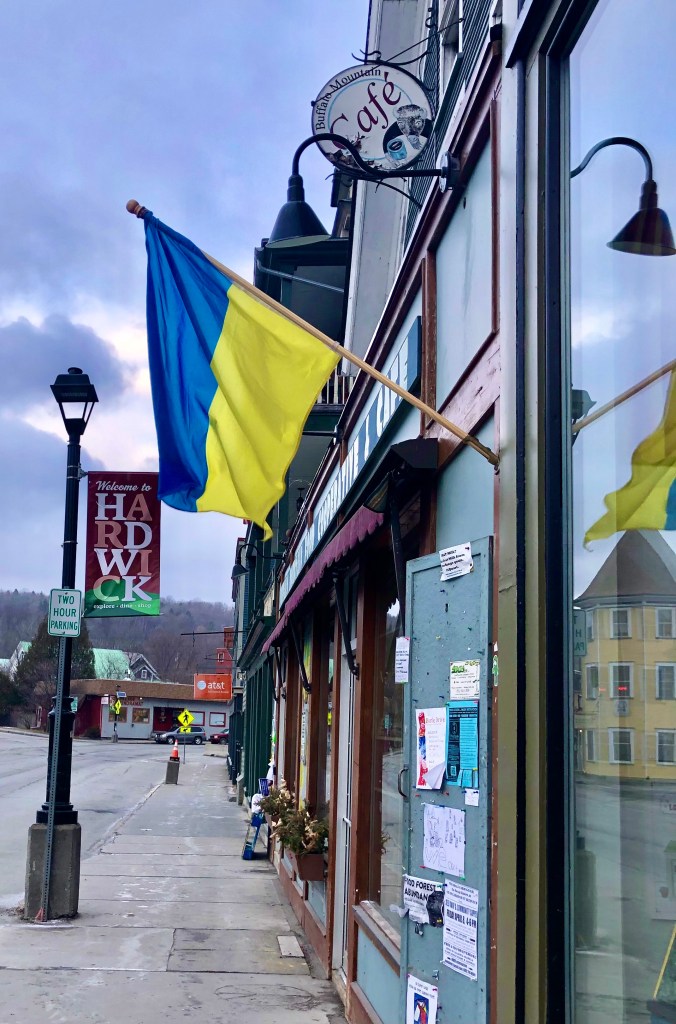
Hardwick, Vermont

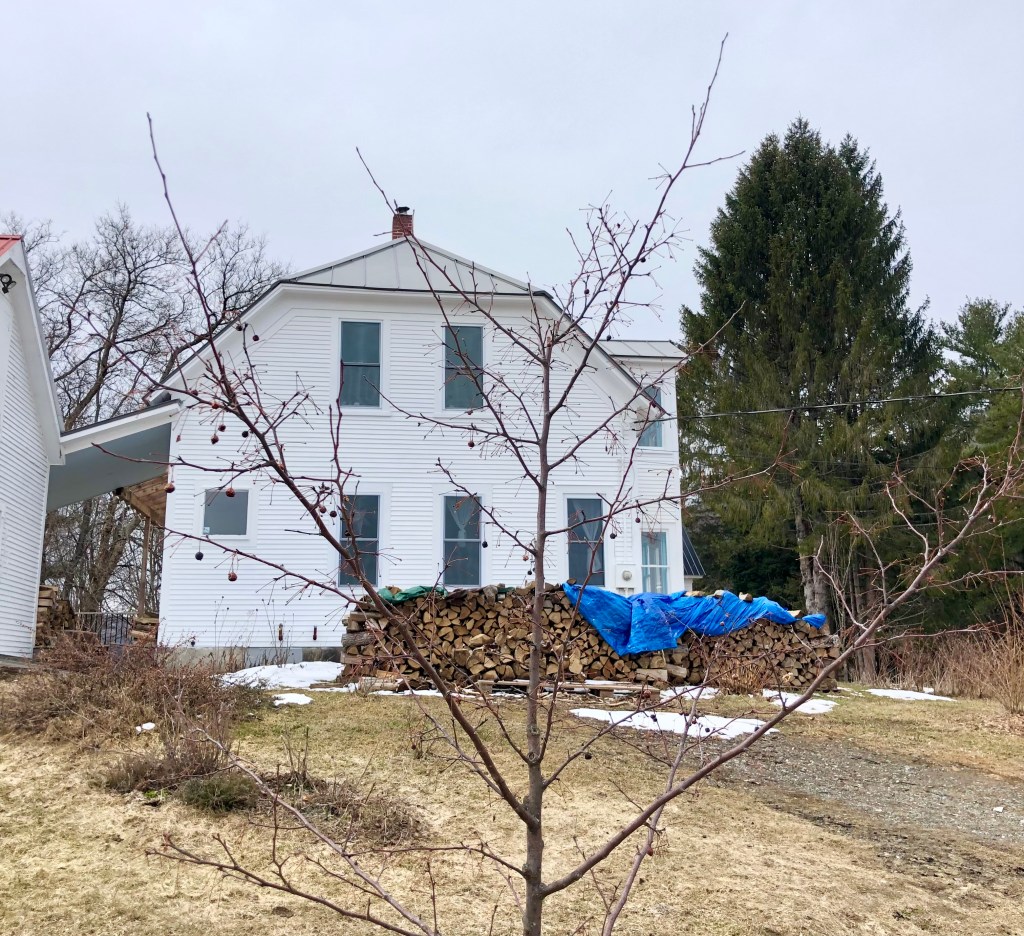
Mud season is fierce this year. The school busses cease running on some roads. Families share photos of kids waist deep in mud ruts. Time, more than all the gravel in the state, is more likely to true up the roads than anything else.

Mud season is the odd shoulder season in Vermont. The skiing winds down. There’s no good biking. The tourists are all in sunnier southern locations, and Vermonters muddle along.

All day long, the prettiest and lightest snow falls — nothing serious, nothing much at all — just a scattering of the purest white and enough of a chill that the wood stove is welcoming when I come in with cold cheeks and armfuls of wood. I put a quiche in the oven and head out for a walk. The snow has (mostly) melted here now, and so my paths through the fields and woods have opened up again. Behind the elementary school, the turkey vultures circle over my head. They’ve just returned from their winter sojourn, to their long-time nest in a stand of white pines. I know what they want; there’s no secret here.

I hurry down the hill and along Main Street. A woman stands outside the laundromat, hands in overall pockets, staring up at the drifting snow. She raises one hand to me. I do the same, round the corner, and head home.