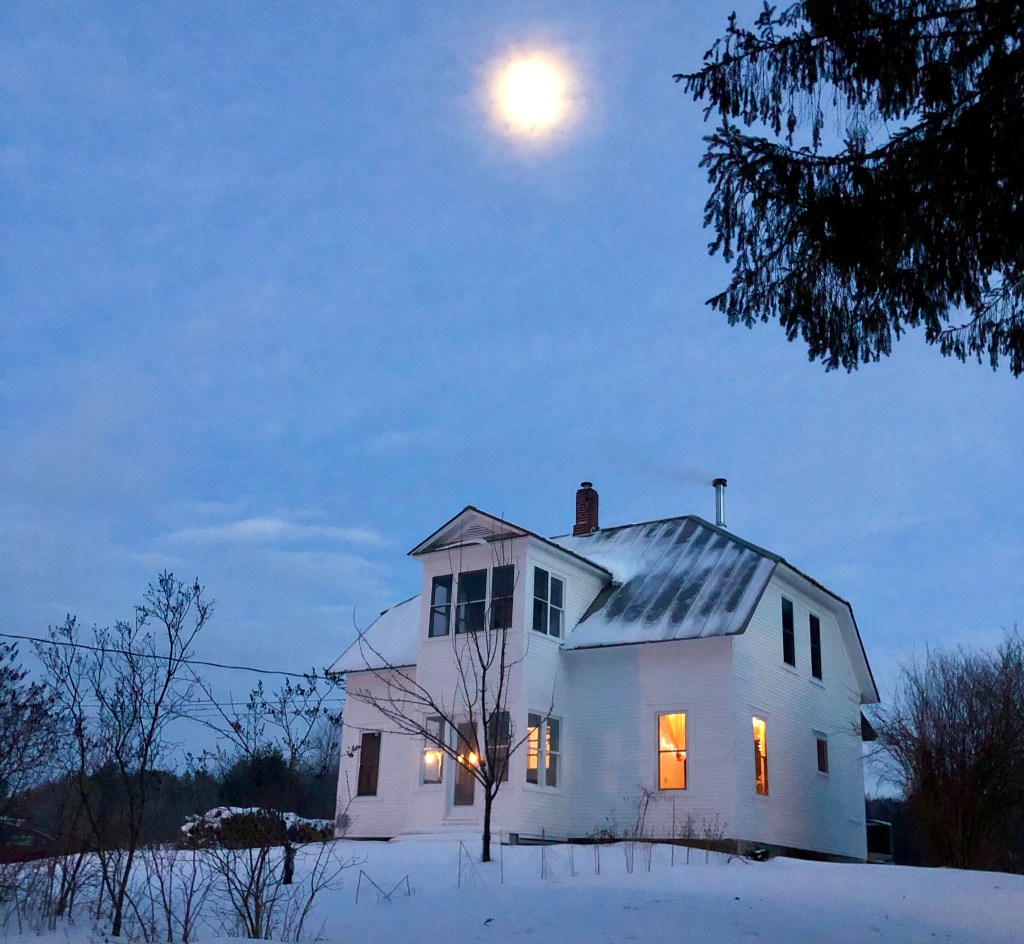
The cold comes at my face like a knife when I take out the wood stove ashes. The early morning is perfectly still, full of sunlight. This is not the songbird season.
I’ve now lived through a few dozen Vermont Januaries, beginning as a young woman when I spent so many January nights walking around beneath the winter sky, amazed at all those stars in the deep country dark. Januaries of nursing babies, of a long driving commute, of sledding and baking bread, and enduring the beginnings of cabin fever’s madness.
Always, there’s the cold that reminds us immediately of our own fragile mortality and an inevitable thaw. By the end of the month, daylight returns in a rush. In these chopped-up days of uncertainty, I remind myself of these constants.
‘We forget about the spaciousness above the clouds
Twilight drags out again — not a sign of spring by any means but a hopeful sign. The light’s returning to us. After work, I rush through my outside chores, then keep walking and walking. I’ve somehow slightly twinged my knee, and so I walk with the faintest of limps, which amuses my athletic daughter no end. Why wouldn’t your body hurt? she asks me.
We live in such a crazy, mixed-up time. Some of this is just us — a high school student, a grown daughter, four jobs between us, an EMT class, a recently published book and another I’m writing, an absent father, my single motherless — and then a world where the Expected Everydayness is suddenly flipped inside out. The rules have all changed, or at least it’s worth rethinking all the rules.
No phones, ever, at dinner. But then my youngest asks why? and we call my brother. He’s working at his brewery and steps into a quiet place. My daughter and I eat calzones and talk skiing and Covid. We talk bread making. And that is really darn nice.
“’Ask Me’
Some time when the river is ice ask me mistakes I have made. Ask me whether what I have done is my life. Others have come in their slow way into my thought, and some have tried to help or to hurt: ask me what difference their strongest love or hate has made.
I will listen to what you say. You and I can turn and look at the silent river and wait. We know the current is there, hidden; and there are comings and goings from miles away that hold the stillness exactly before us. What the river says, that is what I say.”
In below zero temps, I stop by the library on my way home from work to pick up an interlibrary loan book. My friend in her mask runs down from her balcony office, and we huddle against the library’s 100-year-old radiator.
She tells me about the death of a person in town, from Covid. My friend is wearing a sweater from yarn she spun and dyed, from goldenrod blossoms she gathered. The sweetness of early fall is a long, long way from us. I’d been thinking that someday these days will be but a remembrance to us, and here I’m hearing word of family who will never forget these bitter January days.
I finish the afternoon chores I’ve set out to do — buy cheese at the co-op, get the mail at the post office, stop by the superintendent’s office to sign the high school budget warning we voted on last night. At home, I feed the wood stove and the cats and set pizza dough to rise.
Then I do my final outside chore — I gather bits of bark and kindling from the barn floor and a few dry sticks into a cardboard box. In the early, dark morning, I’m up first, and this kindling box is my easy way to begin the day. I think of it as a little gift to myself.
The cold is fierce around me. I stand in the barn, holding that box in my leather gloves, thinking of nothing at all. Just standing there.
In Vermont, winter has begun in earnest. My daughters ski in snow-and-freezing rain, then return home to sprawl around the wood stove with hot chocolate and homework. The red tulip bulbs I planted last autumn seem like a dream.
I carry the compost out, and a cold wind rushes over my potato patch.
My daughter makes toast this morning before heading to work in the bitter dark. I remember the winter she was four, and I baked a red velvet cake with her, to brighten our world. Little things, I remind her, are the stuff of our bigger lives. Day by day, towards spring ephemerals.
…. you who want to grasp the heart
Of things, hungry to know where meaning
Lies. Taste what you hold in your hands: onion-juice….
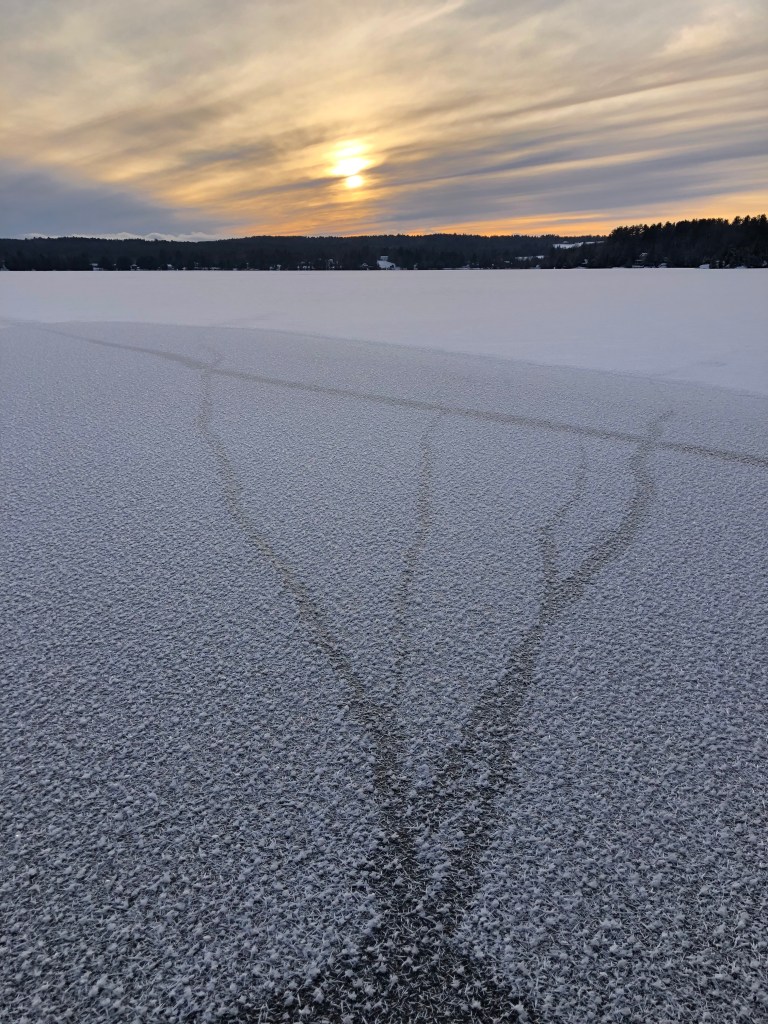
In the late afternoon, on a day just a little above zero, I walk through the woods down to edge of the lake. I come out of the woods where Porter Brook feeds into the lake, and the ice there, despite the cold, looks thinnish. There’s no one around at all. In the summer, that stretch of beach is noisy with vacationers. But now, even not a crow appears.
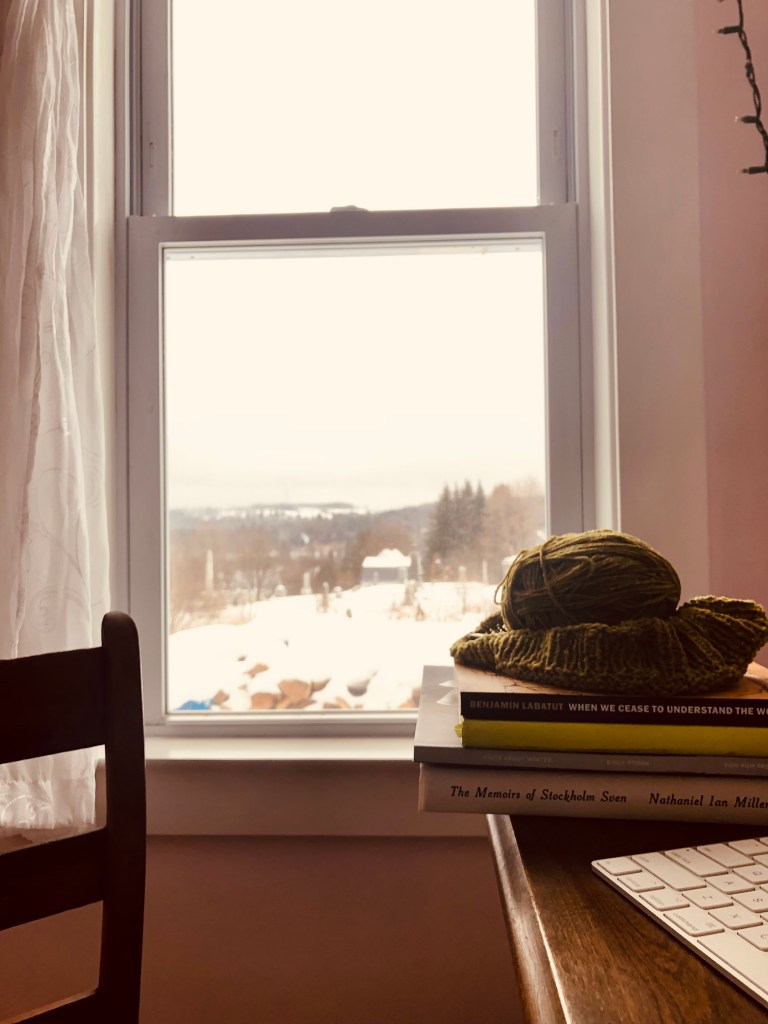
The post-holiday surge of Covid rages around us. These are not the cheeriest of days. My father, sister, nephew, and I — triangulated around the United States — decide to read and virtually converse about Benjamin Labatut’s When We Cease To Understand the World — in essence, the perfect title for our times.
Live in New England long enough, and you crave the return of ice, the experience of cold and clean winter, the turning around of seasons. The ice will pass, too. Cold, I crouch at the ice’s edge. A squirrel skitters out of the hemlocks and chitters at me before scampering off. Then it’s just me for a moment, and all that sky and the mysteries of the frozen lake. In January, the days give cold and a few extra minutes of sunlight….
Here’s the opening lines of Labatut’s book:
In a medical examination on the eve of the Nuremburg Trials, the doctors found the nails of Hermann Göring’s fingers and toes stained a furious red, the consequence of his addiction to dihydrocodeine, an analgesic of which he took more than one hundred pills a day. William Burroughs described it as similar to heroin, twice as strong as codeine, but with a wired coke-like edge, so the North American doctors felt obliged to cure Göring of his dependency before allowing him to stand before the court. This was not easy. When the Allied forces caught him, the Nazi leader was dragging a suitcase with more than twenty thousand doses, practically all that remained of Germany’s production of the drug at the end of the Second World War. His addiction was far from exceptional, for virtually everyone in the Wehrmacht received Pervitin as part of their rations, methamphetamine tablets that the troopers used to stay awake for weeks on end, fighting in a deranged state, alternating between manic furore and nightmarish stupor, with overexertion leading many to suffer attacks of irrepressible euphoria.
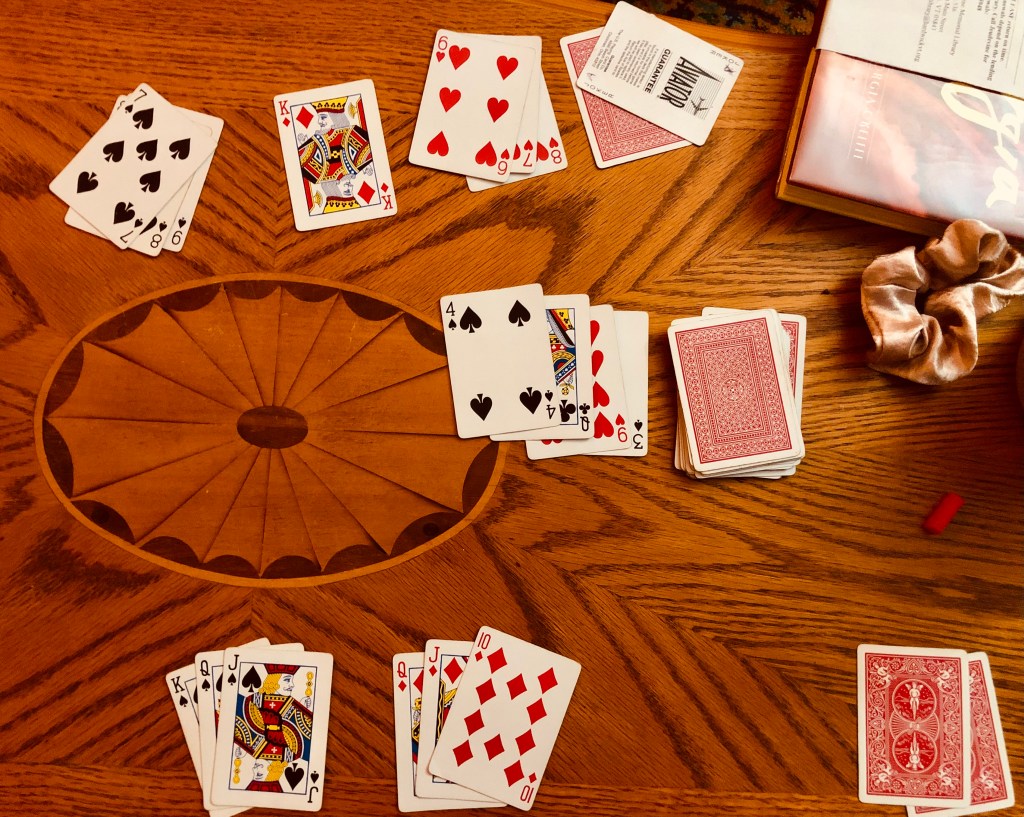
In the evening, we play cards. For years, I had this inner narrative unspooling, about living on the edge of the wilderness, the cold a near constant companion for a good portion of the year. Now, returning from work to a chilly but not cold house, I remember keenly how that narrative began when I was a young woman, living in an uninsulated apartment, reading about polar expeditions.
The cold, indeed, makes us more alive. Too much cold, however, deadens us, too.
Our deck of cards has a few duplicates — additional sixes and eights and two Jacks of Diamonds. We have another, unpadded deck, but I have a particular fondness for this one that bends the rules and mixes our games in funny ways.
January. My inner narratives keep unwinding. Cold. Kids. Cats. Writing that nourishes my soul.
William Carlos Williams’ lines about this winter month:
Again I reply to the triple winds running chromatic fifths of derision outside my window: Play louder. You will not succeed.

 Stony Soil Vermont