A flock of singing red-winged blackbirds kept me company yesterday on my short walk from the village along the frozen lake. Summers, sprawling houses fill with people from other places, more urban areas, but in this nether zone of late winter/early spring — the mud realm — it’s just me and the rain and the birds.
Of all the seasons in Vermont, this odd one seems the most miraculous to me. Out of dull brown, last year’s frost-killed season, tiny nubs of green appear. So much promise. Every year, this surprises me.
Some springs, apples bloom too soon.
The trees have grown here for a hundred years, and are still quick
to trust that the frost has finished…
You could say, I have been foolish. You could say, I have been fooled.
Mud season is fierce this year. The school busses cease running on some roads. Families share photos of kids waist deep in mud ruts. Time, more than all the gravel in the state, is more likely to true up the roads than anything else.
Mud season is the odd shoulder season in Vermont. The skiing winds down. There’s no good biking. The tourists are all in sunnier southern locations, and Vermonters muddle along.
All day long, the prettiest and lightest snow falls — nothing serious, nothing much at all — just a scattering of the purest white and enough of a chill that the wood stove is welcoming when I come in with cold cheeks and armfuls of wood. I put a quiche in the oven and head out for a walk. The snow has (mostly) melted here now, and so my paths through the fields and woods have opened up again. Behind the elementary school, the turkey vultures circle over my head. They’ve just returned from their winter sojourn, to their long-time nest in a stand of white pines. I know what they want; there’s no secret here.
I hurry down the hill and along Main Street. A woman stands outside the laundromat, hands in overall pockets, staring up at the drifting snow. She raises one hand to me. I do the same, round the corner, and head home.
On a day of yet more snow, of wind and cold, I’m reminded that people still keep on with their lives. Living doesn’t wait for convenience.
At the post office, I mail off a copy of my book. The woman who weighs my small package insists this is “sugar snow,” an early spring snowfall that will lengthen the maple syrup season. We sugared for years, and this kind of snow always meant a break in boiling and a chance to wash filthy snowsuits. The upcoming forecast is for as near-perfect sugaring weather as possible. Sugaring is the epitome of day-to-dayness — be smart, keep your eyes open, do the best you can — with no guarantees of a good or even decent season.
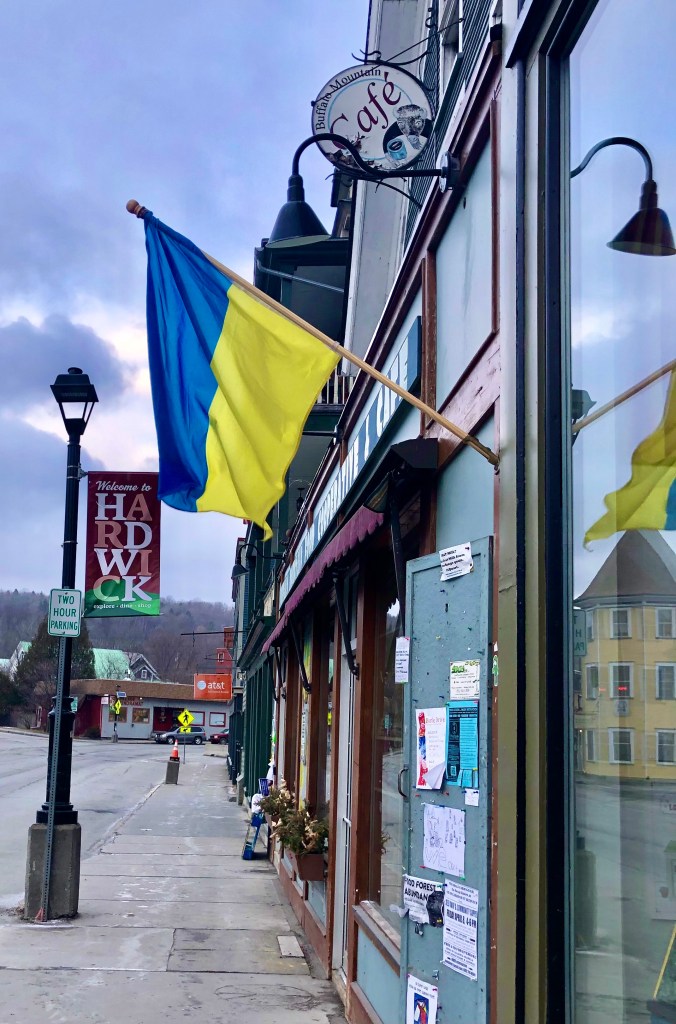
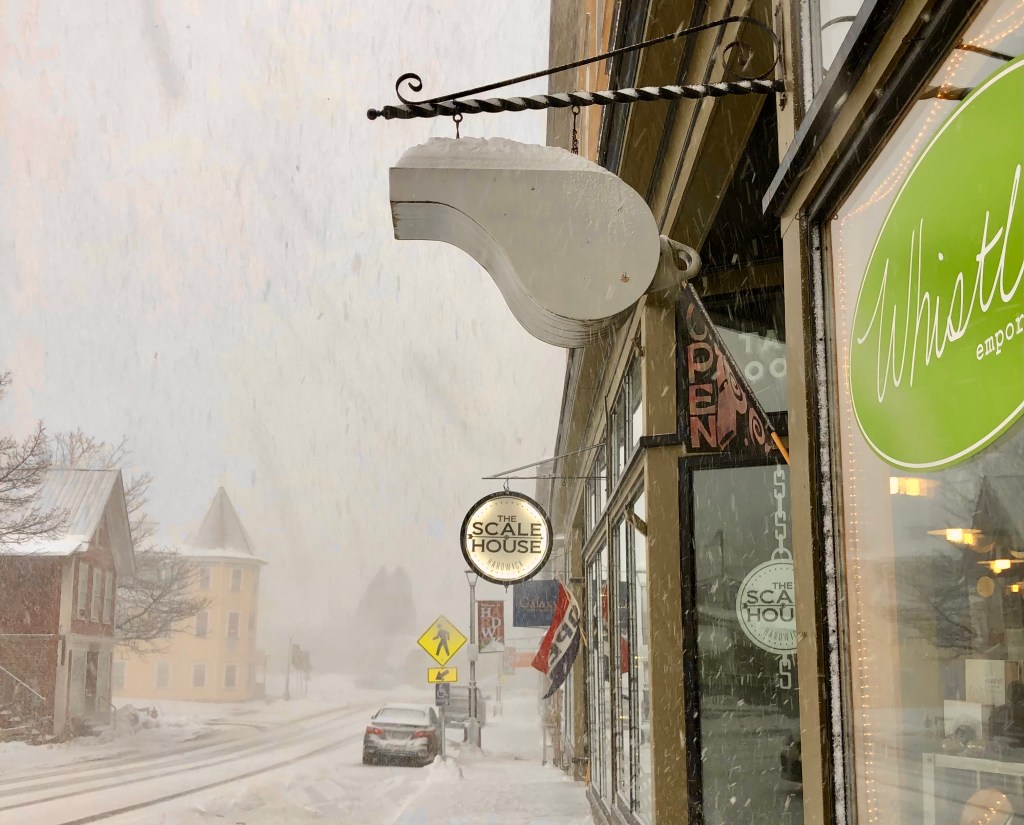
We talk for a few more minutes about shoveling snow, and then I head back out into the town’s Saturday morning. On my walk home, I stop in at the coffee shop and stand in the window drinking an espresso and staring out at the traffic struggling on snowy Main Street. There’s the usual confusion of the three-way intersection so many don’t understand — two stop signs and a blinking yellow light — as if the calculus of two stops and one yield doesn’t make sense. Standing there, I wonder if it makes sense mostly to those who use these streets day after day.
A year ago, the coffee shop’s tables and chairs were closed for seating, and I wondered if I would ever bring my laptop back here, to my favorite table where I once wrote a book. A year later, here I am, drinking coffee, surrounded by maskless people laughing and talking, writing notecards, going on about their lives. On this inclement Saturday morning, that seems nothing shy of a miracle.
“The answer must be, I think, that beauty and grace are performed whether or not we will or sense them. The least we can do is try to be there.”
I’m late to a meeting at the library I’ll participate in when I stop in the parking lot. In the wetlands behind the library, a red-wing blackbird sings. I can’t see the bird. This isn’t a flock; a bird calls and chirrups, that old familiar, unmistakable sound of spring. I’ve driven, in years past, on the hunt, just to hear this bird.
A few years ago, by chance I met a friend outside the Woodbury, VT, post office. We stood talking about something we found mutually so enjoyable, while in a winter-bare maple tree, a flock of these beauties sang. Spring! we marveled.
This year, I remember how long and hard mud season is, most rightfully a season worthy of its own true name. Hence, love of little things like tiny birds.
When my daughter and I return from a walk tonight, we stand for a moment outside our house in the dark. The moon is a bit of a creamy curl over our roof. Mighty Orion stands at his guard in the constellations. Whoever dug this house’s foundation in the sandy soil, carefully set the fieldstones, and built this home has long since passed out of this world. People have lived and fought and loved and died in this house. It’s March and Mud Season hovers over us, freezing, thawing, freezing, and eventually the thaw will win out for the summer. Upstairs, my youngest daughter puts her face to a window. We go in, leaving the stars and the night to their own particular magic.
“It may be important to great thinkers to examine the world, to explain and despise it. But I think it is only important to love the world, not to despise it, not for us to hate each other, but to be able to regard the world and ourselves and all beings with love, admiration and respect.”
Right before the pandemic shut down the world two years ago, I drove with my youngest daughter to the New Hampshire village when I had spent ten years of my childhood. My family no longer lives there. An old high school flame had contacted me around that time, and I was half-thinking I might look him up some day. My daughter and I parked at the end of the street where I had walked with my siblings countless times, and then past the house where we lived and into the library when I had spent so many hours, dreaming of my life to come.
In a strange, almost sepia-toned kind of way, I felt I had been able to step into that past and see again the sweetness of it — something that seems so often lost in memory.
There’s that famous line from Tom Wolfe that you can’t ever go home again, but these days I’m wondering if that’s because you can’t ever really leave your home. I read that novel in high school, in that beloved library, a great big novel that I devoured with such enthusiasm.
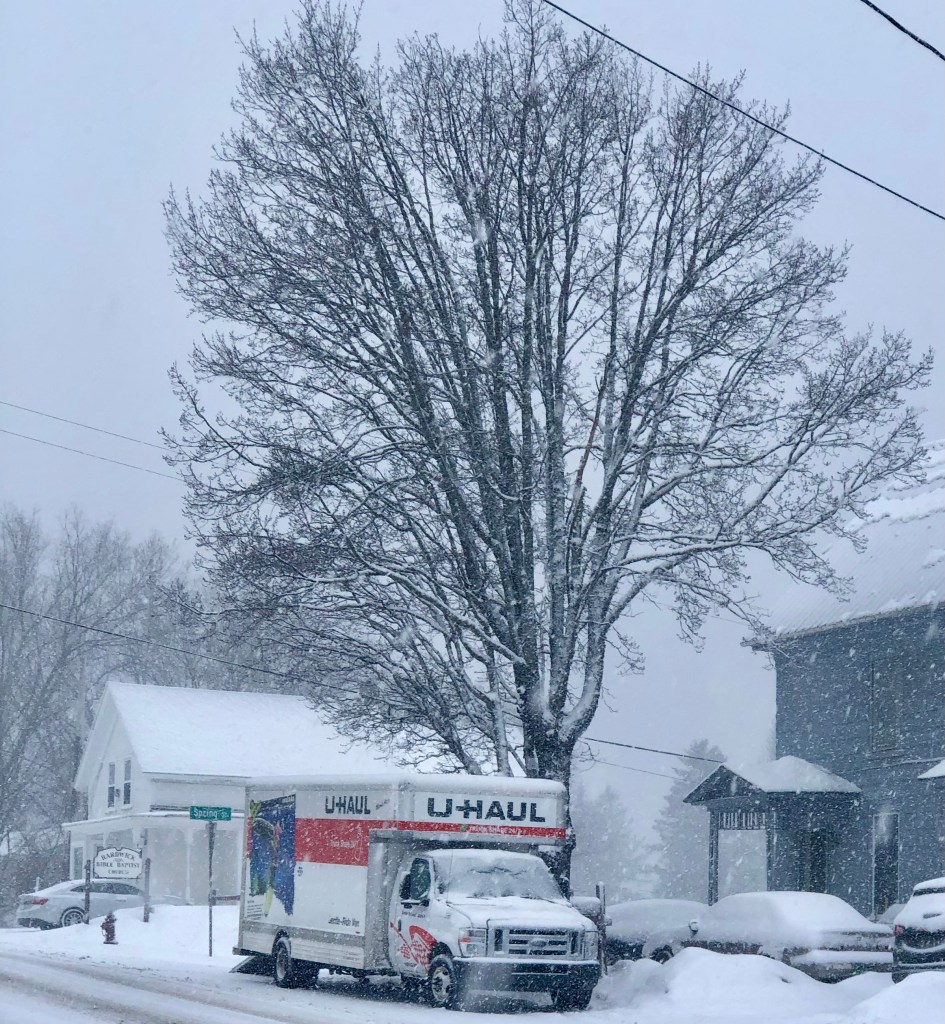
Twenty-five years ago, a young woman driving a Subaru Justy ran into my VW Rabbit in a sudden snow squall, just like the one above. I wasn’t wearing a seatbelt, and somehow miraculously survived wholly intact. The young woman sat in her car, crying, in the middle of the highway, and I stood outside her car, begging her to get out. “I’ve killed you,” she wept. I kept insisting I was fine. I was wearing a blue sweater my mother had knit me, and I spread my arms out wide. “I’m alive.”
Her insurance company gave me three thousand dollars, which my husband and I used to start a sugaring business. Much later, I sold pieces of that business and bought a house in the village. I’m still carrying that squall and that woman with me. I never saw her again. I hope she’s well.