Brief Interlude.

17 years ago, I was at the end of my second pregnancy. The apple blossoms hadn’t bloomed yet. The month of May had been especially rainy and cold.

My second child was born via caesarian. The morning she was born, I walked down to our sugarhouse and closed the front doors we had left open the night before. My oldest daughter who was six was eating breakfast at the house with her father. She was wild with excitement. Baby sister? Baby brother? What was going to happen?

Rain had fallen the night before, and the path to the sugarhouse was slick. I was huge, an unwieldy ball of a woman who was so ready to finish this pregnancy and meet this baby. I had waited years to have this second child. It was early in the morning, and friends were already on their way to meet us at the hospital. I lingered in the open front doors, breathing in the scent of mud and that particular sweetness of new leaves. We’re always leaving and arriving, aren’t we, in this transient life. This year, the lilacs have already faded, the earliest I remember.

I stood there just a few moments before I locked the door and took the longer path back to the house. My six-year-old was in the driveway looking for me. Ready.

Lilac Season.

My daughters each go their own way today in search of waterfalls with friends. It’s a perfect day for waterfalls, the temperature hot, the air drenched with sultriness. I remain behind in my garden’s dirt, moving Jonny Jump-Ups and sowing seeds. The world is alive around me with pollinators and earthworms and the chorus of nesting songbirds. It’s lilac season, here just for a few moments. I remind myself to breathe in, breathe in, while this sweet season lasts.

There are days we live

as if death were nowhere

in the background; from joy

to joy to joy, from wing to wing,

from blossom to blossom to

impossible blossom, to sweet impossible blossom.

~ Li-Young Lee, “From Blossoms”

Travels.

Driving down the heart of Vermont today, I hear an ecologist on public radio explaining how trapping beavers altered our landscape. Something that seems so simple and petty — a craze for beaver hats — changed the flow of water, the flora and fauna, and human transportation, too. As a kid, we made tiny birch bark canoes in grade school. Birch bark canoes were once a kind of Volkswagen for people who lived in Vermont. Serious water flowed over this landscape then.

I drive along the Connecticut River. Eventually, I just pull over and admire where I am. So much green. Such an infinity of shades, and all that water, flowing steadily to the sea.

Our world smells of lilac these sweet days.

I’m parked near an abandoned brick mill, in a town that has seen more vibrant days. The temperature may hit 90 this weekend — in May! in Vermont! — and no one in a rational frame of mind can claim this is right.

But yet….. here I am by the side of this great river, the mountains rising on the other side, the leaves leafing out in summer beauty. I’m in a shifting place in my own tiny life, my youngest nearly grown. Which way this will go, I have no idea, but I’m here, breathing in the humid lilac air, for this moment at least in no rush at all.

Lilacs in dooryards

Holding quiet conversations with an early moon;

Lilacs watching a deserted house

Settling sideways into the grass of an old road;

Lilacs, wind-beaten, staggering under a lopsided shock of bloom

Above a cellar dug into a hill.

You are everywhere

~ Amy Lowell

No Mow May…

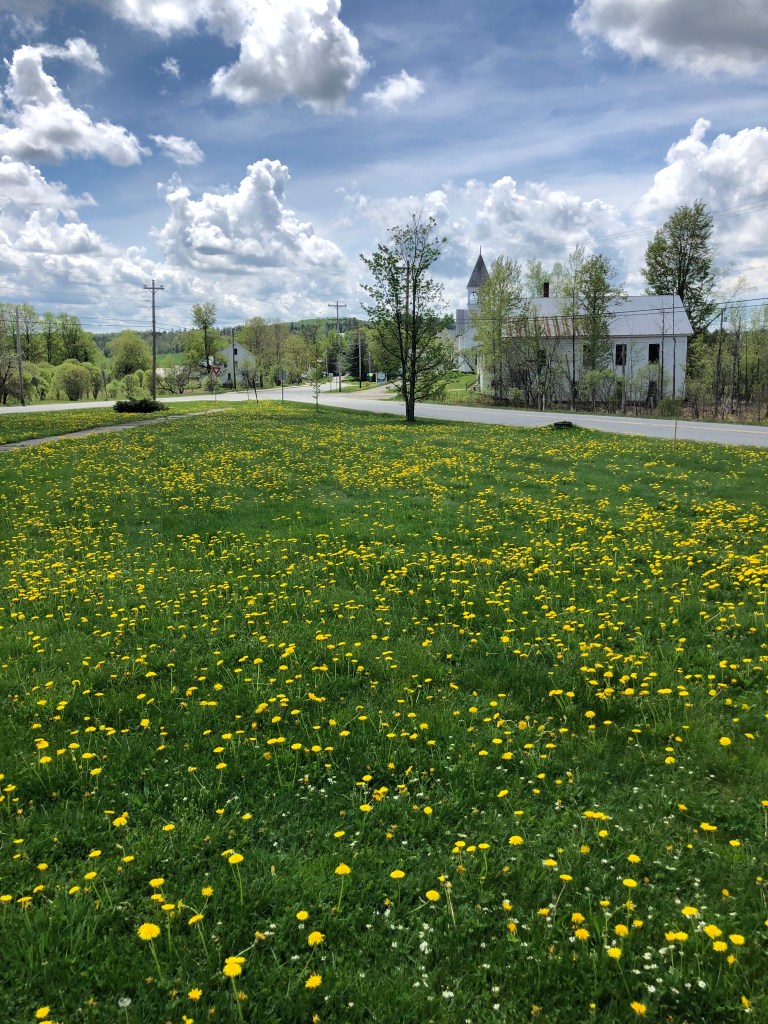
Days like this — or even hours or moments like this (see dandelions above) — remind me that the human world is poor shakes compared to the universe around us. All these things that nag and nip and plague me — from inspecting a car to wondering if my daughters are happy — fall into some kind of place on a sunny May afternoon in Vermont. These things are important; not for a moment am I trying to belittle our human days.

But this is, too. As I crouched in the field to take a photo, a woman bicycling by called out to me. “What gold! It’s cheeseburgers for bees!”

She got off her bike, and we stood talking to each other across the field. I suggested she look at the marsh marigold behind the grange. She mentioned the spring beauties in the woods.

Overhead, the clouds morphed and shifted. Come January, the field might be passable only by snowshoes. But for now, she and I called back and forth, the wind lifting and tugging our words.

 “No creature is fully itself till it is, like the dandelion, opened in the bloom of pure relationship to the sun, the entire living cosmos.”

~ D. H. Lawrence

In the Garden.

Sunday morning, a light rain falls. The rain is a gardener’s dream, a light but steady enough drizzle, interspersed with sunlight. Our world grows. I stayed up late the night before, reading The Year of the Horses, and maybe it’s nothing but exhaustion — and who isn’t exhausted these days, anyway, but the kids — but I keep wandering around, in and out of the house. To the garden to move this or that. Then back inside to wash a window or sweep away some winter cobwebs.

Washed by rain, the colors in my garden are vibrant. I have this strange feeling that I’m inhabiting the Middle Ages, the realm of chivalry and honor, a time when art is justly valued.

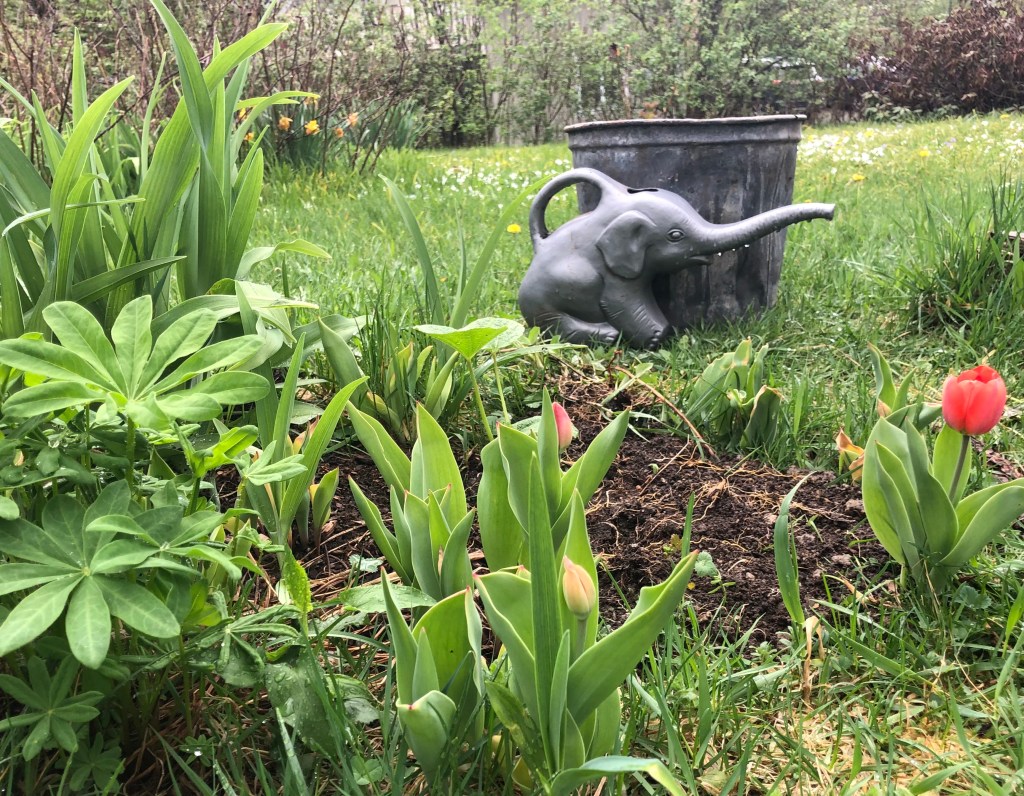
All day long, I work at this, back and forth, making some kind of order in my raggedly life. Before too long, I know, the weeds and the black flies will swarm me. I might be overwhelmed with the messiness of gardening. But for now… just this potential. Just this moment. A single tulip, blooming.

Small, Good Things.

A friend and I drive to a nursery on a back road in Plainfield, VT, through fields that seem impossibly green. The trees have barely begun to bud. I buy a snowdrift crabapple tree there. The tree is so tall that my friend and I spend some time carefully nudging it into the back of my Subaru.

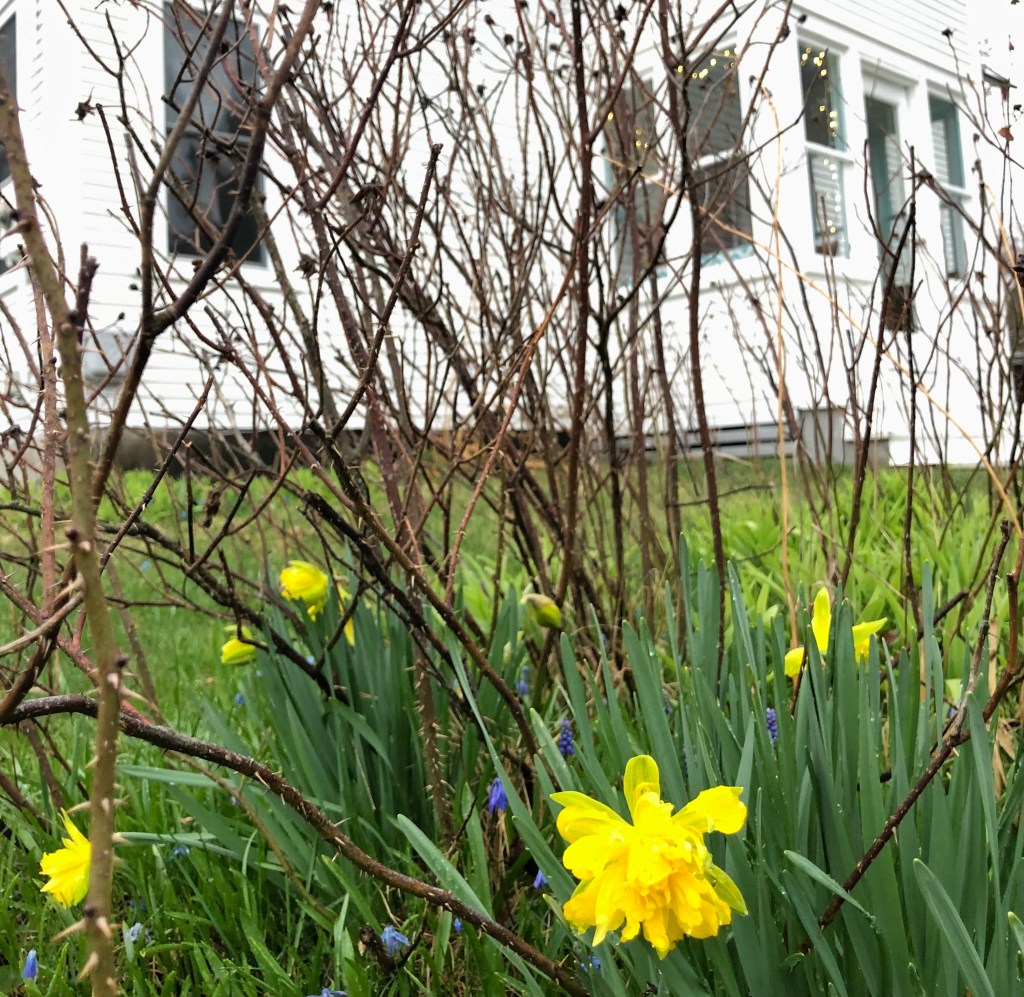
I’ve met the staff on my annual pilgrimage there. They all speak quietly, as if our words might disturb the rows of potted currents and grapes. I ask again for planting advice. As I listen, I suddenly realize I’ve gone at this tree planting and cultivating thing all wrong. Beneath my trees, I should create a forest garden of duff and broken up straw and that humus-y compost that plants must love like chocolate. Daffodils bloom in the gardens beneath their trees.

I expect the staff has told me this before, but for whatever I reason I didn’t listen, or their advice drifted the way of so many words.

All the way home and all afternoon, I keep thinking about these woodland gardens and about a Raymond Carver story, “A Small Good Thing.” Two years plus into the pandemic, in this jumbled world, a small good thing….

That night, my teenager comes home and suggests we get a creemee. Friday night, and there’s no one out. We stand under the moon, licking ice cream cones, the peeper screeching in the swamp behind the pizza joint. A small good thing.