End of September? Apple Pie Season

Every year in Vermont there’s speculation about the upcoming foliage season — will it be good…. or lousy? While the season infallibly delights — and often astonishes — we view fall foliage very personally, almost as if the quality of its splendor reflects on ourselves.

More than any other season, autumn reminds me of being a child, of picking apples in the enormous Mapadot Orchard near our house (named after Ma and Pa and Dot, of course), of the distinct, humus-y scent of fallen leaves in the maples we raked from our trees, of how fine it feels to hike in  woods painted like a wildfire — crimson and gold.

Last night, my older daughter decided to bake an apple pie today.

We might live in a society where the traditions of church have dwindled to near naught, but the ritual of apple pie? Still steaming, in our house. That’s something.

O hushed October morning mild,
Thy leaves have ripened to the fall;
Tomorrow’s wind, if it be wild,
Should waste them all….
Slow! Slow!
— Robert Frost, October
IMG_3504

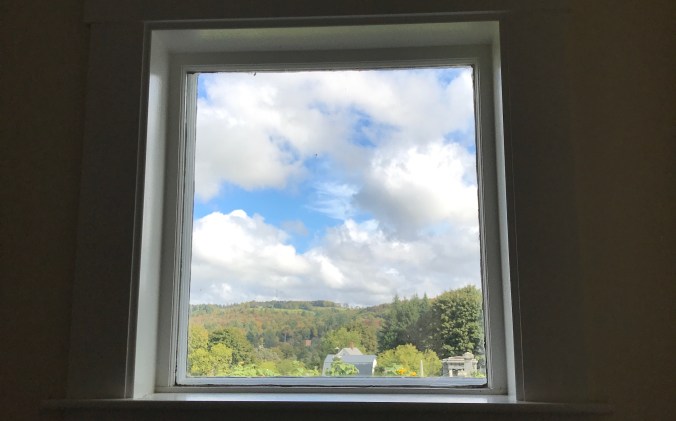
Through my window.

Cream Moon

The other night, my friend and I stand on my back deck, watching the moon rise above the black horizon, a curved sliver at first, then quickly revealing all her radiant round beauty. In the house, my daughters and their friends play a game at the table, eating brownies and laughing. Little white lights sparkle above their heads.

The next night, fever lies me low, and my girls are awake in the wee midnight hours, comforting an oddly crying cat. As I rise out of the fever now, I think of how glad I am to return to our life. Worn out before, as we all get — buried beneath the everyday accrual of putting together work and life and parenting, and the non-everyday weight of am I failing? — I’m simply glad to return to the jumble of our lives, in this somewhat sleep-starved life, keeping the midnight shift, reading in bed or wandering around to the windows to admire the moon. Oh, the autumn moon.

Children grew in their sleep. They were growing now, bones lengthening like bamboo.

— Melanie Finn, The Underneath

thumbnail_IMG_0736

Photo by Molly S.


Symphony of Our Small World

In high school, hidden in the upstairs of my parents’ barn, I read Russian literature — The Brothers Karamazov and War and Peace — I read about life behind the Iron Curtain, Darkness at Noon, Solzhenitsyn.

Late last night, the cats and I read M. T. Anderson’s Symphony for the City of the Dead: Dmitri Shostakovich and the Siege of Leningrad, a book filled with hunger, fear, and love.

These summery, hot days continue to unfold, a world apart from coal-less winters in Russia. Our days are busy, jammed with my multiple work endeavors, with a daughter in middle school, and soccer practices and games, with her babysitting and my older daughter’s tender young adult life — can I build a tiny house? will I fall in love? — with pickling green beans and putting up salsa and somehow painting the upstairs floors while listening to Rumblestrip podcasts, and swimming at the end of the day as often as possible.

This life, messy with creativity and doubt, with love and grief, is lucky beyond belief. Thank goodness, I remember this at times.

Shostakovich states that at the beginning of the Seventh (Symphony) he depicts the peaceful life before the war in the quiet homes of Leningrad. But to a listener in Iowa it could mean the meadows and the rolling hills around his home. After the fantastic theme of war, Shostakovich has put into his music a lament for the dead — and the tears of a Russian mother and of an American mother are the same.

IMG_3286.jpg

Postcard From Hardwick: September 1

After an intense week of work and family — of wondering where is this heading? — my daughter locks her keys in her car and texts me. Can I bring my keys? And there’s a sketchy stranger near her, too.

When I arrive, she’s leaning against her car, looking up at the sky, and the sketchy somebody is a dad in the high school parking lot, teaching his kid to drive, in that jerking, slow way my daughter and I both recognize.

I mention that my brother can teach my second daughter to drive.

From a soggy patch in the weeds, a bullfrog croaks.

September 1 today, the anniversary of the fateful day Hitler rolled his tanks into Poland, beginning the war that destroyed so many lives.

September 1, the anniversary of my former inlaws.

This morning, all’s quiet on this green patch of Vermont, overcast, with cricket songs and bird calls, a day that begs reflection.

All I have is a voice
To undo the folded lie...
There is no such thing as the State
And no one exists alone;
Hunger allows no choice
To the citizen or the police;
We must love one another or die.

— W. H. Auden, September 1, 1939


IMG_3115

Being 13, Hardwick, Vermont

Turtle Visitor

A wildlife biologist smitten with wood turtles makes an evening presentation at my library, turtle in tow.

The room fills with people I know, and some I don’t know — a little girl from Montpelier with her grandfather whose family has owned a lakeside camp in Woodbury for 100 years. The trustees bring homemade desserts; there’s cold cider; we borrow chairs from the elementary school’s second floor gymnasium. In the humidity, I wipe sweat from my forehead with the school’s paper towels.

An older couple brings their dog, who otherwise would have cowered alone at home, if thunderstorms moved in.

These evenings are a microcosm of small town Vermont: one woman quietly counsels another about obtaining a medical referral. The kids pile a paper plate with brownies. Another woman raids my book sale, asks for a box, and says she’ll drop a check by later.

In the end, I lock up, saying goodnight to the silent 100-year-old schoolhouse. So many people have gone through these doors; so much living has happened here.

In my library, next door, I glance around at a bit of chaos — a pile of old buttons in a pie plate the children have strung into necklaces, picture books on the floor.

Enough for one day. I turn off the light, lock the door, and walk out into the cooling-down rain-sweet night.

And over the grass at the roadside a land turtle crawled, turning aside for nothing, dragging his high-domed shell over the grass: His hard legs and yellow-nailed feet threshed slowly through the grass, not really walking, but boosting and dragging his shell along.

— John Steinbeck, The Grapes of Wrath, 1939

IMG_3110


Family Lore

My father, visiting, tells the story of his parents driving from Michigan to California, in the fall of 1941. I imagine my father, 4-years-old in the backseat with his much older sister, his parents driving an American-made car on innumerable two-lane highways, in the time when cars were made with tank-quality metal.

Decades before blue jeans and seatbelts, his parents — both Romanian immigrants — must have been on the immigrant road again, traveling not for leisure but to size up the Golden State: could they make a living in this land of sunshine?

They returned with the intention to sell their business and property and move. That early winter, however, the Japanese bombed Pearl Harbor. With the country at war, moving was no longer an option.

In the blue predawn, I lie awake, thinking of the journey of these people, a grandfather I never met, my grandmother and aunt, now long dead. How this terrible war ended the California dream of my grandparents, but made their grocery business; how my dad enrolled in the University of Michigan in Ann Arbor, where he met my mother; and that his sister lived her adult life in southern California.

All a mystery, perhaps, that journey cloaked in the murky past — and yet not, the consequences of those years still unwinding in my life — and my daughters’ lives.

I saw in their eyes something I was to see over and over in every part of the nation — a burning desire to go, to move, to get under way, anyplace, away from any Here… Nearly every American hungers to move.

— John Steinbeck, Travels with Charley: In Search of America

IMG_3067

Postcard from Hardwick, swimming, 2018