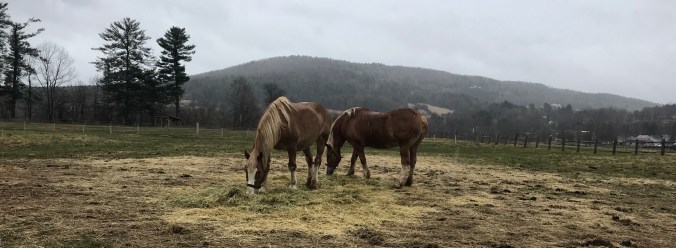
Return From Hibernation

On this unsurpassable, sunny, snow-melting April afternoon, I prop open the library door and stand on the walk. My patrons — a teenage boy, a near retirement age woman — stand there with me, the three of us collectively thinking, what the fuck?!  about this winter — as if a months-long temper tantrum has just passed by.

The school field is still a foot-rich with snow.

Later, as the evening cools, I walk through the crusty patches of remaining snow behind the house, discover there’s a patch of the garden open where I may plant my pea seeds.

I’m back in the cemetery, in my own sacred spot in this town. From the crest, I see the Dollar General with its faux brick and Woodbury Mountain, where bear live. Someone in the trailer park nearly concealed in a hollow is burning something, and smoke rings the mountain’s base. Overhead, a hawk catches an air current so fine the raptor sails out of my sight without a single flap of its wing.

The world? Moonlit
Drops shaken
From the crane’s bill.

— Eihei Dōgen

IMG_5201.jpg

spring kid crafts

Spring, 5:58 p.m., Wednesday

My 13-year-old’s bouncing like her once-beloved Tigger. After school, she’s ecstatic, with no particular reason. All through the afternoon, through cooking dinner together, hopping on one foot from the kitchen to the dining room, setting the table….

What’s up? I think. And then I know. I force myself to drop the adult crabbiness, forswear off my intention to adhere to my list.

It’s spring fever, and there is no cure. There’s only revelry.

11 years ago, give or take a few weeks, I dragged myself in from a long sugarhouse day, got my two and eight year old daughters to sleep, picked up The New Yorker, and read this poem by Louise Gluck.

Still one of my favorite poems, these lines remind me of how this harsh season reflects not only Vermont but the long seasons of a human life. Spring is hard-earned here. We savor it more for that.

It’s a little early for all this.
Everything’s still very bare—
nevertheless, something’s different today from yesterday.

IMG_4953.jpg

Red Flicker

A single cardinal sits in the bird feeder on the wooden pole listing in the old woman’s yard. I pass this way often, where she sits on the glassed-in porch with her friends, a colored paper turkey pressed decoratively against one window.

Her boots have trampled down the snow around the feeder. My eyes search for a fallen crimson feather, but there’s nothing — just a flap of the bird’s wings, and then the bird’s gone.

Let the fox go back to its sandy den.
Let the wind die down. Let the shed
go black inside. Let evening come.


From Jane Kenyon’s Let Evening Come

IMG_4031.jpg

Library Afternoon Snapshot

A woman stops in my library — new to town and looking for basic info about an internet connection and where to buy food. She’s getting the lay of this corner of Vermont’s territory. Early afternoon, the school kids are paired up around the library, working on projects — some seriously, some intently goofing off.

It’s drab November, and the woman stays for a long while, using the library’s internet connection. Her friend calls the library and arranges to meet in the parking lot, exchanging a microwave. School morphs into after school by then, and the kids merge back into the library. A parent takes three crying girls aside and demands the drama to cease. A little boy chats with the woman in the library who pauses in her work and answers his questions. The kids pull out their newest craze — the chess sets.

Through all this, I keep introducing the woman to anyone who comes in the door.

When I leave at 5 p.m., darkness folds around the library. The woman has left with an armful of books; the children have all gone home. A few adults are picking up yet.

I turn down the heat in this library — a kind of living room lined with books. Then I head home myself.

The library might have been the first place I was ever given autonomy. Even when I was maybe four or five years old, I was allowed to head off on my own.

— Susan Orlean, The Library Book

IMG_3992.jpg

Hopeful Strings

In the night, the cold moves in. The evening before, returning after work in Vermont’s “big city” of Burlington, the frogs chirped, and the air, drenched with a heavy rain, was suffused with the hummus-y scent of soil and leaves beginning to turn and rot.

This morning, the crescent moon shimmers.

Against the noise of the news these past few weeks, as I’m feeding the cats, I think of Leslie Schwartz, in Los Angeles County Jail, tenderly nourishing tiny sprouts from apple seeds, the slenderest of life, nonetheless growing within concrete.

So I fell in love with the apple sprouts the way one might a newborn.

— Leslie Schwartz, The Lost Chapters: Reclaiming My Life, One Book at a Time

IMG_3533


Vermont Dawn

It’s autumn here. Better — Vermont autumn — a landscape hordes of people drive and fly hundreds, thousands, of miles to see.

Because the world is dying down, my prolific garden beginning to crumple, autumn always seems to me the season of memory.

A memory of pulling beets and carrots in an enormous garden while my friend’s husband lay in the house, dying of skin cancer. More happily: a memory of my older daughter’s first Halloween costume, a piece of a sheet I cobbled into a baby ghost costume.

Tricia Tierney directed me to Leslie Schwartz’s The Lost Chapters: Reclaiming My Life One Book at a Time. Late nights, I lay awake reading, thinking how glad I am not to be jail. Early one cold morning, I pull on my down jacket, a beautiful turquoise hand-me-down, now worn thin and stained at the cuffs, and follow the path behind my house, disappearing into the darkness and walking all through the sunrise, the ebony sky streaked through with endless ribbons of luminescent pink.

Schwartz writes, “Writing is survival.” Surely creative work of any kind carries us along. Like the Vermont landscape I live in, creativity has its cycles, too, my garden’s sunflowers shedding their golden petals, bending down for winter’s dormancy.

IMG_3553