Evening Out — Of Sorts

A friend and I stand in the high school parking lot, watching our daughters finish soccer practice on the field. At least, I say as the girls walk towards us, laughing and talking, they’ve had one practice.

That’s where we are — maybe our world will fold up again tomorrow, but at least the girls had an afternoon together, running on the field on this sunny August day.

At dinner, I quickly realize the soccer team is angry about a school board position, and my daughter glares at me. I have a seat on the board; I listen to her complaint, and think, Let her be mad at the board.

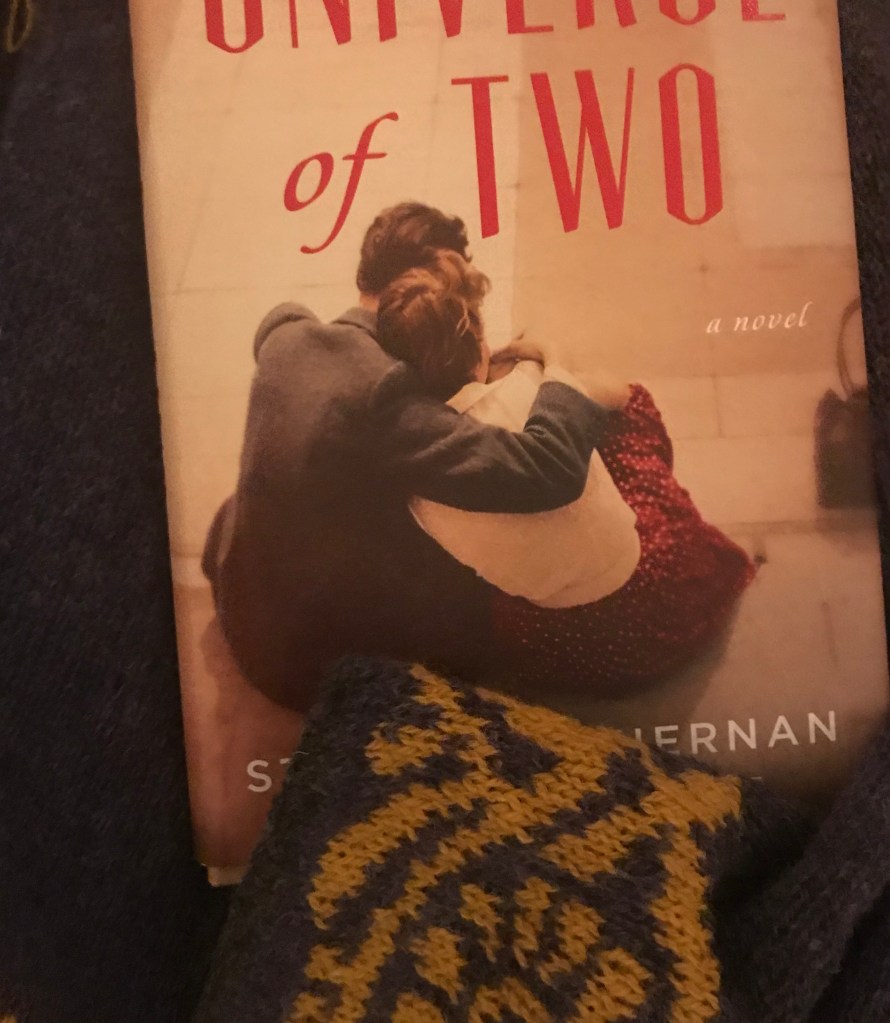
I almost don’t head down the hill to Atkins Field, for the first reading I’ve attended in months, in a beautiful post-and-beam gazebo. A strong breeze blows up, threatening rain. There’s just over a dozen of us, bundled in jackets and blankets folks have pulled from their cars, sitting in lawn chairs. I’m regretting coming, when the author begins speaking. I’ve heard this author before — Stephen Kiernan — and loved his stories. Before coming, I knew nothing about his book, but as he begins speaking, I realize the book is about Los Alamos — a place I know. I put away my knitting, huddle into my chair, and listen.

The dusk comes down. Across the way, I see a single turkey vulture flying across dark clouds, its rising wing glossy with sunset as it struggles to fly into the wind.

At the very end, Kiernan reads the opening page of his book. Kiernan reads particularly well. Listening, for just a moment, I sense all these things coming together — the craziness of attending a reading spread out with masks, unable to whisper and giggle, the ever-present pandemic, but also the setting of Kiernan’s book — WWII — and how ordinary people have endured through terrible times, and we will, too. The chilly wind reminds us of autumn’s imminence, but for these moments, the beauty and power of Kiernan’s writing pulls us together.

And when I arrive home, my daughter is waiting for me on the porch, happy again to see me.

“I met Charlie Fish in the Chicago in the fall of 1943. First, I dismissed him, then I liked him, then I ruined him, then I saved him.”

— Stephen Kiernan, Universe of Two

Teenagers Recite Poems

Reluctantly, my daughter drags herself to a required high school poetry recitation.

While I chat with parents I haven’t seen in ages, I see her laughing with a boy she’s known since third grade.

Adolescents and poetry — how fun! One boy gives a comedic performance of “Stopping by Woods on a Snowy Evening,” beginning by asking the prompter, Where am I stopping now?

Another boy’s fingers tremble as he reads a particularly beautiful poem. A shy girl comes alive.

Afterwards, talking in the dark on the short drive home from the theater, my daughter tells me about each student, how they chose their two poems, and what their voice was like. My daughter’s second poem was Frost’s Two roads diverged in a narrow road, so familiar, such a beloved poem. Nervous for her first poem, Emily Dickinson, she gained her voice with the second, her eyes on the upper balcony, her voice clear, melodious, utterly her.

Tonight the bear
comes to the orchard and, balancing
on her hind legs, dances under the apple trees,
hanging onto their boughs,
dragging their branches down to earth.
From ‘The Bear” by Susan Mitchell
IMG_7193

Left the Shoes on the Back Porch…

After a day of brilliant sunshine, rain moves in during the night. My daughters’ cats, in the screened windows, wake me with their hungry mewing, against the background chorus of steady rainfall and birdsong.

Arriving home from work, I see my daughters have been swimming that afternoon, their hair in damp lanks around their shoulders.

As if in an instant, summer has unrolled in Vermont — verdant and colorful — while simultaneously the woods darken mysteriously with foliage.

90 days, poet David Budbill wrote. Frost-freeze — maybe — for 90 days in Vermont. Hallelujah.

Sparrow singing–
its tiny mouth
open.

— Buson

IMG_5721

Déjà Vu Hiking and a Warbler

In Plainfield, Vermont, my daughter and I start up a wide hiking road, after a discussion about why I so frequently fail to read directions — and yet, as I pointed out, I generally arrive where I’ve planned to go. This is not an abstract, metaphorical conversation. The truth is, I’ve taken the Gazetteer out of the car, failed to print directions, and my daughter — with her adolescent orientation to cartography — navigated by cell phone to the trail head.

Amicably, we’re walking up this wood-flanked, pleasant road, when I have the strangest sensation that I’ve hiked this path, many times, although I know I’ve never been here.

My daughter’s ahead, around a bend in the forest, when a warbler lands on a slender branch near my face, its chest flame-gold, so stunningly beautiful I simply stand there, alone. A second, then a third, fluttered by. Later, Peterson’s guide indicates this is the Blackburnian warbler, fairly common. 

The mystery of déjà vu and extraordinary fiery feathers.

O bush warblers!
Now you’ve shit all over
my rice cake on the porch

— Bashō

IMG_5536

Apple blossom season! Photo by Molly S.

Teen Somersaults

The rain cleared in the early evening, and my daughter and I hung out on her trampoline while she waited for her friend. She’s a pro; I’m a novice. Eventually, I lay back and stared at the clouds breaking apart, and the enormous box elders behind  our house, leafing out.

She, at nearly 14, demonstrated all the moves that can be done on a trampoline. In her face, I could see the sweet impishness of her earliest years.

Rain, rain this May. There’s a kind of rightness to this, the earth and the ponds and the saplings and plants rushing headlong toward green and procreation. May is the season for this, and there’s a sweet satisfaction in the daily discoveries of what’s grown each day. May: bring it on!

Why speak of the use
of poetry? Poetry
is what uses us.

—Hayden Carruth