The Wild.

Barr Hill, Greensboro, Vermont

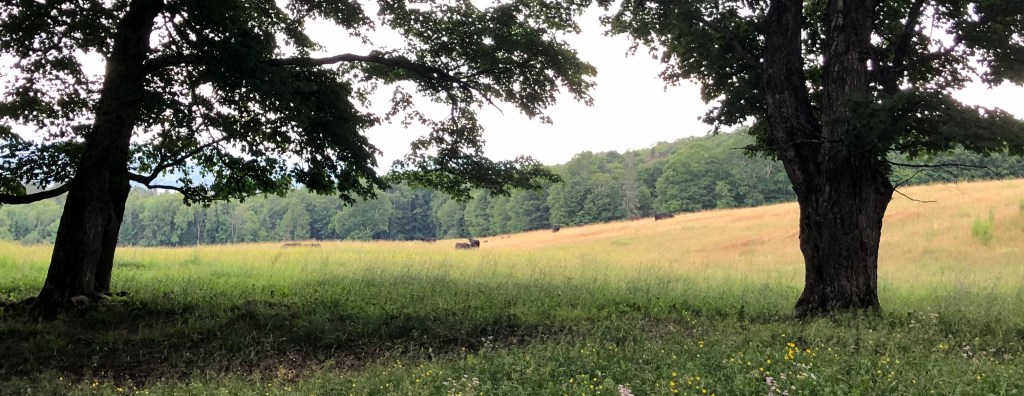
I take a hurried walk on Nature Conservancy land in a slot of time between working hours and a planning commission meeting. I duck beneath the electric fence and wander up an old farm road and discover the most enchanting sight I’ve seen in a long time.

Bright blue forget-me-nots sprinkle the unmown road. Heifers graze in pasture on the other side of enormous sugar maples. The pasture glows amber in the late afternoon, humid light. It’s cool enough this afternoon that I’ve pulled on jeans beneath my dress, and my sandals have been switched for hiking boots. The woods are deep and lush.

This is Wallace Stegner land. He loved this Vermont town and lies buried in a town cemetery on the other side of the lake. As I walk, I’m reminded of his famous lines.

“We simply need that wild country available to us…. For it can be a means of reassuring ourselves of our sanity as creatures, a part of the geography of hope.”

~ Wallace Stegner


This space of wildness wraps all around where I live, winding in and around these Vermont towns. Mighty — these trees and fields — but just as dear are these tiny blossoms, sprinkled all through the forest, far up in the woods where they disappear from sight.

Mixing Memory and Desire.

Note the wood smoke from our chimney….

Note this photo was taken yesterday afternoon, when I walked outside and nearly froze the soles of my feet. Note snow surrounded our house this morning….

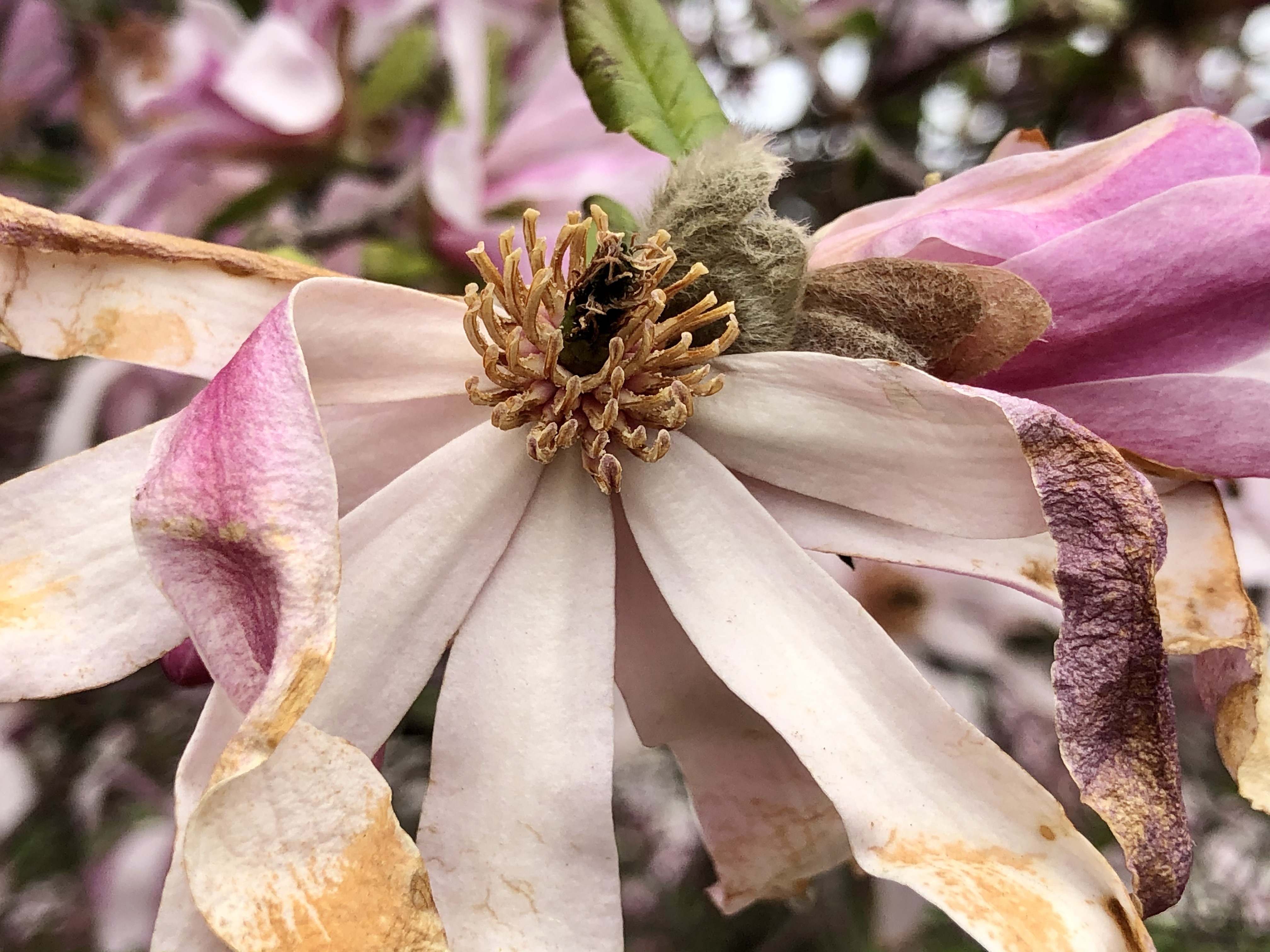
Note that spring comes hard, hard, in Vermont. Jumping the starting block a few days, I keep thinking of T.S. Eliot’s lines:

“April is the cruelest month, breeding

lilacs out of the dead land, mixing

memory and desire, stirring

dull roots with spring rain.”

The first time I read these lines was in high school, digging into the poetry stacks in the school library, mesmerized by lines like Let us go then, you and I, when the evening is spread out against the sky….

Later, later, spring will bloom in all its tender-petal beauty. But for now…. T.S. Eliot knows the score in Vermont.

Demian. Hermann Hesse.

This afternoon, I tore through my bookshelves searching for a paperback copy of Hermann Hesse’s Demian, a book I first read in high school. The book above — brand-new, Harley Rustad’s Lost in the Valley of Death — reminds me of Demian. Like so many other people, in some ways reading Hesse as a young woman shaped my life, every one of my years off the well-trod path. Demian has reappeared at certain keys points in my life, always rising with a strangely mysterious power. At the end of a very long winter, that book returns to me like a breath of spring air.

Fittingly, perhaps, I’m unable to find my copy. Maybe that hardly matters. For the first time in months, I take a long hatless walk, listening to the singing birds, remembering the unstoppable power of spring, and that the world wraps around us in ways we understand, and in ways we’ll never comprehend.

On this sunny Sunday in Vermont, here’s a few lines from the incomparable W. H. Auden on the nature of war. For more about this poem, the New York Times has an essay today.

About suffering they were never wrong,

The Old Masters: how well they understood

Its human position; how it takes place

While someone else is eating or opening a window or just

walking dully along…

Holy/Unholy

A warm Christmas Day rain washes away every bit of snow in our patch of northern Vermont, save for a few ice-hardened and blackened plowed-up ridges. As the dawn drips in with its gray, the landscape appears unfamiliar to me in December — an experience that, again, sums up 2020.

Friends of ours had Christmas dinner on the in-laws’ porch, with the in-laws inside and themselves on the covered porch, eating Christmas dinner 2020-style. Strange and weird, but what wouldn’t I have given that for hilarity.

Talking with my brother on Christmas morning, he mentions he may grout a floor that afternoon. My youngest, afterward, tells me how fun that sounded and then wonders if she would see her uncle before she’s all grown up, headed out into the world on her own, not so far away.

And so it goes in this landscape of unfamiliarity: suspended in a warp of uncertainty. In the midst of all this, there’s me with my lists, my agendas, my determination to craft plans for happiness.

In this gray and blue and brown landscape — not the traditional Vermont snowy Christmas — there’s nothing to do but let all that fly away in the rising and balmy breeze. The heart of the Christmas story, after all, is the unexpected gift in the barn’s manger, the promise of joy where we least expect its appearance.

Photo by Gabriela S.