Singing and Writing: a Small Blue Book

The other morning, between errands, I stopped in at Bear Pond Books in Montpelier, and found a small novel by Tomas Gonzalez, a Columbian, In the Beginning was the Sea. The book is beautifully crafted and fit just about in the palm of my hand, yet with a real heft and weight. And – it was my favorite color: blue.

These past few days I’ve swum down into the sea of this book. I’m not at all likely to head south to Columbia, and the book itself is not gleaming feel-good read. But it’s writing with a depth that goes down and down, and is as true and real to me as drinking a glass of my own well water.

As a Vermont writer, I’m often asked about sense of place and its importance in my writing. Yes, of course, place-centered geography centers in my writing. But equally, I know, the beauty of  a tropical paradise can also drive an inhabitant over the edge, and to write with a sentiment that place is only holy seems false to me. Surely, the yingyang flip of holy is unholiness. While this short novel holds the beauty of human life and the moonlit sea, the writing also contains the deeper elements of all the vagaries of human existence.

“So WHY does our writing matter again?” (my students) ask.

Because of the spirit, I say. Because of the heart. Writing and reading decrease our sense of isolation. They deepen and widen and expand our sense of life: they feed the soul… We are given a shot at dancing with, or at least clapping along with, the absurdity of life, instead of being squashed by it over and over again. It’s like singing on a boat during a terrible storm at sea. You can’t stop the raging storm, but singing can change the hearts and spirits of the people who are together on that ship.

— Anne Lamott, Bird By Bird

IMG_0124

Storm Windows, Fiction

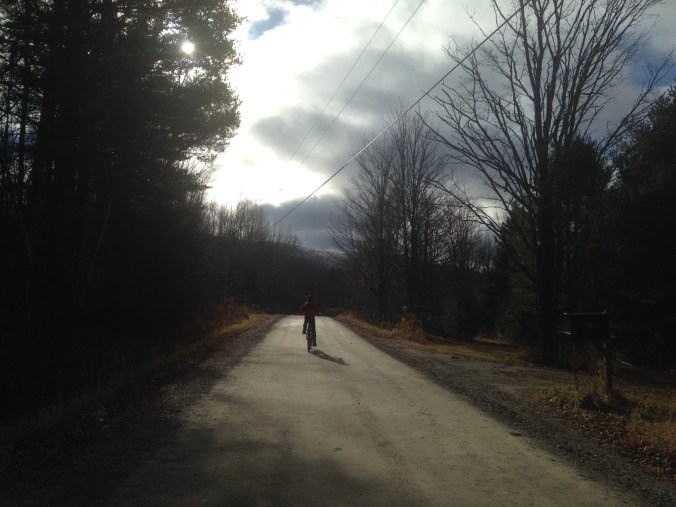
While I was at work yesterday, my daughters washed and latched storm windows on the kitchen windows. They also biked in the season’s first snow, baked a chocolate cream pie from Pie which the younger daughter is reading, argued, played memory games, and spread out a rug in front of the wood stove as an official opening to the wood stove/snow season. Already, the piles of games and books and knitting are growing in uneven piles on that rug.

As my own book nears its publication date, I’m pushed to speak more about how I came to write this book, and why. In my own busy household that mixes children and rural Vermont, what’s increasingly clear to me is that writing is a human activity as essential to our lives as stocking your root cellar or bank account or however you do it for the long, colder season ahead. Our culture emphasizes material gain above pretty much everything else, but, really, at the day’s end, there’s little else of relevance besides stretching your bare toes toward a hot fire, with the children nearby, and the windows buttoned up against the growing dark and cold.

The society to which we belong seems to be dying or is already dead. I don’t mean to sound dramatic, but clearly the dark side is rising. Things could not have been more odd and frightening in the Middle Ages. But the tradition of artists will continue no matter what form the society takes. And this is another reason to write: people need us, to mirror for them and for each other without distortion – not to look around and say, “Look at yourselves, you idiots!,” but to say, “This is who we are.”

Anne Lamott, Bird by Bird

IMG_0119

October/West Woodbury, Vermont

Stellar Fifth Grader

My teenager often ponders her career path these days. She wants a salary (likely because neither of her parents, being self-employed, ever managed that little detail). She wants to love what she does.

My younger daughter listed the various what-I-want-to-be desires she’s cycled through: a pop star, a race car driver, a jeweler in Boston. Then she thought for a moment and said, I’m happy doing what I’m doing now. I’m a really good fifth grader.

I interrupted their conversation to pull over on the road’s shoulder at the mini-storage, and we stood on a strip of frost-bitten grass staring up at a confluence of turkey vultures, circling around and around in the air currents.

Back in the car, my older daughter in her pragmatic way told her sister, Do fifth grade while you’re there, and then worry about the rest of your life.

If these rescuers (of Jews in WWII) had anything in common… it was self-knowledge. When you know yourself there is little to say. This is worth brooding upon as we consider how we, who know ourselves so poorly and have so much to say about ourselves, will respond to challenges to come.

— Timothy Snyder, Black Earth

IMG_0105

Hardwick, Vermont

The Fourth Cottage

Here’s a story from Timothy Snyder’s recent book Black Earth. During World War II, a young Lithuanian woman tumbled into a pit of corpses during a mass execution. When the killing was finished, earth was thrown over the grave. Somehow, buried beneath the dead, she managed to survive. Naked, shot in the hand, covered in her own blood and the blood of others, she managed to claw herself free of the pestilent trench. Terrified beyond what is imaginable, she sought help at a cottage. She was turned away. She found a second cottage, and was turned away again. At a third cottage, she again pleaded for help and was refused. At the fourth cottage, she was given succor, and she survived.

Snyder writers,

Who lives in the fourth cottage?…. When the outside world offered threats but no promises, the few people who acted to rescue Jews often did so because they could imagine how their own lives might be different. The risk to self was compensated by a vision of love, of marriage, of children, of enduring the war into peace and into some more tranquil time.

As a writer, I keep thinking of that fourth cottage, its habitants long-lost in the horrifically bloodied past. And yet:  whose hand opened the door in the fourth cottage? And who dwelled in cottages one, two, and three?

IMG_9341

East Calais, Vermont/Photo by Molly S.

Financial Aid Lingo

Tonight, my older daughter and I sat in her high school library listening to a power point presentation on college financial aid – don’t nod off right now! Sitting there, wishing I had a cup of coffee, I glanced at my daughter’s eyes glazing over as she doubtlessly sat thinking of something else entirely. I added up the loan amounts for four years of college (holy cow!) and underlined my note: Don’t miss deadlines.

On our way out, I asked for the presenter’s email address, and she asked me if I had gone to collegeI told her I had, but my dad filled out the forms – and that was in the prehistoric non-digital age. The woman commiserated that my dad had to xerox tax forms.

Driving home, my daughter remarked that no one used the word xerox anymore. Why do you and grandpa keep doing that? The word is copy.

I assured her xerox is definitely a verb. Like a more modern version of mimeograph.

She was silent a moment, driving through the darkness, and then she asked, Mimeograph? What’s that?

… Sometimes, I see parts of myself in my older daughter – an exasperation I had when I was younger at the adult world’s infuriating mediocrity, a why-can’t-you-get-yourselves-together-ness.  At sixteen, on the cusp of stepping into her adult life, the whole great world of love and desire and ambition (and heartbreak, inevitably, although not too much, please) yet to spin out before her. And then sometimes, in that cyclical way time moves, I see my father reflected in me, all those careful files he kept, putting his three kids through college.

At home, I laid the evening’s materials in a folder on my desk. My daughter came into the room and asked with great seriousness, Can we do this?

I smiled at her. Piece of cake, I assured her. Meet deadlines, stay organized, follow the rules, fill out all the forms. 

Forms are the easy part.

When we are loved, we wish the other to recognize our presence, and this is a very important practice. You must do whatever is necessary to be able to do this:  recognize the presence of the person you love….

— Thich Nhat Hanh

Small Pond in Woodbury, Vermont

Small Pond in Woodbury, Vermont

Enjoying the Digital Age

While I frequently rail against the digital age, the nefariousness of video games — while I believe children should play outside in apple trees and ride bikes, and read real books — while I am the champion of the world made by hand and do-it-yourself ad nauseum — the truth is, I find the digital world just plain fun at times.

My dad sent me a power point presentation he made for his class, and I watched it with my older daughter. At one point, she started exclaiming, Did grandpa photoshop that? I had no idea; I was too busy reading the words. God, she said, of a monastery in Bhutan, I’d like to be there.

At the end, she said, Cool beans to grandpa — that’s high accolades from a teenager.

This past day, I’ve been sending text back and forth to my publisher, making the very last changes on my novel before it heads, digitally of course, to the printers. An s was dropped here; I added acknowledgments, a dedication, and permissions. It’s all email, back and forth, with notes and exclamations, and phone calls of course, too. But truly, having read these 278 pages over and over, in the end, it all comes down to the writing. To story, craft, beauty, and meaning.

But the digital realm offers much to us in rural Vermont. I remember some winters standing outside the co-op with a baby on my back, reading the posters as cultural infusion. Here’s a paragraph I filched from that bounty of my dad’s material:

Like anything that one makes well with one’s own hands, writing good nonfiction prose can be profoundly satisfying. Yet after a day of arranging my research, my set of facts, I feel stale and drained, whereas I am energized by fiction. Deep in a novel, one scarcely knows what may surface next, let alone where it comes from. In abandoning oneself to the free creation of something never beheld on earth, one feels almost delirious with a strange joy.

“The Craft of Fiction in Far Tortuga”
Interview of Peter Matthiessen
The Paris Review 60 (winter 1974)

IMG_9111

East Calais, Vermont/Photo by Molly S.