Cycle of Seasons, Firewood, Re-Envisioning Your Soul….

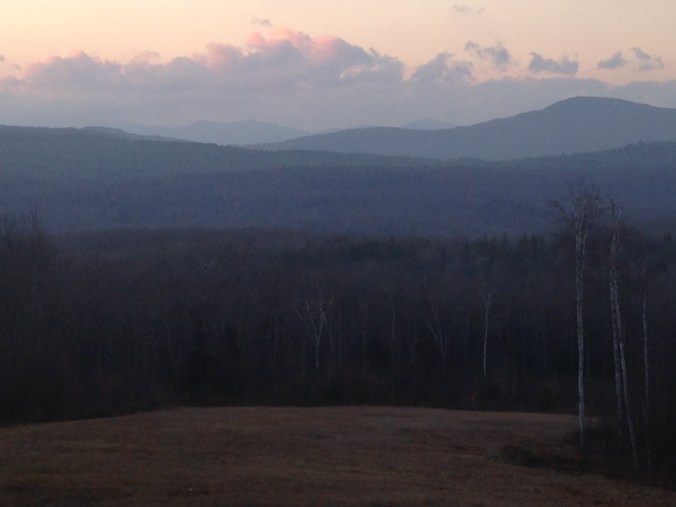
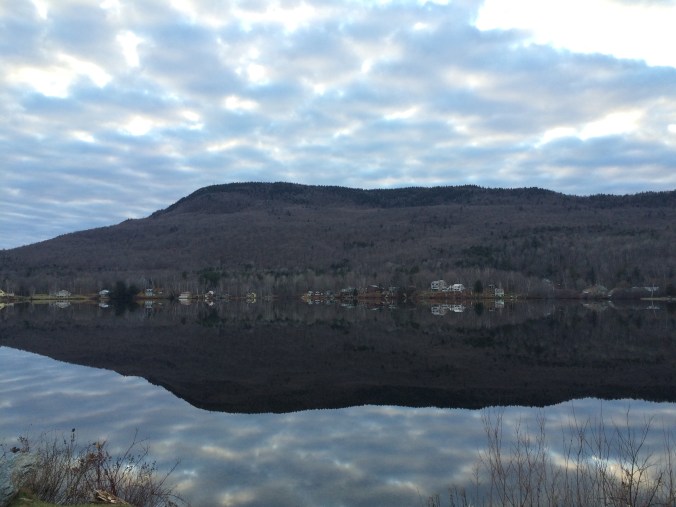
Driving home today, last week’s mantel of golden leaves had fallen from Elmore Mountain, leaving only a dull gray and dark evergreen. In Vermont, the seasons change fierce and hard, the fall hammering away summer’s softness, the spring mud swallowing winter’s crystalline beauty.

The last of our winter’s firewood has yet to be stacked, sprawled over the grass. I’m impatient, anxious for the wood to be stacked and drying, my precious heat. My older daughter complains about the ceaselessness of this chore: we cut and split the wood, stack piles, carry armloads into the house, load the stove, shovel the ashes out, and do all this again. And again, and so on….

I point out this year I actually bought firewood.

Whatever, she says, rolling her eyes, exasperated.

As kindly as I can (which might be little), I say, But that’s life.

She’s sixteen; she’s not buying my advice. I can hardly fault my daughter. At sixteen, my own eyes were on the linear horizon, eyeing the freedom of the open road, the sky unbounded. I believed I could remake – or re-envision – my own soul. Perhaps, yet, even with my hands full of firewood and ashes, I still believe I can.

But you can’t get to any… truth by sitting in a field smiling beatifically, avoiding your anger and damage and grief. Your anger and damage and grief are the way to the truth. We don’t have much truth to express unless we have gone into those rooms and closets and woods and abysses that we were told not to go in to. When we have gone in and looked around for a long while, just breathing and finally taking it in – then we will be able to speak in our own voice and to stay in the present moment. And that moment is home.

–– Anne Lamott, Bird By Bird

IMG_0162

Burlington, Vermont

Potato Digging at the Schoolhouse

At a meeting tonight about the future of my daughter’s little elementary school, a parent spoke about the importance of the schoolhouse, built a hundred years ago, by the town of Woodbury, Vermont. Until I went to a tiny college (also in Vermont), I never attended school in a building that had not only beauty in spades but also soul. The Woodbury schoolhouse has both.

This afternoon, a little thirdgrader showed me the dirt on her clothes from working in the garden. The children had been digging potatoes, and she showed me with her hands the size of the largest potatoes. Sometimes, she told me, my fingers got stuck around the potatoes and they were hard to pull out. She laughed, and I could see a sprinkling of dirt over her cheeks.

Too much of our world now is placeless – grab your i-phone and laptop and head out for new territory, but where we live and work matters; it matters who builds our homes and schools; it matters who opens the door to your child’s schoolhouse each morning. And on a sunny and windy October afternoon, it matters that someone shows a child to bury her hands to the wrists in black soil and extract an apple of the earth.

For the meaning of life differs from man to man, from day to day and from hour to hour. What matters, therefore, is not the meaning of life in general but rather the specific meaning of a person’s life at a given moment.

–– Viktor Frankl

IMG_0160

My House

While the girls and I were taking down screens and putting up storms today, I noticed a pane of glass had fallen from one of the windows. I was alone on the that side of the house and the window is slightly above my head, in an odd place above a bed of chives. This old window had fallen into such disrepair, its glazing entirely decrepit, that the pane had merely slipped down the house. I lifted the glass, about sixteen square inches, between my hands. That window with its peeling teal paint I had intended to scrape and paint this fall, but I had found neither time nor inclination for any of the windows. I held the pane up to the sunlight as if it were a smudged tear from the house, then set it carefully behind the chives where it wouldn’t be broken. I imagined the house shedding that tear of glass in the night.

My house seems more alive to me than it ever has before, with its rooms of children’s artwork, yarn, books, cobwebs and mud crumbles and the crates of garden onions I’ve yet to carry to the basement. Our house sings with light and joy and color in places; other corners need care and paint and trim. Like everything else in our lives, this house has a story, too, one that began before we arrived with the sprawling clutter of our lives, and one that will continue when we are gone, too.

This afternoon, we attended a memorial service for a neighbor, this woman who had helped build so many houses for family and friends. What a good thing, I thought. What a gift that will last.

Storm Windows

People are putting up storm windows now,
Or were, this morning, until the heavy rain
Drove them indoors. So, coming home at noon,
I saw storm windows lying on the ground,
Frame-full of rain; through the water and glass
I saw the crushed grass, how it seemed to stream
Away in lines like seaweed on the tide
Or blades of wheat leaning under the wind.
The ripple and splash of rain on the blurred glass
Seemed that it briefly said, as I walked by,
Something that I should have liked to say to you,
Something . . .the dry grass bent under the pane
Brimful of bouncing water . . . something of
A swaying clarity which blindly echoes
This lonely afternoon of memories
And missed desires, while the wintry rain
Unspeakable the distance in the mind!)
Runs on the standing windows and away.

Howard Nemerov

IMG_0111

Garlic Planting/Rough Draft

I planted the garlic this afternoon, late in the season, a few weeks beyond my more orderly neighbors. Sleet fell this morning when I walked around the property with the logger who delivered firewood. He and his nephew had bought a sugarbush, and we shop talked sugaring. By afternoon, the sleet had wandered off, but the remaining light is meager as November presses in. Working alone, I remembered how long it took to plant garlic with my one-year-old. She dropped each clove into the hole I dug, even then diligent, careful to set ragged roots down.

Despite the bleakness settling in, garlic is hands-down my favorite crop to plant. My cloves this year, from last year’s harvest, are some of the fattest and savoriest I’ve ever grown. Deep in this rich black earth they’ll hibernate all winter, covered with compost and a matted quilt of dry maple leaves. Next spring, the question goes around, How’s your garlic looking?

The garlic is like the second novel I’m writing, where the seeds of the rough draft have been silently sleeping, and now this book is rising and stretching. Grow, I think, in what way will you grow? I’ve carefully sown and fertilized these seeds, and now is the time to dig in with my hands and scrape off that matted mulch and let the green begin to rise and see where it might grow.

 Our bodies are garbage heaps: we collect experience, and from the decomposition of the thrown-out eggshells, spinach leaves, coffee grinds, and old steak bones out of our minds, come nitrogen, heat, and very fertile soil. Out of this fertile soil bloom our poems and stories. But this does not come all at once. It takes time. Continue to turn over and over the organic details of your life until some of them fall through the garbage of discursive thoughts to the solid ground of black soil.

–– Natalie Goldberg

IMG_0118

Apple Tree & Elmore Mountain, West Woodbury, Vermont

Shells, Sea Glass, and Stories

My daughters have no school for a few days, so they came to work with me today, around Mt Elmore, around Mt Mansfield, and along the beautiful Winooski River valley. Inevitably, the drive is longer than I think, after a hurried jumble to get out, we need to leave in the morning, then coffee drinking in the car while the girls either laugh or bicker. The clouds all the way along the interstate were shot through with dark gray and glimmering gold, as if the weather itself couldn’t decide whether to shine or cry.

At the very end of my drive, I arrive at a street’s crest and the city suddenly dips down, and there’s the lake, the great expanse of it, white-capped over cold slate, undulating upward as if twisting deep in its marrow.

My daughters walked off on their adventure, while I went into my windowless office and set my mind fiercely to work. Later, finished, my proofs for weekend work tucked into my bag, I stepped out of that building. The parking lot edges up to a railyard where train cars are stored on dead-end lengths of track, besides enormous piles of gravel, and seagulls swoop down over the lot, hungrily screaming. With my face up to October’s meager’s light and the wind gustily blowing, I thought of the college class with aspiring writers I sat in yesterday, where we talked about the story beneath the story. This odd lot was rife with stories, stretching on out to the mighty granite block building at the corner, where commence a hundred years ago must have once teemed at the lake.

My daughters returned from their exploration along the lake’s edge, where they discovered diminutive shells and sea glass, more bits of stories carried out of the lake and into their hands.

Everything that does not migrate
has fattened up, bedded down,
cocooned up, and seeded itself.
Life’s two principles–
reproduce; survive to reproduce again….
And by this process, even beyond
the evident hand of man, the world
slowly changes utterly.

– Leland Kinsey, Winter Ready

IMG_0140

Beside Lake Champlain, Vermont

Seeds

After a morning’s work, I stepped out on the balcony and saw wild turkeys slowly picking their way through the frost-bent buckwheat around my garden. These birds are amazingly large, with their red and gum-blue heads vibrant colors against the autumn’s gold. By the time I was in the garden, the turkeys had gone on their way, back into the woods.

With my hands, I tore out the pepper plants, the marigolds and nasturtiums, the cosmos, the end of the squash, these beauties finished for this year. The sunflowers and zinnias I left standing, heads bent down, yet rich with seed, for the birds.

Life is not orderly. No matter how we try to make life so, right in the middle of it we die, lose a leg, fall in love, drop a jar of applesauce. In summer, we work hard to make a tidy garden, bordered by pansies with rows or clumps of columbine, petunias, bleeding hearts. Then we find ourselves longing for the forest, where everything has the appearance of disorder; yet we feel peaceful there.

–– Natalie Goldberg

IMG_0131

Garden/West Woodbury, Vermont