Ten-Year-Old Point of View

Both my children were very much planned and desired babies. I desperately – more than anything – wanted to become a mother. But what I didn’t anticipate was how much fun the kids would be. Now years past the baby and toddler stage, I returned from another long school meeting to my children reading beside the wood stove. The younger daughter, when she looked up at me, immediately launched into the rather long and complicated plot of the novel she’s reading.

She rubbed her fingertips over the pages and said, I love this book.

I love that she loves this book. Of course I do – I’m a writer and a reader myself – and, for  better or worse, I know parents often desire their children to be at least somewhat like themselves. Beyond myself, though, this child at 10 is opening up into her own person, too excited at night to sleep because she’s excited for school the next day. She’s curious and questioning and articulate about her world, living more deeply into what a writer calls POV: point of view. Her POV is her lens of the world, dynamic and shifting and, generally, infinitely interesting to me.

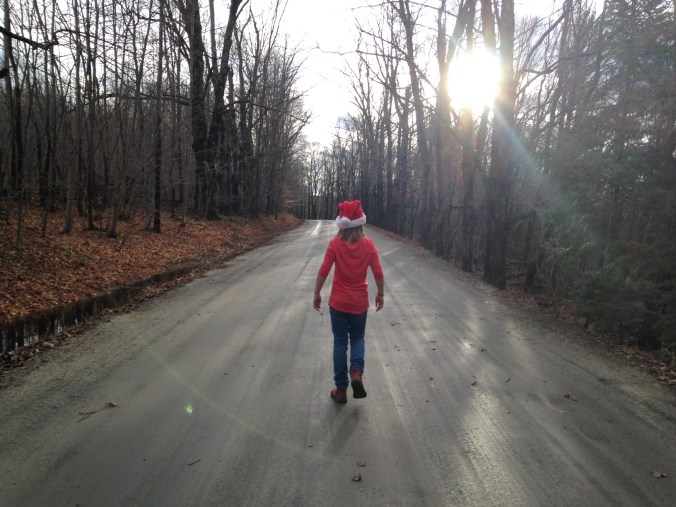
What’s most intriguing is that this child is decidedly not me, that she’s her own unfolding person. By the roadside this morning, on the way to school, she released a mouse from the trap. Look, mama, she insisted. The mouse is cute, really.

I crouched down beside my child and joined her point of view for a moment. The mouse, I saw, was perhaps not that vile, after all….

Take point of view. Editors will breezily comment that POV is child’s play, that naturally one is on top of simple stuff like that. But one is not. POV is far more subtle, complicated, and permanent….

–– Thomas McCormack

IMG_0220

West Woodbury, Vermont, November

Gift of Abundance

When I belonged to the Stowe Farmers Market years ago, as a maple vendor, I knew many farmers. For innumerable reasons, I admire the tenacity and dedication of small scale Vermont farmers, but at the end of this November day, I admire my neighbors for their practical generosity.

For an ill friend, a single father, I stopped by one farm and the back of my Toyota was loaded with carrots, onions, beets, potatoes, squash. I was told that the door’s open; come back. I dropped these boxes at his house, where two young women mopped the kitchen floor. The freezer, empty yesterday, was filled with beef from a nearby farm.

I would never want to sentimentalize my hardscrabble state, but in the face of dire unhappiness, time and again I’ve seen farmers give unstintingly – perhaps in the knowledge that larders fill and dwindle, and fill and dwindle again, as the time of need comes knocking on everyone’s door.

John Cheever famously said, Writing is not at all a competitive sport. How often I think of that line – in school board meetings, for instance, when I think, Educating children is not a competitive sport. Nor is life. In this season of diminishing light, anyone whose hands work the earth knows we’ll each meet our own comeuppance one day, and if golden beets and garlic sweeten our days until then, how lucky we are.

IMG_0212

Gold

Besides the colored candy, Halloween was interspersed with gems of loveliness: laughing children, sparkly tulle, some terrific “adult” dark chocolate candies, Chinese lanterns that disappeared into the dark sky. Halloween is not my favorite holiday, with its campy drama, the ghouls and ghosts, the inarguable and irredeemable descent into the darker season.

Later, lying down with my younger daughter before she went to sleep, we talked about the costumes, the walk through village, and how, returning to the library from a friend’s house, the streets were abruptly emptied save for one small turtle boy and his father.  All the other trick-or-treaters had gone home. We walked under the glowing streetlights and pretended it was midnight. It was just a handful of us, and we followed a shortcut path between houses that none of us had traveled before. Passing a thick cedar hedge, I remembered visiting its other side, years ago, and tried to push a peephole through the hedge, knowing a secret garden lay on the other side. The children laughed, teasing me, but in those streets so suddenly emptied, in the foggy night air, just about anything might have seemed possible. Had I been able to tease my hands through that hedge, and had I been able to see in that darkened backyard, why shouldn’t I have found golden coneflower blooming? Wouldn’t that have been lovely?

Some nights when news is bad in the world
we go out and look at the sky,
which is dark even before the work day ends
save for pinpoints of stars and sometimes
an ivory disk sailing across it….

– Janisse Ray, “Waiting in the Dark”

IMG_3321

Montpelier, Vermont

Freckled Jack O’Lantern

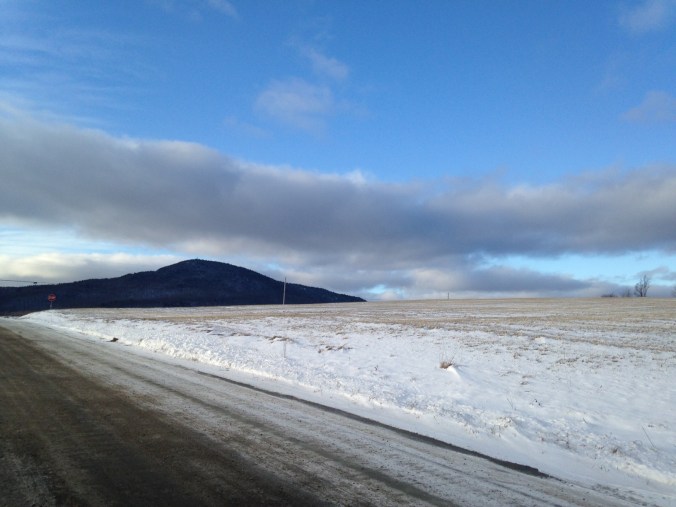
November is the season of mortality. Driving along the southern side of Morristown this late afternoon, the silage fields were harrowed up, dark earth and stone and pieces of corn stalk laid open and fallow for the winter.

Tonight, while the girls carved pumpkins and listened to music, I sat at my desk in the corner upstairs and called one of my oldest friends. We talked about frozen chickens in my freezer, pork, beets, carrots, cabbage. What do you need? I asked. I offered to make soup from beef bones and marrow. He hasn’t long to live, his life caught up quicker to him than he might have imagined. So many years ago, I met his pregnant wife for the first time. She wore a new dress the color of buttercups. That was in the house of many windows and myriad rooms, surrounded by fields of wildflowers. At a wedding one summer, I climbed rickety ladders in my bare feet to the hay barn’s cupola. That marriage ended. My friends’ marriage ended. Strangers to me now live in that house.

Downstairs, my children hunted for stubs of candles. My older daughter had carved flowers and vines and an earthworm on her jack o’lantern. The younger girl’s pumpkin had ears and eyelashes, smiling lips, hearts for hair, and freckles – freckles! – over bumpy orange cheeks. I struck a match and carefully put my hand in the pumpkins. We turned out the lights. The girls’ jack 0’lanterns glowed.

Abandoned house on a
mountainside.

Garden gone to
weeds.

No one home
anymore.

– David Budbill

IMG_0190

Morristown, Vermont, November

Windstorm

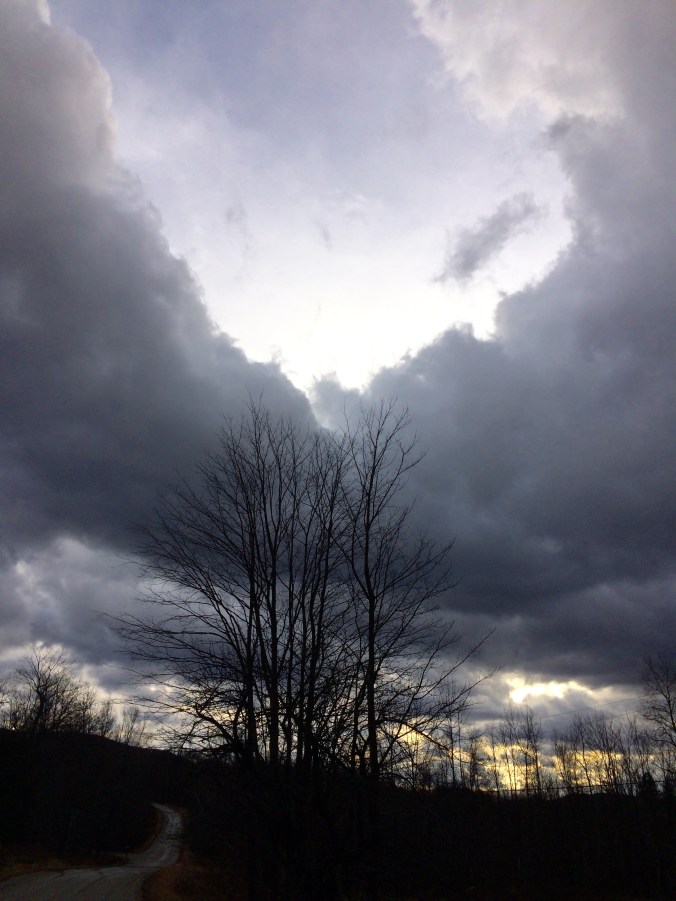
These autumn days hold the dim shortness I remember from this time of year as a child in New England, but the air this afternoon lay almost balmy, redolent with wet earth, like spring. Driving to meet my children at school, a sudden wind blew up violently, throwing dry leaves in the air, bits of twig, the abrupt rain nearly sideways against the windshield. The clouds spun darkly.

Looking up through the glass at crows tossing in the unsteady air currents, suddenly I realized the heart of the book I’m writing is about light and shadow. I pulled over at an ugly patch of Hardwick  – a mini-storage – and ran to the center of the parking lot. The rain bit at my eyes, and the wind spun in a gyre with shreds of trees and plastic debris. I closed my eyes and thought of those Salinger stories I had been reading last night; I imagined each of those stories in their own entity – with Teddy and Esme and the Laughing Man – circling around.

Just as abruptly, the wind ceased. I stood for just a moment more, thinking of those stories, as full as any story could possibly be, with layers of shadow and light, story beneath story.

Between Third and Lexington, she reached into her coat pocket for her purse and found the sandwich half. She took it out and started to bring her arm down, to drop the sandwich into the street, but instead she put it back into her pocket. A few years before, it had taken her three days to dispose of the Easter chick she had found dead on the sawdust in the bottom of her wastebasket.

–– Salinger, “Just Before the War with the Eskimos”

IMG_0180

Woodbury Elementary School, Vermont, late October

Creative Chairs

I picked up six free chairs the other day. Amazing, what the back of a Toyota Matrix can hold, when the kids aren’t in. Chairs have been a burr in this household for a number of years, and we’ve cycled through a number of incarnations of castoffs, supplemented with a  great deal of glue. A shocking number have ended up permanently relegated to the basement. But these chairs, I believe, will be here to stay for some time. They’re hard-used, fully broken with the kind of grime around the edge that fits in here, from hands like ours, dirty and calloused and into all kinds of things.

I took the smallest chair, the one the giver (also a writer) preferred, and set it at my desk. The chair’s well-made, well-used, and infinitely appreciated by me. Not to mention, I didn’t have to outlay any cash.

Sweeping under the kitchen table tonight, I remembered being a teenager and wandering through the adult section of the public library. I found all kinds of gems in those stacks, but a particular one was Salinger’s Nine Stories, stories I’ve read over, and over, through so many phases of my life. These chairs reminded me of De Daumier-Smith’s Blue Period, a koan of a story (aren’t these all?) ending with a mystical experience involving a mannikin. At the story’s end, in exasperation perhaps, the main character takes a chair up to his room. The house’s owners are Japanese, and the bedroom lacks a chair. I’m reminded of this story at times, when I can’t seem to get it together to just bring a chair up to a room, to just do an apparently simple thing.

I remind myself: do the simple thing. The harder things are hard enough. Early this morning, while the creamy moon was sailing over the house and the children were still sleeping, I was at my desk with my pages and pages of sentences. I thought, This is hard, but do something harder, write what I’d least expect, and I leaned over the page.

… the letters seemed to write themselves. It may have had something to do with the fact that, before sitting down to write, I’d brought a chair up from downstairs.

–– J. D. Salinger
IMG_0177