Womanly Arts

Cleaning out a storage room in our sugarhouse, my daughters found two large wooden shelves, intricately crafted from small pieces of wood hammered together. Who made these? the girls wanted to know. Decades ago, their grandmother scavenged slender strips of wood from a mill, and created these shelves, and also an entire ceiling in a kitchen she remade.

The girls washed dust from the shelves and set them to dry in the sun. Later, a friend of mine stopped by and asked about the shelves again. She ran her thumb over the wood still smoothly polished after decades and said, Nice work.

Without thinking, I began a list of my mother’s skills: besides her handiness with a hammer, my mother redid an old farmhouse; she sewed quilts, knitted aran sweaters, opened a children’s store in the ’70s, cooked about a million meals, planned extensive cross-country camping trips. An R.N., she dressed in my childhood evenings in a white uniform and nylons and drove off in the dark to a hospital, returning at breakfast with stories, and, one Fourth of July, an orange kitten who had been abandoned by the side of the road.

There’s a story from Elizabeth Gilbert about her aunt, who cut up her prized clothes and resewed them into baby outfits. It’s the same old story of women chopping up the finer parts of themselves and handing those gems right over their children. Unacknowledged and, doubtlessly, unthanked. The raw truth is that gender is not a label, that the pulsing lives of mother and father are inherently different, in a way that’s neither good nor ill: simply different.

In my own all-female household right now, one morning I found a word from a magnet set we had used on the refrigerator. I must have vacuumed the piece and then emptied the dusty bag on my woodstove ash heap. The word was woman. I pulled the word from the dirt, shined it up with my spit, and laid it on the center of my kitchen table.

The cold ugly fact is that marriage does not benefit women as much as it benefits men. From studies, married men perform dazzingly better in life, live longer, accumulate more, excel at careers, report to be happier, less likely to die from a violent death, suffer less from alcoholism, drug abuse, and depression than a single man…The reverse is not true. In fact, every fact is reverse, single women fare much better than married women. On average, married women take a 7% pay cut. All of this adds up to what Sociologists called the “Marriage Benefit Imbalance”…It is important to pause here and inspect why so women long for it (marriage) so deeply.

– Elizabeth Gilbert, Committed
fullsizerender

Interlude of Merriment

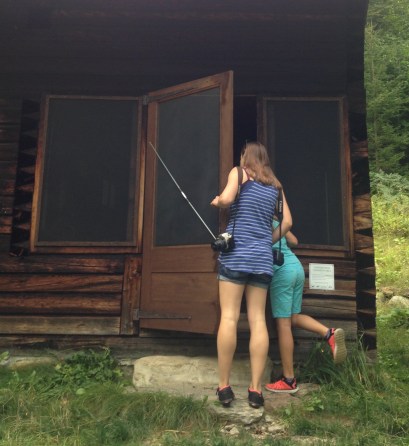
My daughters are like me this way: a difficult week? Pack lunch and retreat into the woods.

Yesterday found us hiking along a series of cascades, then walking barefoot through a shallow, boulder-strewn stream. Among mushrooms, we walked on cushy pine needles in a shaded forest. At the end, chilled from swimming in the mountain stream’s pools, my car didn’t start, tossing me that curve with its recurring electrical problem.

In those two hours we spent by the side of a not-well-travelled road, at some point I began laughing at everything humorous and absolutely not-humorous in our lives, verbally listing, and once I began laughing, I laughed so hard I sat down on the graveled roadside. More than any words, my daughters found my laughter exquisitely reassuring.

In times of acute family duress, I’ve laughed with my siblings and father until tears have run down our cheeks. The people I am most aligned with (whether I know them well or not) wield the same two practical tools I return to, over and over: the inherent (and physical) need for comedy and an awe of beauty.

Afoot and light-hearted I take to the open road,
Healthy, free, the world before me,
The long brown path before me leading wherever I choose.

Henceforth I ask not good-fortune, I myself am good-fortune…

– Walt Whitman, Song of the Open Road, I

fullsizerender

Bingham Falls, Stowe, Vermont


The Girls’ Landscape Widens

The school day was unexpectedly cancelled for my sixth-grader this week, and so, while I was working in the air-conditioned world of Burlington, my daughter spent the steamy September day at a friend’s house, doing what she described as “all kinds of things.” Those things included cribbage and trampoline, but also biking down the dirt road to Number 10 Pond to swim.

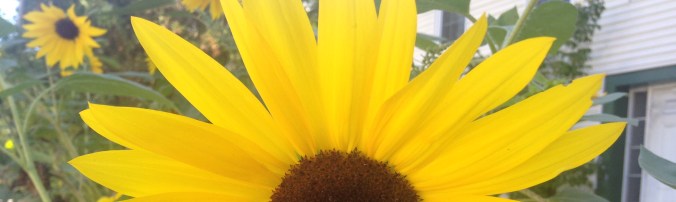
At the day’s end, I drove out of Burlington’s traffic, along I-89, and through Montpelier’s end-of-day busyness, and then I was in some of my favorite local terrain, the small but steep hills of Calais and Woodbury, where the land rises right out of the myriad ponds, and forests abruptly give way to valley views, where old stone walls mark tended fields, and gardens with giant sunflowers, their heads bent down down, are profligate at this time of year.

I passed almost no traffic on these dirt roads, until I met the two 11-year-old girls, sweatily pushing their bikes up a final slope, soaked and sandy towels wrapped around handlebars, their faces radiant.

These two friends had biked a fair distance, zipping down hills, surrounded by the beginning of autumn’s easing-to-gold beauty, to the pond surrounded by woods where “only old ladies” were swimming. I could imagine the water’s stillness, and how sweet and cool it would feel on hot and dust-covered skin.

Those were my two pieces of Vermont that day. Before leaving the friend’s house, the girls and I talked for a little while, the humidity thick, drawing up the scents of soil and plant, the girls’ faces flushed from their travels and ready for more adventure.

… I don’t write out of what I know; I write out of what I wonder. I think most artists create art in order to explore, not to give the answers. Poetry and art are not about answers to me; they are about questions.

– Lucille Clifton

fullsizerender

The Void and Story

One of the more harrowing experiences I had recently was offering up testimony in a county courthouse. In a large, wood-panelled room with no windows, separated from the landscape I know and love – my children and the dark-green mountains where I live, the world of singing crickets and flower petals easily frost-bit, the sky sprawled infinitely overhead, I was asked to give my story.

What’s in each of our own, unique stories, anyway? Breath, thought, memory: words from my larynx spun from the slender bends of my ribcage. To return to David Hinton’s Experience again, while speaking I realized how keenly our stories are presence surrounded by absence. Into this unknown world, I told my story of fear and love, my presence filling that space. In this 21st-century American world, we’re accustomed to defining ourselves in terms of our acquisitions: degrees we hold, a dwelling, occupation, the clothing we choose each day, political beliefs we cherish, whether we raise our own meat and vegetables or buy boxed foodstuffs at Price Chopper. Pushed up the against the razor’s edge of the void – through illness or a turn of misfortune we’ll all experience – we’re left with only a body created from carbon and calcium, and the immaterial thread of our story.

Our stories, always imperfectly told, are not a reflection or mirror of who we are. The stories are who we are. Hand-in-hand with telling our stories is that persistency of doubt. Is this true? Is my story worth telling? For a writer: why write, anyway? The answer, perhaps, may be as simple and raw-edged as this: because at our hearts, we are but the conjoining of body and story. In the face of the void that courthouse morning, my story hooked into strangers’ stories, as my story now weaves into yours, and yours winds into others.

In Chinese with its empty grammar, Absence appears as the space surrounding the ideograms, and ideograms emerge from that empty source exactly like Presence’s ten thousand things – a fact emphasized in the pictographic nature of ideograms, and no doubt the ultimate reason for that pictographic nature. Indeed, the ideograms are themselves infused with that emptiness, as they are images composed of lines and voids, Presence and Absence…

David Hinton, Experience: A Story


fullsizerender

Elm Street, Montpelier, Vermont

On the Cusp

The raucousness of Vermont summer simmers down in September. The songbirds are long finished with their mating season, and our main company these days is the constant sizzle of crickets.

As if she sensed the quietness, too, my 11-year-old and I played cribbage after school, drinking lemonade with the kitchen windows wide open and eating tomatoes. My kid’s favorite snack these days are tomatoes, juicily ripe, still warm from the vine. Before bed tonight, she stood on the balcony, the curve of moon hidden in an apple tree.

Summer’s nearly shot all its splendor out. What’s growing in the garden has hit its threshold, except for some greens and the squash still fattening under the cover of its vines.

It’s a poignant time in many ways, with the days shortening rapidly, but the afternoons steamy enough to swim. I always consider September full of many things: back to schoolbooks but still digging in the dirt, the tempo winding down, the wild beauty of autumn’s song just around the bend.

Dry cheerful cricket
chirping, keeps
the autumn gay…
Contemptuous of frost

– Bashō

fullsizerender

Craftsbury Common, Vermont


Dissolution

My dad, the physicist, had a phrase when I was growing up: this is a high entropy day, kids. Generally, this involved car repairs, a busted hot water heater which happened surprisingly frequently in my childhood home, cracked roof valleys, or any other number of household calamities.

Entropy is an apt word for my existence these days, as – in addition to my broken washing machine – I’m breaking apart a business I spent the bulk of my adult life building, sending physical pieces to this nice couple, that retired gentleman, and so on. Here, again, is that theme of creation and destruction braiding together: any gardener knows growth and decay are not opposites but different bends of the same process, always coming and going, ceaselessly.

And so, in my pre-dawn reading these days of Chinese poetry, I’m evolving to know on a deeper and more biting level that literature is as real as the mound of scrap metal my daughters and I moved today: that poetry is essential precisely because it reflects that universal experience of dissolution and rebirth, the immutability and inevitably of change. More than anything else, I’m reading this poetry because it pulses with the same pounding heartbeat of ceaseless desire that – in varying tones and intensity – links us all.

Vast and deep, everything and everywhere: existence is alive somehow  – magically, mysteriously, inexplicably alive. Nothing holds still…. nowhere does it appear so directly or dramatically as in the twisting and tumbling form of dragon. Fear and revered as the awesome force of change, of life itself, dragon is China’s mythological embodiment of the ten thousand things tumbling through their traceless transformations. Small as a silkworm and vast as all heaven and earth, dragon descends into deep waters in autumn, where it hibernates until spring, when its reawakening manifests the return of life to earth.

– David Hinton, Existence: A Story

IMG_2288

Hardwick, Vermont