Revision, Again and Again – Or, Happiness

One of my first introductions to my daughter’s elementary school was the all-school hike, all 51 kids on an extended walk through the woods behind the 100-year-old schoolhouse. Of all the school activities, this is one of my very favorite, a relaxed easy hike through a lovely woods. On the way, I had a conversation with another adult about that same theme I keep circling back to, over and over: happiness. Even so many years ago, as an undergraduate, that theme of pleasure versus happiness wound all through my philosophy classes, my writing, and my own life. Here again: present as a handful of soil in my hand.

Pleasure may lie in a well-brewed cup of espresso. But happiness…. what holds the whole of a contented life? All my life I’ve had a dislike of stasis, of suburban dullness, of a two-dimensional life, and I’ve never lived that kind of life. Deep into motherhood, though, I seesaw between feeding the wild dragon of creativity and struggling to keep an even modicum of domesticity. Here’s one line from that conversation: Allow yourself to think differently. Or, as a former grad school teacher insisted, You must revise your life.

When I was an elementary school student like my own daughter now, I believed revise was a punishment, a word written in red pen across my book report. Now, revision in my own work is a near-daily activity. Revise, re-envision, recreate: weave writing practices into life, spread the domestic cloth wider.

The desire to go home that is a desire to be whole, to know where you are, to be the point of intersection of all the lines drawn through all the stars, to be the constellation-maker and the center of the world, that center called love. To awaken from sleep, to rest from awakening, to tame the animal, to let the soul go wild, to shelter in darkness and blaze with light, to cease to speak and be perfectly understood.

– Rebecca Solnit
fullsizerender

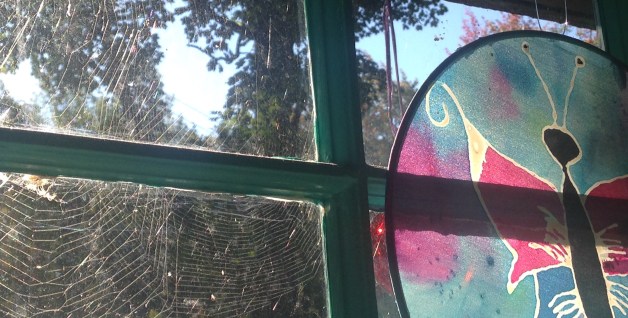
my kitchen window, September


View from a Childhood Room Window

My 11-year-old daughter G. sleeps with the window open just inches from her head. From her bed, she sees leafy branches of an ash tree and watched since April buds unfurling into the green that’s now turning to a canary yellow. In one of the few pounding thunderstorms this summer, I slipped into her room in the middle of the night. She lay awake. Her side of the house was mostly sheltered from the storm, and she wanted the window left open, with a smattering of cool drops blowing through the screen on her cheeks. “I like it,” she said.

The room of her childhood.

Late summer, I stacked a portion of our firewood between three straight-trunked ash trees beside her window, in an isosceles triangle. One side I left open, for a entryway. A younger child would have delighted in the three-cornered playhouse, but this child slept with her soccer jersey – number 21 – on the floor beside her last night.

Nonetheless, what composes her childhood room view – leaves on slender branches, woodpile with a beckoning in, and, further beyond, wild elderberry bushes and the old woods road where one afternoon we saw a shaggy-furred bear noiselessly passing by  – are the gateway near her head to the wider world, imprinting on her memory as she sleeps.

O it’s I that am the captain of a tiny little ship,
Of a ship that goes a sailing on the pond;
And my ship it keeps a-turning all around and all about;
But when I’m a little older, I shall find the secret out
How to send my vessel sailing on beyond….

– Robert Louis Stevenson, “My Ship and I” in A Child’s Garden of Verses

fullsizerender

September, Vermont


The Kitty Cat Boots

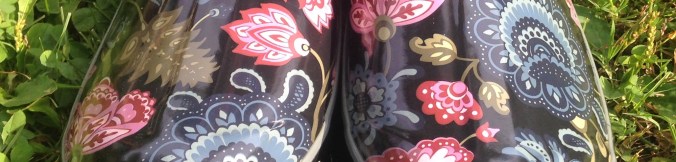
Hardly anyone knows this, but when my younger daughter was 2, her older sister and I bought her a used pair of pink rubber boots with kitty cat faces on the toes. These boots gave incredible joy to this blond-haired little girl, and she wore them until the boots were actually in shreds. Today, she wears her first adult boots – with flowers, of course – but yet fully woman-sized, larger than my own feet. The girl’s been walking around all afternoon, admiring these boots, marveling at the size of her growing feet, a bit mystified at how this happened.

A very much desired and longed-for younger sister, this girl was graced with an exceptionally long cosseted period, carried on her sister’s back and hip long beyond the time most children are required to walk by themselves. While her older sister began speaking well before her first year, the younger daughter had a prolonged echolalia phase. I had been told to record those singing syllables, lovelier than a hermit thrush’s song, but even then I knew that dear sound rang in our ears merely in passing and had the sense that to let that fleetingness go.

Enjoy the flowers on your boots, lovely one.

When voices of children are heard on the green
And laughing is heard on the hill,
My heart is at rest within my breast
And everything else is still…

– William Blake, “Nurse’s Song” (Innocence)

fullsizerender

End of One Road….

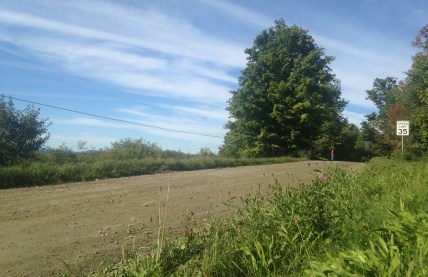
After a summer of chaos and bitter heartbreak, tears, the Vermont state police, too many times through the county courthouse’s metal detectors, I crashed my car yesterday. The impact came at slow speed, and when I got out of the car, I knew instantly I was uninjured. The woman in the car I hit also assured me she was fine.

I stood on the road, my vision caught for some reason at the sun shining in the canopy of an immense maple nearby. I stood staring upward for a moment, admiring the brilliant September afternoon. In every sense of the word, I had been driving blind, the inside windshield of my car smeared greasily, never tended to, and I had been crying. I hadn’t seen the woman who was at a standstill, until after I hit her. By sheer grace of luck, I had managed not to hurt this stranger, and then she spent three hours sitting in the grass with me, infinitely patient. This morning, an apple pie bakes in my oven as a meager gesture of my gratitude.

My publisher, Dede Cummings, describes herself as a glass-half-full woman, a feature I’ve tried to emulate. That afternoon, my glass foamed over. All the things I had held coiled so tightly within me – my daughters’ well-being, lack of childcare, too many demands for money and too little lucre – released from me when I stepped out of that crumpled car. Standing on the road, I felt strong, resilient as a birch sapling, and immensely calm, expansively alive as the nearby hayfield. Oddly, I had been returned to whom I was once, soles on the ground, my eyes sparkling and full of sunlight.

It had been a very long time since I had hoped for more than that my daughters and I accept and endure their father’s apparently unbreakable descent into a place where we cannot reach him. In that brief moment, I realized we would thrive, too, that our lives would unfold further in a vibrant tapestry, and the goodness of the world was, truly, yet at my hands, there for the taking. The world hadn’t turned its familiar back to me.

In my novel, the moon in all her various faces – crescent, gibbous, cloud-strewn – appears repeatedly as a talisman to my main character. Yesterday’s geometry of sunlight descending scattershot through leaves, dusty road beneath my clogs, and the  September afternoon with its darting dragonflies wound together as my own unbidden talisman.

I never accomplished what I intended that afternoon. That evening, the moon rose full, the hue of spring-grass-tinged cream. O, sweet lady moon, traversing her patient path across the heavens. We slept with the windows open to the night, moonbeams moving across our cheeks as we slept.

Come, see the true
flowers
of this pained world.

Bashō, On Love and Barley

fullsizerender

Woodbury, Vermont

Leland Kinsey, Vermont Poet

A few years ago, when I was a bookseller at The Galaxy in Hardwick, I was reading a book of poetry, Winter Ready, when the poet himself called to order a book for a relative. The book was a gift for a child, and in his polite way, he took great care with the order.

The poet, Leland Kinsey, crossed over into the world beyond last night, no longer part of this slowly-golding-to-autumn realm where the rest of us around here still dwell.

Leland Kinsey, premier among Vermont writers, exquisitely gifted, a man who wrote of the myriad ways the earth giveth – and the earth taketh.

Here’s his lines…

…. His mother’s pickles, whose recipe
he thought would, perhaps should,
die with him. A crock in a cool place
that holds enough for a year.
The ripe smell when fishing
The doubly ripe pieces out.
All this is your heritage now,
as it is preserved here,
make of it what you will.

Leland Kinsey, “An Old Man’s Recipe for Tongue Pickles” in Galvanized

fullsizerender

September, 2016, Vermont


Go Outside

One of the cool things about seeing your writing appear in a magazine is reading what writers your words butt up against. Taproot, always a lushly artistic production, has an essay by Milla Prince (what a knock-out name) about what I’ve been ruminating upon: our need for immersion in nature is so primal and so necessary – for all of us, infants to the truly very old. Far beyond the antidote to whatever may be ailing my own waning soul at times, I crave unfettered sky, cold clouds, an unfenced expanse to walk, frog slime on my fingers.

Which brings me back, again, to my recurring theme that, much as we might perceive ourselves as separate entities – beings complete in ourselves – we cannot be lifted from our landscape, cut out and pasted like stick figures. I’m as much part of the mountain I live on as I am a woman at my kitchen table.

There is some integral part of us that is nourished only by interacting with nature, some part of us that longs for our ancestral home, before our fall from “paradise,” before making ourselves the outsiders in our natural environment… Separated from the mycelial networks that connect all life to itself, severed from other beings by the walls of our houses, our paved-over streets, we truly are lonely.

– Milla Prince, “A Ritual of Woods & Fields” in Taproot: Wander

fullsizerender