Monday Morning, Still Dark

My older daughter cut her literary teeth reading Mercy Watson chapter books to her younger sister — silly stories about a pig who loved stacks of hot buttered toast. We were homeschooling then, and that winter, the girls spread on the rug before the wood stove. Read, the little one begged. One more chapter! 

Monday mornings in March didn’t mean all that much when we were homeschooling. Sap held every bit of meaning for us in those days. Now the older daughter hurries off before dawn to clinicals, full of excitement.

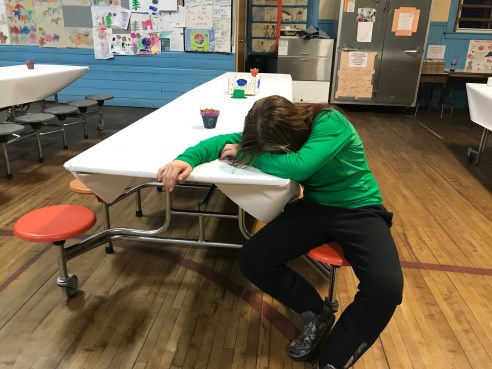
Fed, the cats sprawl on the sleeping younger sister. Fittingly, the striped feline who loves this child best also miraculously appears at the scent of toasting bread, hungry for melting butter.

Another year is gone;
and I still wear
straw hat and straw sandal.

— Bashō

IMG_1371.jpg

And They Brought Pies…

I never went to work with my parents, although (in very different ways) I heard so many stories I know my parents’ occupations, wittingly or not, fed into my young writer self.

My mother worked the night shift as an RN, floating all over the hospital, from pediatrics to the ER, often returning as my siblings and I were drinking orange juice and heading to school. She always had stories — of washing diesel from a child’s hair or an ER doctor who snapped, took a fire ax to a door, and had to be restrained. She told stories of an administration who treated nurses terribly, of family members in the cancer ward who thanked her on Christmas morning.

My older daughter was in the sugarhouse when she was three weeks old, her rosy cheeks slicked with a sugary patina from the clouds of maple steam. Like many Vermonters, the girls’ father and I have done all kinds of things for work, and generally never hesitated to take the kids along.

This morning, I’m one working piece of Woodbury Pie Breakfast, one of the best of New England traditions, and late last night, my younger daughter helped set up.

In the dark, I walked back and forth from the school to the library, in the snow beginning to fall again, magically wafting down in the outside lights.   Townspeople I knew and didn’t know carried in still-warm pies in their hands, offering their homemade gifts.

I ate another apple pie and ice cream; that’s practically all I ate all the way across the country, I knew it was nutritious and it was delicious, of course.

— Jack Kerouac, On the Road

IMG_1356

Woodbury Elementary School

White Stuff

Snow.

Driving back from Burlington, the interstate is snow-and-slush-covered, and the green Montpelier exit sign is nearly concealed. The conditions are nearly white-out, and I know where I am mostly by the long bridge over the Winooski River. I know the train station at Montpelier Junction is below, and that my family has walked on the railroad trestle over a summer-slow river.

In Montpelier, passersby walk with their faces turned down from the wind and blowing snow.

Then it’s all backroads home for me, driving on unplowed roads over ice-rutted dirt. Where fields loom up, the edges of the road disappear, and I’m driving more by memory than anything else. It’s March, and my snow tires have been hard-used for three or four years now, and I’m fed up with hearing about people’s trips to places with palm trees or, heck, even open water. March is the eternal Vermont month.

In Woodbury, the village that doesn’t even have a store now, I pull into the library to work a little longer before I head back to my daughters. As I walk by the elementary school, I see the children have built an enormous snowman, so tall I imagine adults must have helped with this.

After all that driving, bent over the steering wheel, just me and VPR and that eternal list running through my head — and who will take care of my daughters if I spin off the road and disappear? — the snow falls silently. The flakes twirl slowly, sheltered here from the wind, graceful as the season’s first snowfall. It’s so lovely I can imagine making a day of it, if I would just keep walking.

Nirvana is not something that we should search for, because we are nirvana, just as the wave is already water. The wave does not have to search for water, because water is the very substance of the wave. Living deeply makes it possible to touch nirvana, our ultimate reality….

— Thich Nhat Hanh

IMG_1339.jpg

Woodbury, Vermont

Imagine

The other day, I woke up on the wrong planet. That’s the opening line of the picture book I read to the kids in my one-room library yesterday.

I was standing outside talking to one of my trustees when the kids walked over after lunch, kindergarteners through sixth graders. What a crew, he said, the kids cheerful, some of them in unzipped winter coats, others in t-shirts.

The kids spread out on my well-worn carpet. What if you did? I asked. Imagine if one day, you opened your eyes…..

The littlest kids’ faces glowed, and I wondered at the mysterious thoughts meandering through their minds, as they considered imaginary realms. Afterwards, the oldest kids lingered, checking out books, with their own system of swapping library books, sharing their imaginary worlds.

Afterwards, alone in the library for a few moments, I began pulling together a program in commemoration of the 50th anniversary of Martin Luther King’s assassination. What if, I kept thinking… And isn’t this one of the drives of literature? To sway our story through imagination and action?

We must rapidly begin the shift from a “thing-oriented” society to a “person-oriented” society. When machines and computers, profit motives and property rights are considered more important than people, the giant triplets of racism, materialism, and militarism are incapable of being conquered.

— Martin Luther King, Jr.

IMG_1338.jpg

See Our Territory

Small town living isn’t always so saccharine sweet — I’m no great fan of Norman Rockwell.

At soccer games, you’ll meet the parents of the child who slighted your own. Argue at school board meetings, and you’ll discover one of the four chambers of democracy’s beating heart is listening. Walking down the sidewalk on Christmas Eve, you might see your former spouse eating dinner in a restaurant, laughing. I’ve never lived in the anonymity of a large city, but in these small towns, you can’t help but suck up every bit of sorrow, of bent desire, of the generosity of strangers, the pleasure of walking with friends under open skies.

My daughter and her friend report seeing a man flying a drone in the cemetery adjacent to our house. From behind tombstones, they spy on him.

Through a chance encounter from the couple who sold me my house, I learn of this arial footage of our village, Hardwick. My daughter pauses from her homework to watch with me. In this muted winter palette, the town sprawls ragged and enchanting, with an ice-choked river, yellow school buses, and the dead laid down between the trailer park and the white houses on the hill: here’s an illustration of poetry I aspire to in my own writing craft.


This Woman, My Daughter

From seemingly out of nowhere, my youngest daughter asks me if Jesus really brought dead people back to life. I pause — there’s been no recent death in our family — before I say that might be possible.

What are miracles, anyway?

My daughters are two of the billions of people who have walked the planet. This morning, I woke thinking of my older daughter, 19 now, and the conversation she and I and my friend had last night, over dinner and knitting and the cats who played with the feathery toys my friend brought. My daughter is grown up now. Always headstrong, she’s plowed into passion and passion’s heartbreak.

The cliché for mothers is to mourn the loss of the tender, little years; this young woman and I share a whole remembered world together — just she and I — like the afternoon in her stroller when she was two and I pushed her through a thousand tedious errands in Montpelier, while she held three buttons in the shape of balloons — pink, yellow, blue — in her tiny fist. I had promised to sew those on her favorite dress. Her younger sister wore that same dress, with those same three balloon buttons.

Or the afternoon in a thunderstorm when she was four, wearing her favorite friend’s t-shirt with a frog on the front, she leaned over the porch and pulled out the neck of the t-shirt so a river of water from the roof poured down her face and body. Laughing: full of radiant joy.

Billions and billions. Over and over. There’s nothing simple about any of this. Not childhood, not growing up, not making a woman or a man’s life. And yet, here we are.

…. it ought to make us feel ashamed when we talk like we know what we’re talking about when we talk about love.

— Raymond Carver, What We Talk About When We Talk About Love

IMG_1311.jpg