And More Snow

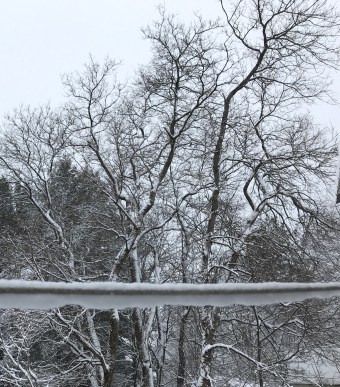
We fell asleep last night with the running of little cat paws from bedroom to bedroom and beneath the silence of falling snow. The cats this morning are sleepy, purring and hungry, and the snow falls yet. Where the grass beneath the mock orange had reappeared last weekend, fresh white has smoothed that over again. One year, eight inches of snow bent down my pea shoots. The peas survived. We ate them in June.

When my daughters were two, three, even five or six, I would have despaired: not more of snowsuit weather, tussling over winter boots, soggy mittens, the creeping pace walking from woodpile to back door with armfuls of wood and a small-legged toddler.

In the way of life ever-changing, here’s a morning spread with white beauty, soundless with falling snow, temporal as anything else.

How long the winter has lasted — like a Mahler
symphony, or an hour in the dentist’s chair.
In the fields the grasses are matted
and gray, making me think of June, when hay
and vetch burgeon in the heat, and warm rain
swells the globed buds of the peony…

— Jane Kenyon

IMG_1309.jpg

Where I Am


Marvelous March Madness

Spring may be fêted with pastel bunnies and pale eggs in the Hallmark and Nestle worlds, but Vermont’s spring must be brutally strong to break winter’s back.

Thaw, and the ice pounds back. Melt, and freeze steals into the night.

The hardest I’ve ever worked in my life is sugaring season. When my younger daughter was two, I remember lying with her under the skylight over our bed, completely spent, reading Louse Gluck’s poem in The New Yorker. I had little time for reading in that season, and this poem always reminds me of this season’s pithiness, the stubborn desire to press on through mud and ice, toward the blossom season.

The sea doesn’t change as the earth changes; it doesn’t lie. You ask the sea, what can you promise me and it speaks the truth; it says erasure

Nothing can be forced to live.The earth is like a drug now, like a voice from far away, a lover or master. In the end, you do what the voice tells you. It says forget, you forget. It says begin again, you begin again.

From March by Louise Gluck

IMG_1295.jpg

Rough-Hewn Grace

Lately, I’ve been scavenging donations to my library’s yearly book sale, digging through stuff I’d never read (but others may deeply love) for some real gems. In one not-so-hot memoir I skimmed, I found a reference to a Flannery O’Connor line from one of her letters. The line — such a good one — also depicts this Vermont March.

All human nature vigorously resists grace because grace changes us and the change is painful.

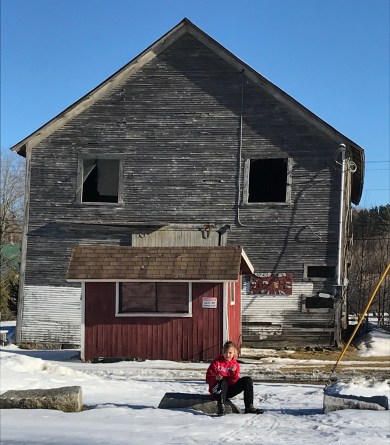
I skied over the pine-needle-strewn ice, took off my skis and crossed an oozy mud road. Then the snow gave out. Here’s a photo of an empty house along the road, once a farm beside Big Hosmer Pond, now padlocked up, with a For Sale sign in the front yard, waiting for new inhabitation.

In its online listing, a black-and-white photo from the 1950s shows a woman in a dress standing beside what might have been a fancy new car. Who? Where have you gone? Did you love living in this house? And did the loons sing then, too?

IMG_1281.jpg

Craftsbury, Vermont

Treasures of the Least Likely Kind

Rough-cut diamonds rain on Jupiter: we learn this at a planetarium presentation in St. Johnsbury.

Afterwards, my daughter and our friends walk out of the Fairbanks Museum — one of my favorite places with its collection of local and exotic: freshly picked flowers in season and an ancient clay vessel for wine, Egyptian mummies and Civil War paraphanelia.

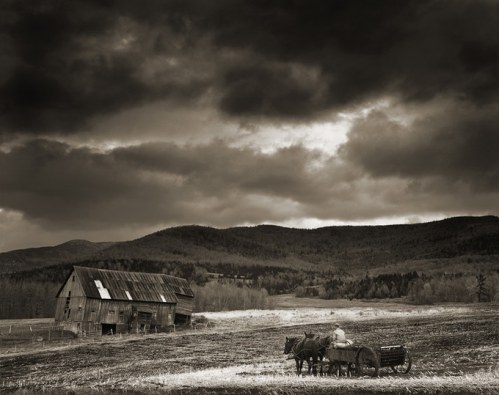
And, a fantastic collection of Richard W. Brown’s photographs temporarily on-display, the real reason we had driven to St. Johnsbury that day.

When my younger daughter was three, we had the head rebuilt of a Volvo station wagon we had bought from someone who likely botched the original job and passed the vehicle to us. A mechanic far out on a back road in St. Johnsbury did the work. My three-year-old and I on a beautiful summer day drove along twisting back roads I had never traveled, and ended up at an enormous windowless garage with a single green door at one end. I knocked; no one answered.

Holding my daughter’s tiny hand in mine, I entered and walked through what seemed to be an Alice-in-Wonderland mechanic’s world of room after room of greasy engine parts. I found the mechanic, a man in his sixties, his face and hands permanently hued with that same black used engine oil, in the labyrinth. The inside to my Volvo’s heart he had wrapped in a cloth. He opened the cloth and showed me the shining silver.

I lifted my tiny daughter, in her yellow and red-flowered sundress, a hand-me-down from her sister. He showed my child the work he had done. He and I spoke for a bit, while I wrote a check. As I turned to leave, he noticed my daughter was staring at a tiny plastic horse on a cluttered desk and told me to take the toy for her. He said the horse had been there for a long time and must have been waiting for her.

In a borrowed car, I followed the dirt roads down to the river, then turned left, toward  home. My little daughter sat in the backseat, that horse clenched in one fist, staring through the window at the landscape passing by. In the back was that rebuilt piece of our car, wrapped in clean cloths.

That Volvo has long since passed out of my and daughters’ lives, in the endless way of consuming minerals and money cars claim. My daughter wore that dress for years, until it was far above her round knees. The horse is likely still in our possession, in a treasure box of childhood mementos. And the mechanic? We never saw him again. But I still hold the kindness of a stranger who paused on that July day to wonder what interested a small, unspeaking child.


Scrambled eggs and whiskey
in the false-dawn light. Chicago,
a sweet town, bleak, God knows,
but sweet. Sometimes….

From Hayden’s Carruth’s Scrambled Eggs and Whiskey
39ec7c5d890ce6aca0c29faaef453547_original.jpg

Richard W. Brown


Mud Season in All Its Holy Glory

My daughter texts me at work: My car is stuck in the mud.

Snap, I think. I continue what I’m doing, thinking my girl can likely solve whatever she’s gotten into now. It’s the last day of February, 2018, a day so warm I’ve propped open the library door. The lilies are pushing up around the school, and I step outside with a patron to watch a woolly bear inching its way across the walk.

My daughter, laughing, calls me and tells me she could no longer drive her little Toyota on a muddy road. I just stopped! In her nice Danskos, she stayed in her car, surrounded by glistening mud. The town road crew, working nearby, asked if she was going to move, and she explained her predicament. The road commissioner had her slip over to the passenger seat. He floored her car, drove it free, and suggested she might want to stay off that stretch of road.

Ah, spring.

….I, who so often used to wish to float free
of earth, now with all my being want to stay,
to climb with you on other evenings to this stone,
maybe finding a bear, or a coyote, like
the one who, at dusk, a week ago, passed
in his scissorish gait ten feet from where we sat—
this earth we attach ourselves to so fiercely….

— Galway Kinnell

IMG_1226.jpg

Dinner Chat

My daughter and I are often eating dinner in the lengthening daylight at the kitchen table, just the two of us with the cats under our feet, and my daughter offering bits of her day — if I listen, and don’t press too hard, what she cares about she slowly spills.

Our conversation drifts into what it means to grow. Through our glass doors, I see the box elders behind our house swaying in this spring-is-coming wind, the Vermont winter gradually eroding. So much of my life I sought stasis — the imagined security of here is where I am. In my daughter, I see this same illusion of when I am grownup, as though adulthood is a kind of plateau.

We linger at the table, with the unwashed dishes and evening chores undone. While she speaks, I think, here, now. The wind curls around our house.

Accept yourself: be yourself. That seems a good rule. But which self? Even the simplest of us are complicated enough.

— From Apsley Cherry-Garrard’s The Worst Journey in the World

IMG_1246.jpg

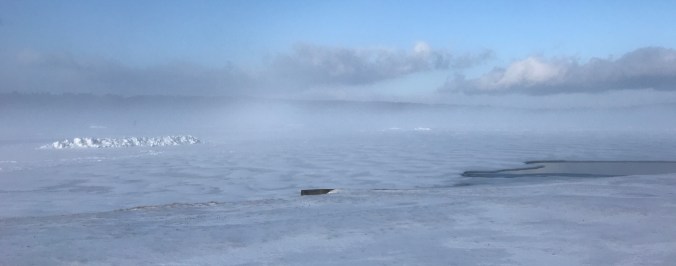
Caspian Lake, Greensboro, Vermont