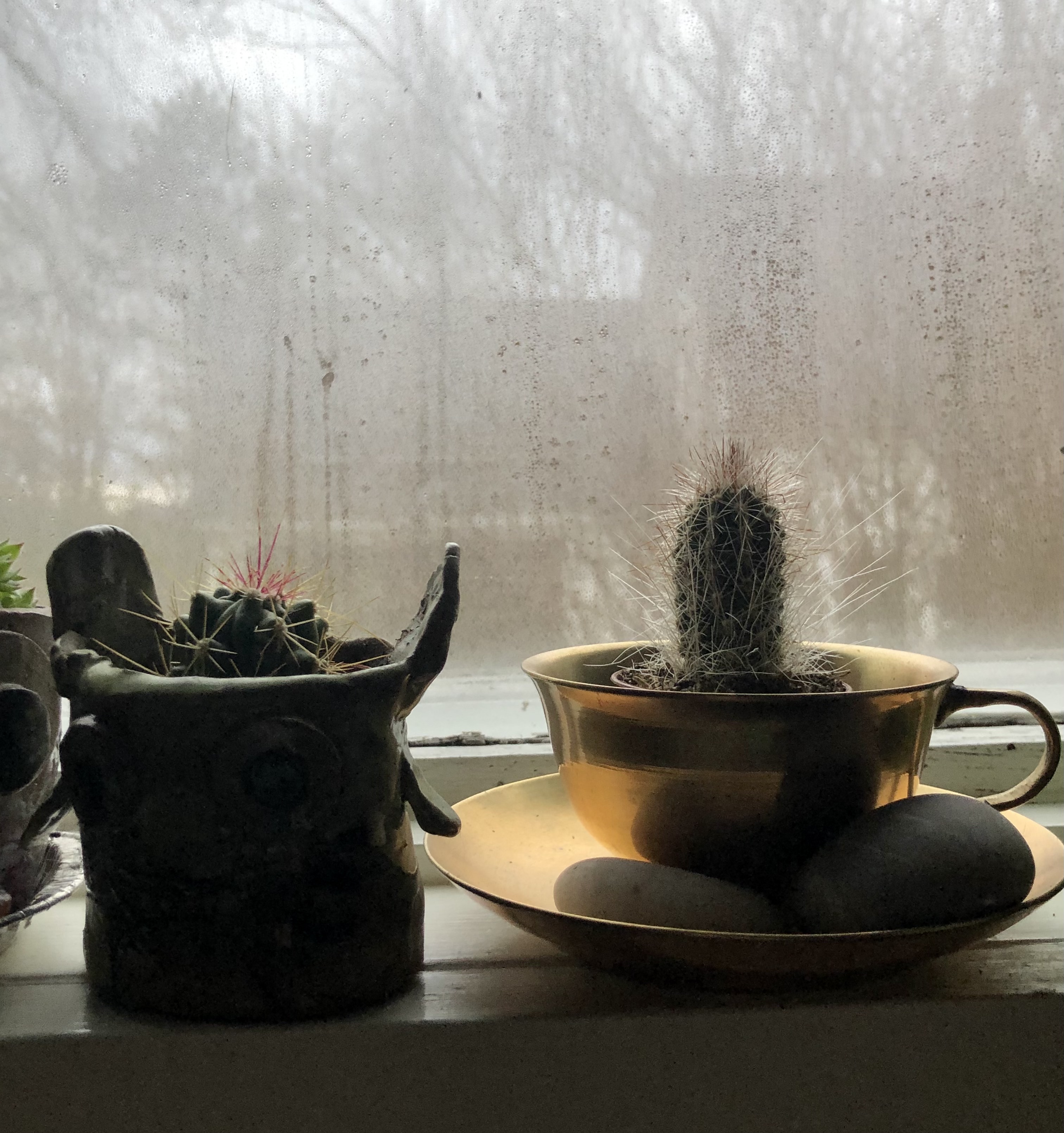
Sing, Robins

I lingered on our porch yesterday evening, gathering a few pieces of firewood. It’s warm enough now that the fire could stay out, but somehow letting the hearth go cold in March just doesn’t seem right.

There’s that worn-out cliche that the laughter of babies is one of the best sounds on this planet — and it’s not a cliche, because baby laughter is really dear.

But so is the songs of robins.

We’re back again in these melodies. Around us, mud and thaw pushing up the debris that’s hidden under the snow all winter. Pieces of cardboard and empty yogurt containers, the runny mess of my ash pile, my youngest’s holey (or is that holy) pink socks where she tossed them over the porch railings in a burst of spring enthusiasm.

Oh, robins, mud your nests, lay your eggs, raise your newborns. We need you!

Open a window. Rain falling
on good land is good for melancholy.

Jody Gladding

Hardwick, Vermont

Me, the Mother, Grimacing

Sunday morning, my daughter drives on icy roads to meet a friend to ski. In the passenger seat, I grimace. There’s no more polite way to reveal my actions: I’m grimacing. My daughter — perfectly capable, but my God, she’s 15, driving on icy roads.

She intends to be driving thus for decades to come, without me, of course, grimacing away in the passenger seat.

We head over the mountain and down along the river where the roads improve. Driving, she talks to me, as if the steering wheel has loosened her natural reticence. She laughs and confides, there’s just so much you don’t need to know.

Oh, my Queen of Economy. Wise and experienced beyond your years.

On the way home, we stop for coffee, and I drive while she eats and talks and plays country music that, good lord again, I’m becoming quite fond of.

Who knows will happen next year, this summer, this spring, this very week — goodness, even this afternoon with so much yet spread out before us? For this moment, here we are.

On the way home, I pull over, hand her the keys, and knock off the grimacing.

Coyotes feed themselves on gaunt dreams of spring. 

— David Budbill, “March”

East Burke, Vermont

Walking Home

Aren’t we all thinking about this Covid anniversary? A year into the pandemic?

Time’s such a tricky thing. I’ve lived through moments that seemed like an eternity — such as the terrible experience when my baby had an allergic reaction and ceased breathing. Those were endless moments before she gasped again, her tiny chest taking in air. Conversely, my second pregnancy appeared to stretch out far beyond the standard nine months….

One year into the pandemic realm, I’m at the point where I’ve accepted: Live here now.

In a conversation with someone today via Zoom, I’m asked what I’m doing in September.

September, on one hand, is not so far off. On the other hand, I’m hoping there’s a lot of living between here and there. (Plus, I can hardly envision what I’m doing next month.)

This makes me think of my younger, more hippie days, reading Ram Dass.

We’re all just walking each other home.


Cardinals — crimson and soft brown

Two cardinals perch in our mock orange bush, a brilliant flash of feather and beak, meeting and mating, much to the joy of our cats, who want to eat these these little creatures.

Around our Vermont house is yet an oasis of snow and ice, not a single sign of grass yet apparent. In the front yard, the rhododendron emerges stubbornly. I’m here! I’m here!

On this early morning that promises warmth, lines from poet Marie Howe.


Johnny, the kitchen sink has been clogged for days…

We want the spring to come and the winter to pass. We want
whoever to call or not call, a letter, a kiss–we want more and more and then more of it.

But there are moments, walking, when I catch a glimpse of myself in the window glass,
say, the window of the corner video store, and I’m gripped by a cherishing so deep

for my own blowing hair, chapped face, and unbuttoned coat that I’m speechless:
I am living. I remember you. 

— Marie Howe, from “What The Living Do”

Falling Ice

In the night, ice slides off our back roof and breaks our porch railing. I discover this in the morning while I’m carrying out the stove ashes, cautiously looking for one of the neighborhood skunks.

The broken railing doesn’t even register as an annoyance. While I’m making coffee, I think this over. Just a few years ago, I would have brooded on the broken wood, resentful of the expense of money and time to repair this piece of our house. Now, I think merely, That can be repaired.

There’s a lesson here, I think, on this mundane Thursday morning. Of all the broken things in my life — inevitably, in all our lives — a snapped piece of wood hardly matters. For years, I saw the accumulation of disrepair, from a loose coat peg to a leaking roof, as sure evidence that my family life was unfolding. A year into the pandemic, a broken railing is evidence of warming nights. Repair, and move on.

From Leland Kinsey’s poem “Winter Stay in a Peat Bog”

Chance Encounter

Rain? Snow? Sleet? A mixture of all falls this morning.

Rounding a bend on a snow-covered dirt road in East Hardwick yesterday morning, I suddenly brake when hundreds of little black birds cover the road. There’s no one behind me, no one ahead of me, and I get out. A few birds flutter upward and perch on the electric wires, strewn already with these little creatures.

I’m at at farm, near a manure pit. Through the barn’s open sides, I see cows twisting their heads.

The birds don’t move. I don’t move. Then, eventually, because I’m a human and the birds are wild, I get back in my car and nudge forward slowly. Grudgingly — or maybe patiently — the birds part to the fields and the wires, and I move on.

Still February here.

On snowy afternoons there is a special blessedness in saying, oh it is too snowy to chop wood this afternoon. And the gray snow sifts down, and one takes off one’s boots and sits by the fire and is glad of the way wool socks smell; and a pie is baking in the oven, and the gray snow is sifting down.

— Elliott Merrick, Green Mountain Farm